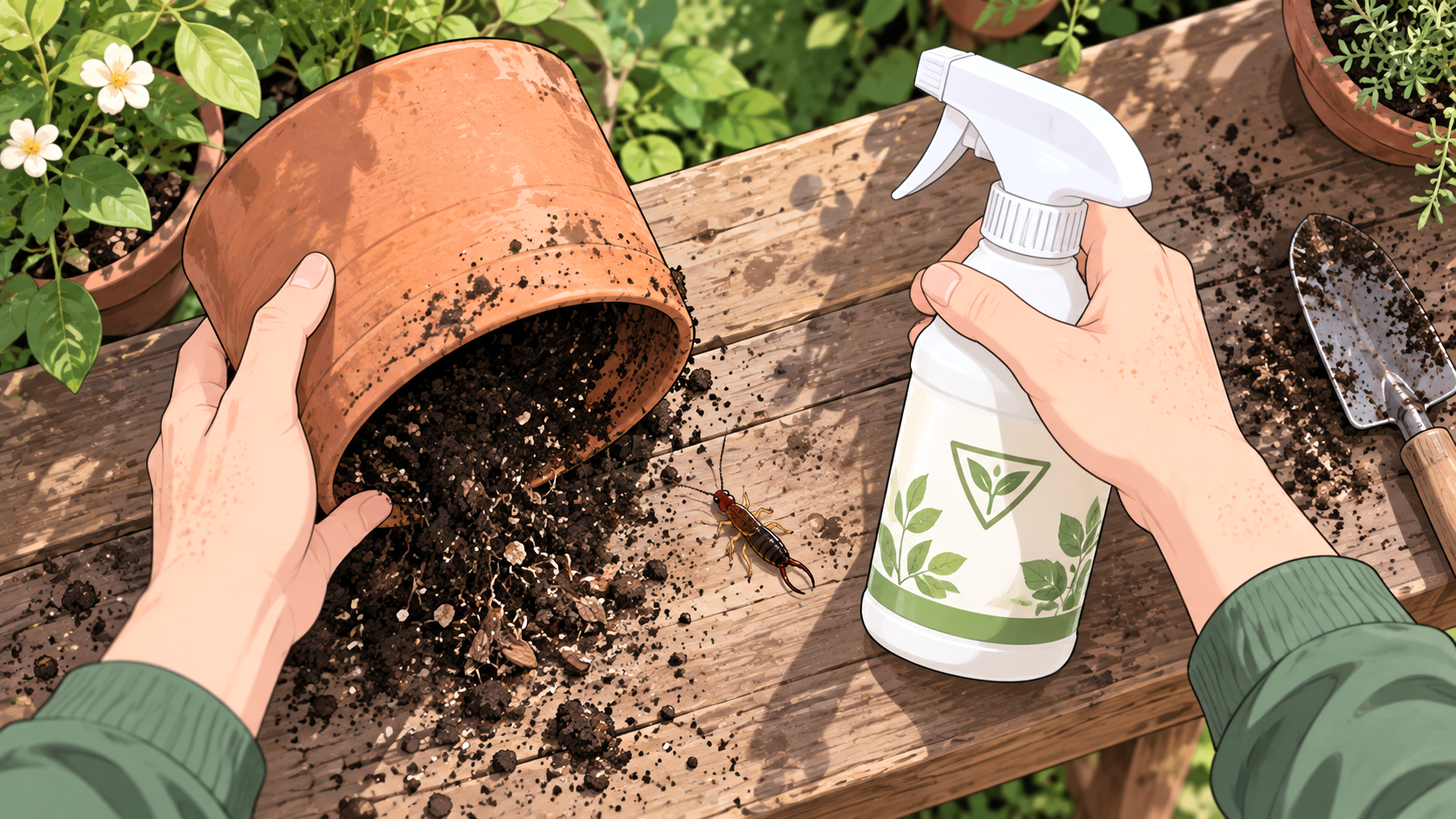
Wondercide kills earwigs. Wondercide Indoor Pest Control for Home + Kitchen specifically lists earwigs among the insects it kills, using a formulation containing cedarwood oil, sodium lauryl sulfate, sesame oil, and additional essential oils depending on the scent. It is designed for direct-contact killing and household pest prevention, but its earwig-specific residual performance has not been established.
The manufacturer makes an explicit earwig-control claim for its indoor spray. However, its published laboratory results do not provide a separate earwig mortality percentage or guaranteed killing time. Wondercide is therefore a reasonable contact-spray option for occasional indoor earwigs, with greater uncertainty surrounding prolonged control of recurring invasions.
Which Wondercide Product Is Intended for Earwigs?
Wondercide’s Indoor Pest Control for Home + Kitchen with Natural Essential Oils explicitly identifies earwigs among the insects it kills. It is available in cedarwood, peppermint, lemongrass, and rosemary scents, with ready-to-use spray bottles offered in several sizes.
The Wondercide Indoor Pest Control product information distinguishes between insects the company says the spray kills and those for which it additionally advertises repellent or preventive effects.
| Wondercide product | Earwig-specific claim | Intended application |
|---|---|---|
| Indoor Pest Control for Home + Kitchen | Explicitly lists earwigs as insects killed | Approved household surfaces and direct contact |
| Flea & Tick Spray for Pets + Home | Same formulation as Indoor Pest Control, with different use instructions | Specified pet and household applications |
| Outdoor Pest Control for Yard + Garden | Broader outdoor pest-control claims; verify earwigs on the particular package | Outdoor yard and garden treatment |
| Flying Insect Trap | No established earwig-control claim | Capturing certain flying insects |
The manufacturer states that its Indoor Pest Control and Flea & Tick Spray for Pets + Home products use the same underlying formulation. Their directions differ because one is marketed for general household treatment while the other includes pet-specific applications.
The outdoor products require separate consideration. Wondercide states that Outdoor Pest Control and Flea & Tick Yard + Garden share a formulation, but their labels emphasize different pest groups and applications. The current outdoor product information does not provide the same clear earwig-specific claim as the indoor spray.
For someone purchasing Wondercide primarily to kill earwigs, Indoor Pest Control for Home + Kitchen provides the clearest manufacturer-supported choice.
What Ingredients Does Wondercide Use Against Earwigs?
Wondercide’s indoor spray contains multiple active ingredients, with cedarwood oil forming a substantial part of the formulation. The other ingredients vary according to the selected scent.
| Indoor Pest Control scent | Active ingredients |
|---|---|
| Cedarwood | Cedarwood oil 5.7%, sodium lauryl sulfate 2.2%, sesame oil 0.1% |
| Peppermint | Cedarwood oil 4.2%, sodium lauryl sulfate 2.2%, peppermint oil 1.5%, sesame oil 0.1% |
| Lemongrass | Cedarwood oil 4.2%, sodium lauryl sulfate 2.2%, lemongrass oil 1.5%, sesame oil 0.1% |
| Rosemary | Cedarwood oil 4.2%, sodium lauryl sulfate 2.2%, rosemary oil 1.5%, sesame oil 0.1% |
These concentrations are published in the manufacturer’s current ingredient information. The formulation also includes other ingredients such as water, glycerin, and emulsifying agents.
The essential oils contribute insecticidal and repellent properties, while sodium lauryl sulfate is a surfactant that affects how the liquid wets insects and surfaces. The performance of the complete mixture should not be attributed to cedarwood oil alone.
For example, buying pure cedarwood essential oil and mixing it with water would not reproduce Wondercide’s formulation. Oil concentration, emulsification, additional ingredients, and spray distribution all affect exposure.
The manufacturer states that all four indoor scents have comparable effectiveness in its testing. Choosing peppermint rather than cedarwood is therefore primarily a fragrance preference, not an established way to improve earwig mortality.
How Well Does Wondercide Kill Earwigs on Contact?
Wondercide is marketed as a contact-killing spray, making direct exposure particularly important. The manufacturer’s application directions recommend spraying visible insects and allowing treated surfaces to dry.
Its published laboratory efficacy results describe controlled tests involving fleas, ticks, and mosquitoes. For example, direct spray testing against cat fleas produced high mortality under laboratory conditions.
Those findings demonstrate activity against the tested organisms, but they do not establish an equivalent mortality rate for earwigs. Earwigs differ from fleas in body structure, behavior, and exposure conditions. A flea-killing result cannot simply be transferred to another species.
Wondercide’s earwig-specific claim supports the expectation that direct spraying can kill susceptible earwigs. However, the available published results do not establish whether an earwig will die within seconds, minutes, or another specific interval.
An earwig concealed beneath furniture may also receive less spray than one exposed on a floor. Since earwigs commonly become active at night, a homeowner may encounter moving insects rather than those sheltering in inaccessible spaces.
For an individual earwig on an accessible surface, a vacuum or collection container remains a practical alternative. Immediate removal methods do not depend on the insect receiving a particular chemical dose.
Does Wondercide Repel Earwigs or Prevent Them From Returning?
Wondercide markets its indoor spray as providing killing, repellent, and preventive effects against various household pests. Earwigs, however, appear in the product’s also kills category rather than the primary group for which the manufacturer highlights killing and repellent claims.
The distinction limits what can reasonably be promised. The product may affect earwigs on contact, but its published information does not establish a specific duration of earwig repellency or residual protection.
Wondercide recommends repeated surface application as needed for general household prevention. Those instructions should not be interpreted as evidence that one application creates a long-lasting earwig barrier.
An earwig entering through an untreated opening may never encounter the sprayed area. Similarly, insects arriving after a previous application do not prove that the original earwigs survived.
The reasons earwigs continue appearing after treatment include new arrivals and concealed insects that escape exposure. These limitations apply even when a spray successfully kills individuals it reaches.
Wondercide can therefore be considered a contact treatment with broader manufacturer-advertised preventive uses, but not a guaranteed solution for recurring earwig intrusion.
Where Can You Spray Wondercide Indoors?
Wondercide Indoor Pest Control is intended for household surfaces, including specified areas around baseboards, doors, windows, flooring, furniture, carpets, and rugs. The manufacturer’s directions call for shaking the bottle before use and spraying from approximately 8 to 12 inches away. A targeted stream or wider mist can be selected depending on the application. Surfaces should be allowed to dry afterward.
For a visible earwig, the spray can be directed at the insect where its label permits treatment. There is no need to saturate surrounding surfaces merely because an insect was observed nearby.
The Wondercide application instructions also permit various household surface treatments, but suitability should be checked before spraying delicate materials.
The manufacturer recommends testing specialty fabrics such as leather, suede, and silk before broader application. Lemongrass-scented Wondercide can temporarily discolor light fabrics because of its naturally yellowish tint.
Floors may become slippery while wet. Avoid walking on freshly sprayed surfaces until they have dried, and wipe up excess liquid when necessary.
Can You Spray Wondercide Around Kitchen Food?
Wondercide’s product name includes Home + Kitchen, but this should not be interpreted as permission to spray food, exposed ingredients, or utensils.
Avoid applying insect spray directly to food-contact surfaces unless the exact product instructions permit that use and specify any required cleaning afterward. For food-preparation areas, physically removing the earwig usually avoids unnecessary residue.
Earwigs found near cabinets and sinks may be associated with kitchen moisture and concealed entry points. A spray cannot repair a leaking connection or close a structural opening. Keep food and cooking equipment protected whenever household pesticide applications are made.
Is Wondercide Safe Around Cats, Dogs, and Children?
Wondercide advertises its indoor spray as suitable for use around cats, dogs, and people when the product is used as directed. That claim does not mean direct exposure is harmless or that every animal will tolerate the ingredients equally.
The formulation contains essential oils, and concentrated essential oils can cause adverse effects in pets. Cats, birds, and certain small animals warrant particular caution because sensitivity and metabolic handling vary among species.
The ASPCA’s guidance on essential oils and pets describes potential risks from inappropriate exposure, including ingestion and direct contact. Commercially formulated pest sprays should not be treated as equivalent to pure essential oils, but neither should they be applied indiscriminately around animals.
Wondercide’s directions distinguish products intended for direct use on pets from products intended for household surfaces. Do not assume that every Wondercide spray is suitable for direct application to an animal simply because another product in the range carries pet-use instructions.
Keep pets and children away from freshly treated surfaces until the spray has dried as directed. Prevent animals from licking wet residues, protect food and water bowls, and avoid spraying near aquariums or sensitive animal enclosures.
The manufacturer’s product safety and usage information also explains that outdoor sprays are not formulated or tested for indoor use. Substituting an outdoor Wondercide product inside the house is inappropriate, even when both products contain cedarwood oil.
If a pet develops unusual symptoms after exposure, stop using the product and contact a veterinarian. Persistent irritation in a person should be assessed according to the symptoms and exposure involved.
Does Wondercide Have EPA Approval?
Wondercide describes its plant-based pest sprays as FIFRA Section 25(b) minimum-risk pesticides. Products meeting this exemption’s requirements do not need ordinary federal EPA pesticide registration, although individual states may impose their own registration requirements.
This regulatory status differs from EPA approval following product-specific efficacy and safety review.
The EPA’s explanation of minimum-risk pesticide exemptions states that qualifying products generally are not reviewed or registered by the agency. Manufacturers are responsible for ensuring that their formulations and claims satisfy the exemption conditions.
Consequently, Wondercide’s published laboratory studies should be understood as manufacturer-presented supporting evidence, not as proof that the EPA independently verified its earwig-killing performance.
The EPA also restricts misleading claims suggesting that exempt products have received federal endorsement. Its minimum-risk pesticide conditions explain the requirements governing ingredients, labeling, and representations.
This distinction does not establish that Wondercide is ineffective. It clarifies what the available evidence supports and why a minimum-risk classification should not be confused with a government-verified earwig kill rate.
Is Wondercide Worth Using Specifically for Earwigs?
Wondercide Indoor Pest Control is a reasonable choice for someone who wants a ready-to-use, plant-derived contact spray and prefers avoiding conventional synthetic pyrethroids. The manufacturer explicitly includes earwigs among its target insects, and the application directions are suitable for selected household surfaces.
Its main limitation is the lack of separately published earwig performance figures. There is no established earwig-specific mortality percentage, guaranteed killing time, or residual duration that can be reliably applied to ordinary household conditions.
For a small number of earwigs, physical collection is often sufficient. Earwigs are generally occasional indoor invaders, and their presence does not usually indicate an established indoor infestation.
If Wondercide is used, evaluate fresh earwig activity rather than relying on fragrance intensity or assuming that treated surfaces will repel insects indefinitely. The time needed for earwig sightings to decline depends partly on whether additional insects continue arriving.
A homeowner who continues finding earwigs beside the same entrance should investigate that location rather than automatically increasing spray frequency. Repeated contact treatment can kill exposed insects without resolving the source of new arrivals.
Wondercide’s clearest supported earwig benefit is direct-contact killing with its Indoor Pest Control formulation. Choose it for that limited purpose, follow the specific package instructions, and avoid assuming that a plant-derived spray is universally harmless or provides permanent prevention.