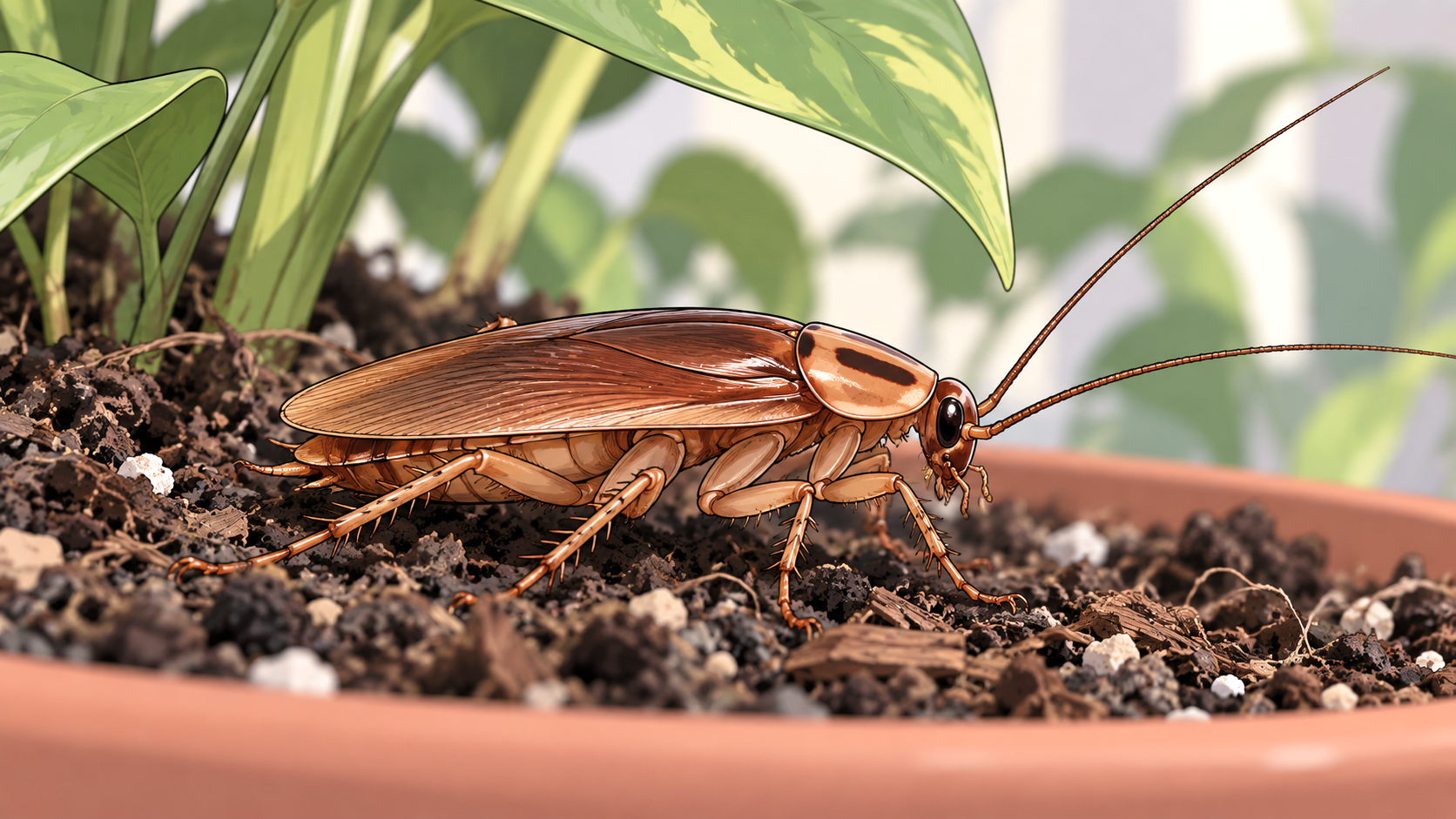
A bug shoots under the refrigerator before you get a proper look at it. Brown body, long antennae, fast legs. That can be enough to suspect a cockroach, but not enough to identify one confidently. An adult cockroach typically has a broad, flattened, oval body, very long antennae, six conspicuous legs, and a head that can look partly hidden when viewed from above. Brown is common, but adult cockroaches range from pale tan through reddish brown to nearly black. Size varies substantially because the word cockroach covers many species rather than one standard-looking insect.
The Cockroach Shape Is Usually the First Clue
From above, a typical cockroach looks low, wide, and somewhat oval rather than cylindrical. The body is flattened enough to fit into narrow cracks and crevices, while the legs project noticeably from the sides. Long, slender antennae extend from the head and can approach or exceed the body length in some cockroaches. The overall silhouette is one of the most useful features when you only see the insect briefly.
The head can be surprisingly difficult to see from directly overhead. A shield-like section immediately behind it partly conceals it, producing the characteristic rounded front profile seen in many cockroaches. The exact structures responsible for that shape belong to cockroach anatomy, but you do not need to identify every body part to recognize the basic outline.
Six legs confirm that you are looking at an insect, although leg count alone tells you little because cockroaches are insects just like beetles, ants, flies, and many other household bugs. On a cockroach, the legs tend to look long, splayed, and visibly spiny. Their combination with the flat oval body and sweeping antennae creates a much stronger visual clue than any one feature by itself.
Adult Cockroaches Range From Small to Surprisingly Large
There is no single adult cockroach size. Among species commonly encountered around North American buildings, adults can differ by more than an inch in body length. German cockroaches are roughly 1/2 to 5/8 inch long, while American cockroaches can approach 2 inches. Other pest species fall between those extremes, so size can narrow an identification without proving it.
A tiny tan adult and a large reddish-brown adult can therefore both be cockroaches. For example, the German cockroach is about half an inch long, whereas the American cockroach is much larger. The nearly black Oriental cockroach reaches roughly 1 to 1 1/4 inches. Because individual species occupy different portions of this range, cockroach type matters when interpreting size.
We would not identify a cockroach from size alone. A small beetle can overlap a small cockroach in length, while a cricket may overlap a larger one. Body shape, antennae, markings, wings, and where the insect was found provide a much better identification when considered together.
Brown Is Common, but Cockroaches Are Not One Shade
Tan and brown dominate the familiar household species, although the range is wider than the generic label “brown bug” suggests. Adult German cockroaches are tan to light brown with two dark longitudinal stripes behind the head. American cockroaches are reddish brown with a pale margin around the shield behind the head. Oriental cockroaches are dark brown to nearly black, often with a shiny appearance.
Brown-banded cockroaches add another pattern. Adults are small, and pale bands cross parts of the body, while males and females differ in overall coloration and proportions. Outdoor species widen the palette further. Some field cockroaches have grayish or olive tones, and Cuban cockroaches can be pale green.
Color is consequently useful only as part of the whole appearance. A nearly black insect is not automatically an Oriental cockroach, and a light brown one is not automatically German. When the specimen does not fit the familiar pest species cleanly, cockroach lookalikes deserve consideration before you decide what you found.
Wings Can Change the Outline of an Adult Cockroach
Many adult cockroaches have visible wings lying flat over the back, which can make the body look smoother and more elongated. Wing length varies by species and sometimes by sex. American cockroaches have well-developed wings, for example, while male Oriental cockroaches have shorter wings and females have only reduced wing pads. Some adult wood cockroaches also show strong differences between male and female wing length.
Visible wings do not prove that a cockroach regularly flies. Some winged household species rarely fly, and flight ability differs among cockroaches. Likewise, an insect without obvious full-length wings should not immediately be ruled out. Sex and species can change how much of the abdomen the wings cover.
Age creates another identification issue, but immature appearance belongs in its own category. A small wingless cockroach may be a juvenile rather than a tiny adult species, so baby cockroaches require different visual clues.
A Brown Bug With Long Antennae Is Not Automatically a Cockroach
Beetles, crickets, and several other insects can produce a convincing cockroach scare when they appear indoors. Beetles are a particularly common source of confusion. Adult cockroaches lack the hard shell-like forewings characteristic of beetles, and their flattened profile is usually different. Those differences become easier to see in a direct cockroach-versus-beetle comparison.
Crickets can also be dark, fast, and equipped with long antennae, but their enlarged hind legs give them a different silhouette. Earwigs are narrower and carry obvious forceps at the end of the abdomen, making an earwig and cockroach comparison useful when only the dark coloration looked similar.
A photograph taken from directly above is often more useful than trying to remember a bug that disappeared in seconds. Include something for scale without touching the insect. Size, body outline, markings, and wing coverage can then be compared together rather than relying on the vague impression that it “looked like a roach.”
Other Visual Clues People Notice on Cockroaches
Do cockroaches look shiny?
Some do. Oriental cockroaches can have a noticeably shiny, almost greasy-looking surface, while other species appear less glossy. Shine alone is too variable to serve as a reliable cockroach test.
Do male and female cockroaches look different?
They can. Differences may include body width, wing length, coloration, and overall proportions, depending on the species. A male and female of the same species can therefore look less alike than a homeowner expects.
Can you identify a cockroach from a blurry photo?
Sometimes the general body shape and size are enough to narrow the possibilities, but species identification may require markings that a blurry photograph cannot preserve. A clear overhead image showing the entire body is far more useful.
What should you check after confirming the insect is a cockroach?
The next useful clues come from the property rather than the specimen. Check where the insect appeared and whether there is additional evidence nearby, since finding one cockroach does not by itself tell you the size of the problem. Droppings, shed skins, egg cases, additional live cockroaches, and repeated sightings can provide stronger evidence of an established population.
3 thoughts on “What Does a Cockroach Look Like?”