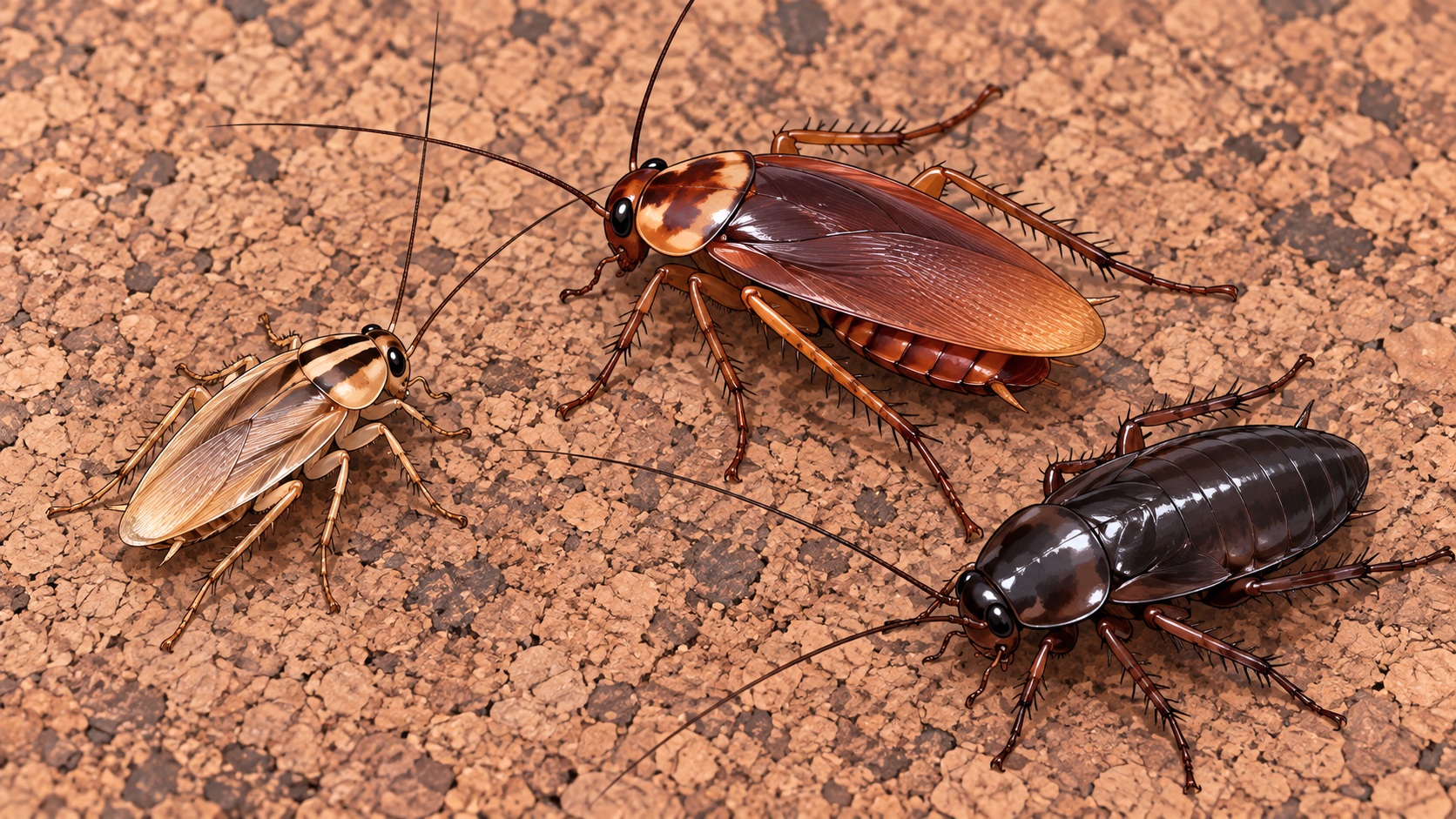
Cockroaches come in brown, black, reddish brown, tan, yellow, green, orange, red, and even metallic blue. Most cockroaches commonly found inside homes are shades of brown or black, often with distinctive stripes or pale markings. However, many outdoor species have far more colorful bodies, including bright green wings, orange patterns, and iridescent surfaces.
A cockroach’s color can also change as it grows. Young cockroaches may look different from adults, and an individual that has just molted can appear almost entirely white before its new exoskeleton darkens. Color can help narrow the possibilities when identifying a cockroach, but it is rarely sufficient on its own.
The Colors of Common Household Cockroaches
Most household pest species have relatively subdued coloration, although their markings can be distinctive.
| Cockroach | Typical adult color | Recognizable markings |
|---|---|---|
| German cockroach | Light tan to amber brown | Two dark, parallel stripes behind the head |
| American cockroach | Reddish brown to chestnut | Pale yellowish border around the pronotum |
| Oriental cockroach | Very dark brown to black | Often glossy, especially on adults |
| Smokybrown cockroach | Deep mahogany to nearly black | Relatively uniform coloration without prominent pale stripes |
| Brown-banded cockroach | Light to medium brown | Pale transverse bands, especially noticeable on nymphs and females |
| Australian cockroach | Dark brown | Yellowish markings on the pronotum and outer edges of the forewings |
The Victoria Department of Health’s cockroach descriptions document these colors and markings across six common pest species.
These descriptions apply primarily to adults. Immature cockroaches sometimes have markedly different patterns, so comparing a nymph directly with an adult identification photograph can be misleading.
Why German Cockroaches Look Tan With Black Stripes
Light brown and amber coloration. German cockroaches (Blattella germanica) are usually pale brown, tan, or amber. Their most recognizable color feature is a pair of dark longitudinal stripes on the pronotum, the shieldlike structure immediately behind the head.
The stripes are often easier to recognize than the insect’s overall body color. An adult may appear light golden brown under bright lighting or considerably darker in a shaded cupboard, but the contrasting markings usually remain visible.
Young German cockroaches have a different arrangement of dark and pale areas. Early nymphs are predominantly dark, with a lighter central region that becomes more distinctly defined during development. The University of California, Riverside’s account of German cockroach nymphs describes how their early pale thoracic markings develop into the characteristic adult pattern.
A dark juvenile with a light marking should therefore not automatically be assumed to belong to a different species from the nearby tan adults.
Reddish-Brown Cockroaches: American Roaches
Chestnut, rust, and mahogany tones. American cockroaches (Periplaneta americana) have a relatively rich reddish-brown body color. Depending on the individual and lighting, they may appear chestnut, rusty brown, or dark mahogany.
Their pronotum commonly displays a pale yellowish margin surrounding a darker central area. This contrasting pattern provides more useful information than the reddish body alone because other cockroach species can share similar shades.
The University of Florida’s description of the American cockroach identifies the reddish-brown coloration and yellowish pronotal markings as characteristic adult features.
Reddish coloration does not necessarily mean the insect is an American cockroach. Some woodland and tropical species also display warm brown or red tones, while developmental stage can influence the shade visible on a particular individual.
Black Cockroaches and Nearly Black Species
Glossy black, dark chocolate, and smoky brown
Oriental cockroaches (Blatta orientalis) are among the household species most commonly described as black. Adults have dark brown to nearly black bodies, frequently with a glossy surface that reflects light.
Smokybrown cockroaches (Periplaneta fuliginosa) can look similarly dark. Their bodies are generally a uniform, shiny mahogany brown that may appear almost black indoors.
The difference is often easier to recognize through markings than through darkness alone. Smokybrown cockroaches typically lack the pronounced pale thoracic border found on American cockroaches, while Oriental cockroaches possess a different adult wing arrangement.
North Carolina State University’s smokybrown cockroach description identifies its uniformly dark, glossy coloration.
A black cockroach is not necessarily an old cockroach, nor does black coloration indicate that it has absorbed dirt or soot. These are normal appearances for some species.
Brown Cockroaches With Yellow or Cream Bands
Not every light marking runs lengthwise. Brown-banded cockroaches (Supella longipalpa) have pale transverse bands that extend across the body rather than along it. These markings are particularly noticeable on immature individuals and adult females.
The background coloration varies from golden brown to dark chestnut. Adult males tend to be narrower and lighter, while females have broader bodies that may appear considerably darker. The University of Minnesota’s cockroach identification guide describes these contrasting appearances within the same species.
Australian cockroaches (Periplaneta australasiae) display a different yellow pattern. Their bodies are primarily dark brown, with pale yellow to orange markings near the pronotum and along the outer margins of the forewings. The North Carolina State University description of Australian cockroaches documents these markings, which can help separate them from American cockroaches of similar general appearance.
The position of a pale marking is more informative than merely describing the insect as brown and yellow. Two parallel stripes behind the head, bands crossing the abdomen, and yellow wing margins suggest different possibilities.
Can Cockroaches Be Green?
Yes. Some cockroach species are naturally bright green. The green banana cockroach (Panchlora nivea), sometimes called the Cuban cockroach, is a particularly recognizable example. Adults have delicate, pale green to lime-green wings, often with yellowish margins. Their appearance is substantially different from the darker cockroaches commonly associated with household infestations.
BugGuide’s account of the green banana cockroach documents its green adult coloration and the brown or black appearance of its nymphs.
Green banana cockroaches occur in tropical and subtropical environments, including parts of the southeastern United States. They may occasionally appear near buildings, but their coloration does not indicate that they are simply green versions of German or American cockroaches.
A bright green insect should not be classified as a cockroach based on color alone. Leafhoppers, katydids, and other green insects can look superficially similar.
Blue, Orange, Red, and Multicolored Cockroaches
Some tropical cockroaches possess colors rarely associated with household pests.
Members of the genus Eucorydia are particularly striking. Scientific research published in ZooKeys describes metallic blue or green cockroaches with vivid orange markings. Some have reflective wing surfaces that appear to change color with the viewing angle.
Other species display patterns resembling unrelated insects. Certain Prosoplecta cockroaches have rounded bodies with red, orange, or yellow backgrounds and dark markings, giving them a resemblance to ladybugs. The American Museum of Natural History’s examination of animal mimicry identifies these cockroaches as examples of insects that resemble potentially unpalatable beetles.
The Australian Museum also documents native cockroaches exhibiting orange, red, yellow, and blue coloration. These species demonstrate that the familiar dark-brown household appearance represents only a small portion of cockroach diversity.
Why Do Some Cockroaches Look White?
A white cockroach is usually an individual that has recently molted.
Cockroaches periodically shed their old exoskeleton as they develop. Immediately afterward, the newly exposed outer covering is soft and pale, sometimes appearing creamy white or nearly translucent. The insect gradually acquires its normal pigmentation as the cuticle hardens.
According to UC Statewide Integrated Pest Management, newly molted cockroaches are initially white and usually darken within hours.
This appearance does not establish that the insect is an albino, belongs to a white species, or has been affected by pesticide. A pale cockroach may simply have been observed during the brief interval following a molt.
The insect can also appear unusually vulnerable during this period because its new exoskeleton has not fully hardened. Newly molted individuals often remain in protected areas rather than moving openly across floors.
Detailed cockroach molting and exoskeleton changes explain the developmental process, but the immediate identification point is straightforward: temporary whiteness is not a permanent species characteristic.
Why Baby Cockroaches Can Be Darker Than Adults
Cockroach nymphs are not always miniature versions of their parents’ final coloration.
German cockroach nymphs are predominantly dark, with pale markings that differ from the two longitudinal pronotal stripes of adults. Brown-banded nymphs have conspicuous light bands across their dark bodies. Young Australian cockroaches may be nearly black with pale spots or bands that change as they develop.
The North Carolina State University account of Australian cockroaches specifically describes dark young nymphs with a pale thoracic band and two lighter abdominal spots.
Successive molts allow the external patterns to change as the insect matures. Wing development also alters which portions of the body are visible, sometimes covering markings that were conspicuous on younger individuals.
Consequently, two cockroaches found together may have different color patterns while belonging to the same species. A small, dark nymph near a tan adult does not automatically indicate that two species are present.
Does a Dead Cockroach Change Color?
A cockroach’s appearance can change after death, although there is no universal color transition that reliably indicates how long it has been dead.
Drying can make the body appear duller, while damage or decomposition may alter the original surface coloration. Exposure to moisture, sunlight, and environmental debris can produce additional changes. A dead cockroach may also become darker or lighter in photographs because its position exposes different parts of the body.
A pale dead specimen is not necessarily a newly molted individual, and a dark specimen is not necessarily old. Color alone cannot determine when the insect died or what caused its death.
The presence of shed exoskeletons can add further confusion. A discarded skin may look pale, tan, or translucent and may retain the general shape of a cockroach even though no insect remains inside it.
Can You Identify a Cockroach by Color Alone?
Color is most useful when it forms a recognizable pattern rather than a single overall shade.
A light-brown insect with two dark longitudinal stripes behind its head is consistent with a German cockroach. A dark-brown individual with pale markings along its forewing margins may suggest an Australian cockroach. A uniformly glossy, very dark specimen could belong to several species, making color less decisive.
The viewing conditions also matter. Warm household lighting can make a reddish-brown cockroach appear orange, while a camera flash can turn a dark-brown exoskeleton almost black. Metallic species may look blue or green depending on reflected light.
The American Museum of Natural History’s presentation of cockroach diversity illustrates how dramatically coloration varies across species, including forms that resemble beetles or other unrelated insects.
For an unfamiliar cockroach, record its overall color, the placement of stripes or spots, whether the insect has developed wings, and whether it appears freshly molted. Body dimensions can provide additional context because adult cockroach sizes vary substantially between common household and tropical species.
A photograph showing the top of the head, pronotum, wings, and abdomen will usually provide more identifying information than a description such as “black roach” or “reddish bug.” Especially with nymphs and recently molted specimens, the pattern and developmental stage are more dependable than color alone.
One thought on “What Colors Do Cockroaches Come In?”