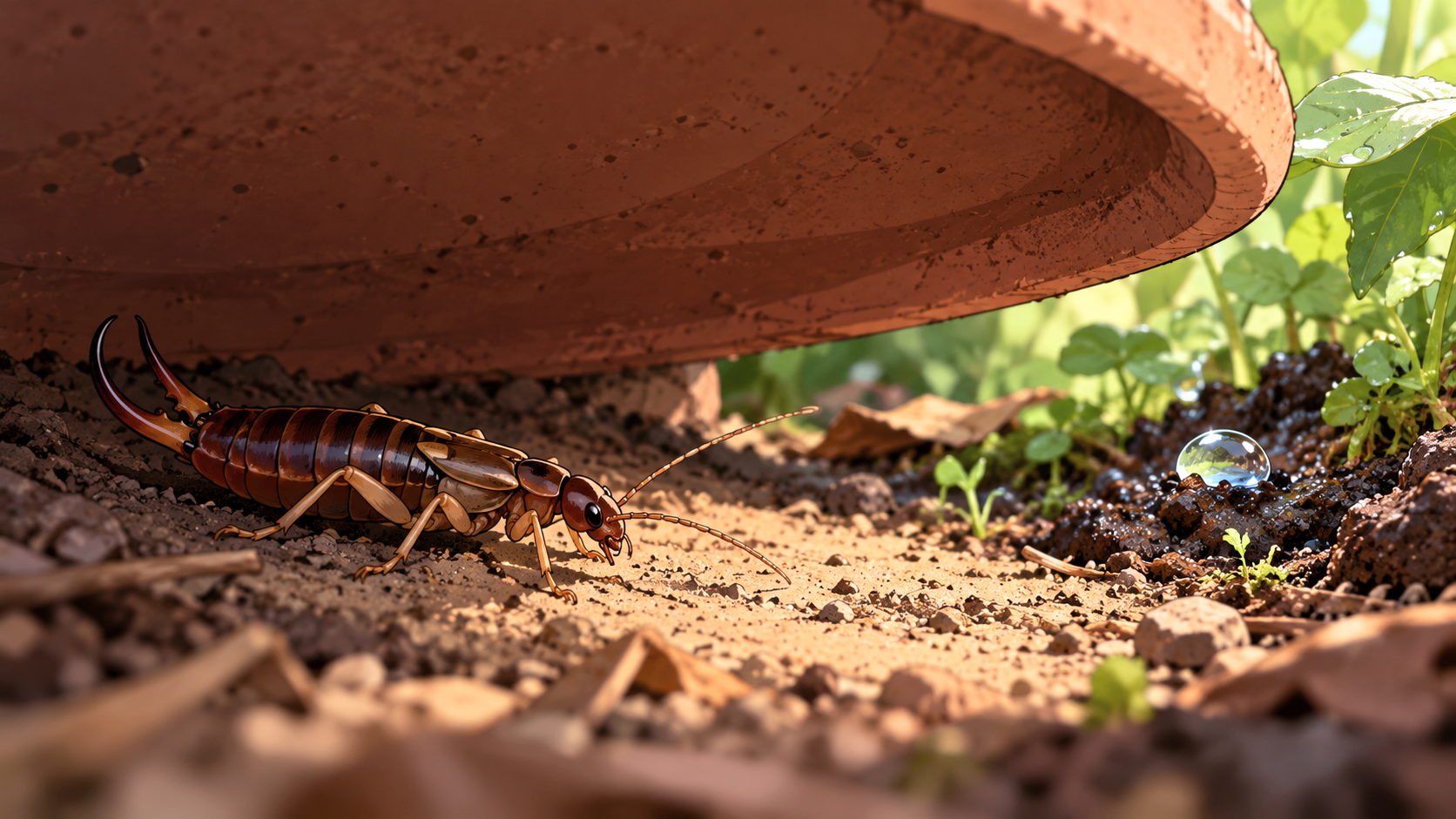
Earwigs can survive several days without food, and some individuals last longer, but there is no reliable universal survival time for earwigs deprived of water. Scientific experiments have demonstrated that certain earwig species tolerate a week of starvation, although survival varies considerably between individuals. The duration of water deprivation is harder to establish because temperature, humidity, and access to moisture from the environment can substantially change the outcome.
Food deprivation and dehydration are different physiological challenges. An earwig may stop eating while still obtaining moisture, or it may lose water rapidly despite having access to food. Consequently, claims that every earwig dies after a fixed number of days without food or water oversimplify the available evidence.
How Many Days Can Earwigs Survive Without Food?
A published starvation experiment provides unusually specific survival figures for the striped earwig, Labidura riparia. Researchers isolated 40 adult males and 40 adult females, withheld food for seven days, and supplied moistened cotton wool.
By the seventh day, 15% of the males and 37.5% of the females remained alive. The experiment demonstrated that some adult earwigs could survive at least a week without eating, but most individuals in the tested groups died before the experiment ended.
The results were reported in the 1974 study Studies on the Behaviour and Biology of the Earwig Labidura riparia. Survival differed significantly between sexes, with females displaying greater tolerance to starvation.
| Day without food | Males surviving | Females surviving |
|---|---|---|
| 1 | 87.5% | 97.5% |
| 3 | 45% | 72.5% |
| 5 | 20% | 47.5% |
| 7 | 15% | 37.5% |
These figures should not be applied directly to European earwigs (Forficula auricularia), the species commonly found around homes in many temperate regions. Nor do they establish the longest possible survival period. The experiment stopped after seven days, and the insects had moisture available throughout.
The results nevertheless demonstrate why an earwig cannot be expected to die simply because it misses one or two opportunities to feed.
What Happens to European Earwigs When Food Is Restricted?
European earwigs have also been studied under experimentally limited food supplies, although those investigations generally examine development, parental care, or survival under nutritional stress rather than establishing an absolute starvation limit.
A 2021 study involving 207 juvenile European earwigs examined survival during starvation under different temperatures and experimental conditions. Researchers found that lighter juveniles died sooner than heavier individuals. Mortality was also faster at 24°C than at 20°C, while exposure to higher concentrations of an insect-pathogenic fungus further reduced survival.
The findings indicate that an earwig’s condition before food deprivation influences how long it remains alive. An individual with greater energy reserves may endure starvation longer than a smaller or weakened insect, even when both experience the same surroundings.
Food restriction can also have lasting developmental effects. Experiments involving European earwig families with limited food found that nutritional conditions altered offspring survival. The consequences extended beyond the immediate period of reduced feeding, demonstrating that surviving a shortage does not necessarily mean an insect remains unaffected.
These studies support variation in starvation tolerance rather than a single survival estimate for every European earwig.
How Long Can Earwigs Live Without Water?
The available research does not establish a dependable number of hours or days that European earwigs survive without water. More importantly, an insect deprived of drinking water is not necessarily experiencing complete dehydration.
Earwigs can obtain moisture from food, damp surfaces, and their surroundings. An experiment that removes a drinking-water source while maintaining humid conditions does not measure the same stress as placing insects in very dry air without food or water.
A study published in Nature investigated seasonal changes in the humidity preferences of European earwigs. The researchers observed that dehydrated earwigs tended to move toward more humid conditions, even when individuals had previously preferred drier surroundings. Their responses also changed with the season.
This research establishes that water balance influences earwig behavior, but it does not supply a lethal dehydration threshold. Humidity preference, water loss, and survival time are related measurements, not interchangeable ones.
A European earwig confined in a dry, heated room may experience much greater water stress than one sheltered beneath a damp object. Both might lack a visible drinking-water source, yet the actual deprivation conditions are substantially different.
For that reason, estimates such as three days without water or one week without water should not be presented as established species-wide limits.
Which Conditions Change Survival During Deprivation?
Three environmental factors make especially large differences when interpreting starvation and dehydration experiments.
Temperature affects metabolism and water loss. Warmer conditions can increase energy demands, while cooler temperatures may reduce activity and energy expenditure. However, prolonged exposure to unfavorable cold can create its own survival risks. The juvenile starvation experiments demonstrate that even a relatively modest temperature difference can change how quickly European earwigs die when food is withheld.
Humidity influences the rate at which an insect loses moisture. Earwigs commonly occupy protected spaces where conditions differ from the surrounding air. Sheltered and relatively damp locations that attract earwigs can therefore influence their water balance independently of whether food is available.
Developmental stage and physical condition also affect the outcome. An immature earwig undergoing growth and molting has different nutritional demands from an adult. The juvenile studies found that initial body mass predicted survival during starvation, while the Labidura riparia experiment demonstrated substantial differences between adult males and females.
These variables interact with the circumstances of deprivation. An earwig surviving several days in moist laboratory conditions cannot be used to predict precisely how long another individual will survive on a dry household floor.
Can Earwigs Survive by Eating Other Earwigs?
Food shortages can encourage cannibalism in some earwig species, meaning an apparently foodless enclosure may cease to be foodless when several insects are confined together.
The Labidura riparia researchers examined this behavior after observing earwigs attacking and consuming other individuals. In their experiments, cannibalism occurred more frequently when food was withheld than when food was supplied. The frequency also varied according to how males and females were grouped.
This introduces an important complication when measuring starvation. A group of earwigs confined without ordinary food may obtain nutrients by consuming other insects in the enclosure. Survival in that situation cannot be interpreted as uninterrupted fasting.
Cannibalistic behavior has also been documented in European earwig family groups. Research into food limitation and family interactions demonstrates how restricted resources can influence survival and competition among individuals.
These findings help explain why controlled starvation studies sometimes isolate insects rather than housing them together. They do not imply that cannibalism is inevitable whenever earwigs become hungry.
Does an Earwig Need to Drink From Standing Water?
An earwig does not necessarily need a visible puddle, water bowl, or dripping faucet to obtain moisture. Food containing water and contact with damp environments may contribute to its overall water balance.
Consequently, removing a dish of water from an enclosure is not equivalent to removing every possible moisture source. Researchers frequently provide moist substrate or cotton wool when studying earwig behavior, specifically because the insects’ condition is influenced by environmental moisture.
This is relevant to earwigs appearing in bathrooms. Their presence does not prove they have been drinking from a sink or toilet. The room may simply provide favorable conditions for shelter and moisture conservation.
The University of Minnesota’s observations of earwig habits describe their tendency to occupy protected locations beneath objects and within narrow spaces. Those habitats can differ substantially from exposed surroundings in temperature and moisture.
A lack of visible water should therefore not be interpreted as proof that an earwig is undergoing severe dehydration.
Why Surviving Without Food Is Not the Same as Living Normally
Starvation tolerance describes how long an organism remains alive under restricted conditions. It does not establish that the organism can grow, reproduce, or function normally throughout deprivation.
Female earwigs of certain species may undergo prolonged periods of reduced feeding while guarding their eggs. Research into the reproductive and fasting phases of Labidura riparia documents physiological changes accompanying parental behavior. Such adaptations help explain why adult females can sometimes endure periods without feeding, but they should not be mistaken for unlimited starvation resistance.
Likewise, an insect that survives a food shortage may experience reduced activity, impaired development, or increased vulnerability to additional stress. These effects are especially relevant to juveniles because their bodies are still developing.
The normal lifespan of an earwig describes a much broader period that includes ordinary feeding and environmental conditions. It should not be used to infer how long the insect can withstand complete deprivation.
What Can You Conclude From an Earwig Found Alive After Several Days?
An earwig remaining alive after several days in a seemingly empty room has not necessarily survived without food or water throughout that period. It may have entered more recently, obtained moisture from an overlooked source, or consumed small amounts of organic material.
Even when the same insect has remained present, observing that it is still moving provides little information about how close it may be to the limits of starvation or dehydration.
A dry-looking surface also does not establish that the insect’s entire surroundings are dry. Cracks, gaps, and protected spaces can maintain different moisture conditions. Earwigs discovered in carpets and nearby flooring may have moved between exposed and sheltered locations rather than remaining continuously on the visible surface.
The strongest experimental finding available for a specific fasting duration is the seven-day Labidura riparia study, conducted with moisture provided. For European earwigs, existing work demonstrates substantial effects of temperature, body condition, and nutritional restriction, but it does not establish a universal maximum survival time without food. A corresponding precise limit for complete water deprivation remains unsupported.