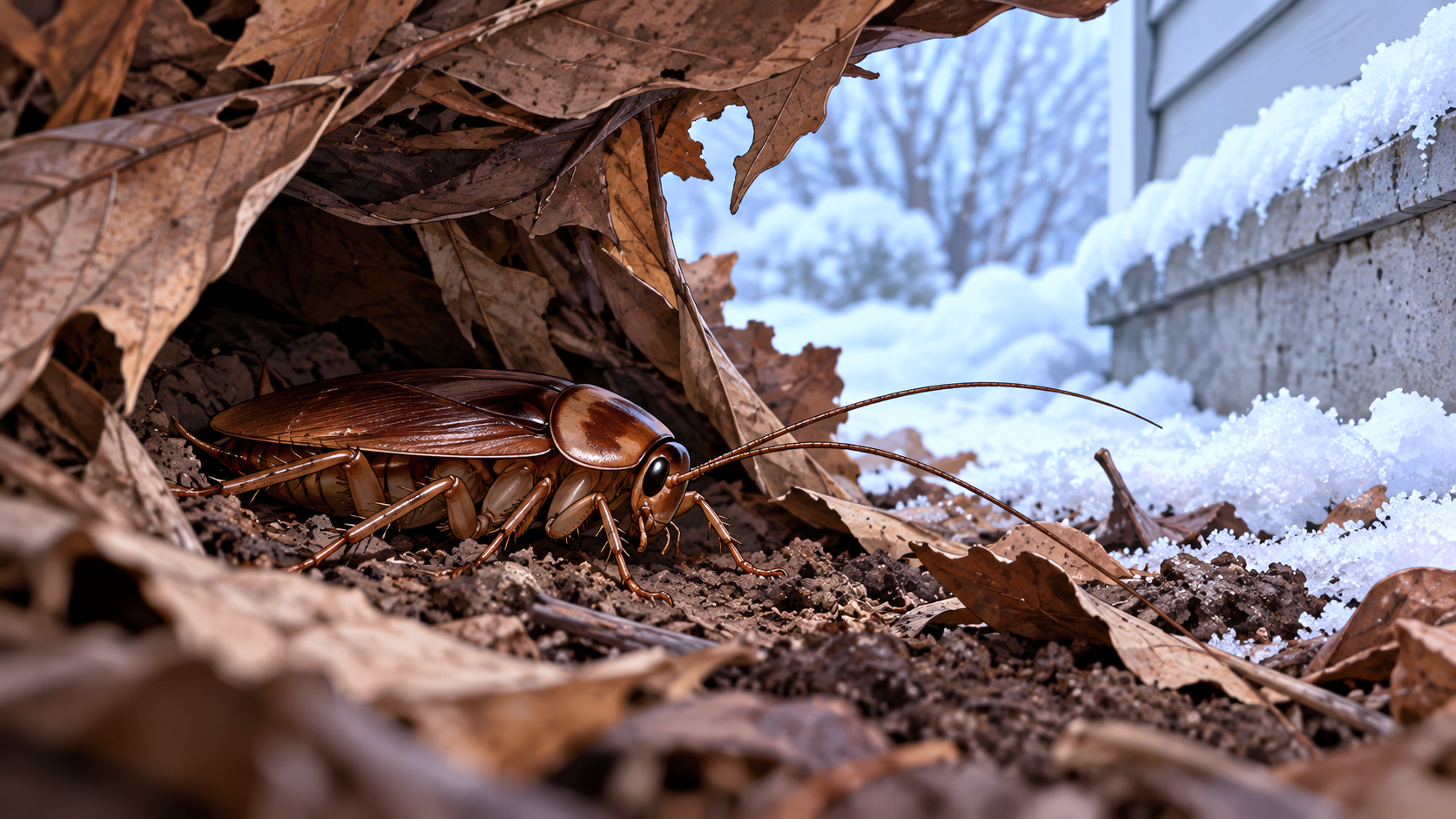
Cockroaches do not all disappear or become dormant when winter arrives. Some species enter a genuine developmental dormancy called diapause, others simply become less active in cold conditions, and household species such as German cockroaches can remain active throughout winter in heated buildings.
The differences depend on species, life stage, and the temperature of the insect’s actual shelter. A cockroach living beneath tree bark faces very different winter conditions from one occupying a warm kitchen or an insulated service area. Even among outdoor species, winter survival does not always involve true hibernation.
Hibernation, Diapause, and Cold-Weather Inactivity Are Different
Hibernation is primarily a term used for a particular form of seasonal dormancy in mammals. Insects have their own mechanisms for reducing activity or interrupting development during unfavorable conditions.
Diapause is a regulated developmental state in which growth, reproduction, or other physiological processes are suppressed. It may be triggered by environmental signals such as shortening day length, and it can persist even when conditions temporarily become favorable. Quiescence, by contrast, is a more immediate response to unfavorable surroundings. An insect that becomes inactive because its environment is too cold may resume activity when conditions improve.
Both occur among cockroaches, but neither applies universally to the entire order. Research on the woodland cockroach Ectobius lapponicus identified diapause in both the egg and nymphal stages. In another species, Symploce japonica, researchers documented winter diapause in nymphs, along with other developmentally regulated dormant periods.
These findings explain why calling every inactive winter cockroach “hibernating” is inaccurate. Some insects have entered a programmed period of suspended development; others are merely responding to their immediate temperature.
German Cockroaches Can Remain Active All Winter Indoors
German cockroaches (Blattella germanica) are strongly associated with heated human environments. Their continued development depends far more on indoor conditions than on the outdoor calendar.
A Japanese study followed German cockroach development in laboratory and building environments over two years. Populations maintained at approximately 25°C reproduced continuously, whereas some populations in buildings without adequate winter heating failed to survive. Heated buildings permitted overwintering and, under suitable conditions, continued reproduction.
The experiment comparing heated and unheated environments demonstrated that building temperature strongly influenced whether German cockroaches could maintain established populations.
Consequently, cold weather outside does not necessarily interrupt an indoor infestation. Cockroaches occupying warm areas near plumbing, appliances, or heating equipment may continue feeding, developing, and reproducing while outdoor temperatures are low. Their normal lifespan and development still depend on food, moisture, and temperature, rather than following a compulsory winter resting period.
A poorly heated outbuilding presents a different situation. Development may slow considerably, and prolonged unfavorable conditions can prevent a population from persisting. A motionless German cockroach found in such an environment should not automatically be considered safely dormant or capable of recovering.
Oriental Cockroaches Can Overwinter in Protected Outdoor Sites
Oriental cockroaches (Blatta orientalis) are better adapted to relatively cool, damp environments than German cockroaches. They occur around foundations, drains, crawl spaces, and outdoor ground-level refuges where moisture is available.
According to the Illinois Department of Public Health, Oriental cockroaches can survive temperate winters outdoors in protected locations such as leaf litter and mulch around foundations.
Their development is comparatively slow, and immature cockroaches can persist through colder periods in sheltered environments. The University of Florida’s account of Oriental cockroaches likewise documents their tolerance of cooler habitats and use of protected exterior spaces.
Overwintering does not imply that every individual survives or that the population remains equally active throughout the season. Temperature, shelter conditions, and developmental stage determine the outcome. An Oriental cockroach occupying a protected crawl space may remain alive while showing relatively little movement, whereas one exposed to severe conditions may not survive.
Wood Cockroaches Spend Winter as Immature Insects
North American wood cockroaches (Parcoblatta species) ordinarily live outdoors among decaying vegetation, beneath logs, and under loose bark. Their life cycles commonly include an overwintering nymphal stage rather than continuous development into adults throughout the year.
According to Penn State Extension’s account of wood cockroaches, nymphs develop during warmer conditions, remain sheltered through winter, and mature when conditions become favorable again. Some take longer than one year to complete development.
An immature wood cockroach beneath bark may therefore be alive despite showing very little activity. Such insects are following an outdoor developmental cycle, not behaving like German cockroaches occupying a heated kitchen. Wood cockroaches sometimes enter buildings accidentally, but an individual found indoors does not establish that it has successfully established a winter population there.
The protected microhabitat is important. Loose bark, decaying wood, and leaf litter can moderate exposure to changing outdoor temperatures, providing conditions different from those measured in the open air.
Some Cockroaches Have Genuine Winter Diapause
The Japanese cockroach, Periplaneta japonica, offers a particularly clear example of biological adaptation to winter.
In colder parts of Japan, its life cycle can extend across two years, with immature stages spending successive winters in diapause. Research published in Physiological Entomology also identified multiple forms of diapause in Symploce japonica, including a winter developmental pause controlled partly by day length.
The study of three diapause types in Symploce japonica demonstrates that seasonal dormancy can be an intricate part of a cockroach’s life cycle rather than a simple reaction to falling temperatures.
Winter dormancy also does not necessarily mean complete immobility. Laboratory research on Periplaneta japonica found that cold-acclimated nymphs could retain the ability to move on ice, unlike several other cockroach species tested. The 2002 experiment on overwintering nymphs and temperature acclimation showed that this capacity developed seasonally and was associated with temperature exposure rather than diapause status alone.
An insect may therefore have its development suspended while retaining some ability to move under cold conditions.
Where Do American Cockroaches Spend the Winter?
American cockroaches (Periplaneta americana) generally favor warmer conditions and lack the pronounced outdoor cold tolerance of species adapted to temperate winters. In cooler regions, their continued presence is strongly associated with protected habitats that retain heat.
These include heated basements, sewers, steam tunnels, and some large commercial buildings. Penn State Extension documents American cockroaches surviving Pennsylvania winters in warm refuse environments, where decomposing material generates heat.
Their survival in such locations should not be mistaken for true winter diapause. The surrounding environment may remain suitable for activity even though outdoor air temperatures are unfavorable. Access to a warm refuge also influences how long cockroaches can remain alive through periods of environmental stress.
The ability of these insects to occupy heated infrastructure helps explain why American cockroaches persist in cities situated well outside the warmest parts of their geographic range.
Does a Cockroach Found in Winter Mean It Was Hibernating?
A winter sighting provides little evidence of dormancy by itself. A German cockroach discovered in a heated apartment may have been active continuously, while a wood cockroach disturbed beneath bark may have been spending the winter in a largely inactive developmental stage.
Temperature at the insect’s hiding place is more informative than the outdoor weather. The different types of cockroaches associated with buildings and outdoor environments have distinct habitat requirements, so identification helps explain whether overwintering outdoors is plausible.
Similarly, finding a motionless cockroach in a cold garage does not establish that it is dead. Cold-induced inactivity can resemble death, although severe or prolonged exposure may also be fatal. Movement alone cannot reliably distinguish temporary inactivity from irreversible injury.
A warm room should not be assumed to interrupt every form of diapause immediately, either. Unlike simple cold-induced quiescence, programmed dormancy can persist despite short-term improvements in environmental conditions.
For household observations, the most meaningful questions are which species is present and whether its surroundings remain warm enough to support ordinary activity. There is no universal winter resting period shared by all cockroaches.