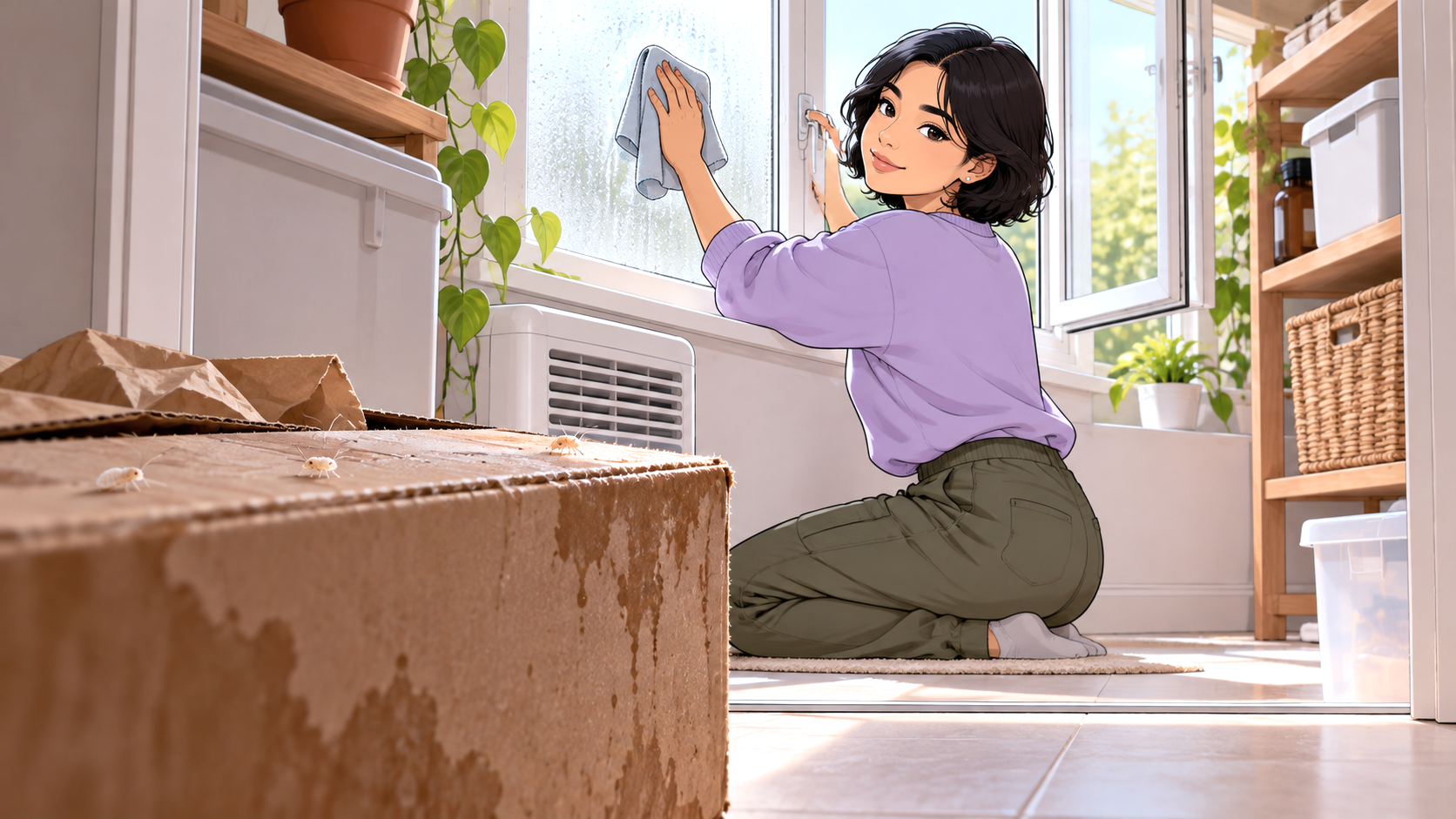
Booklice can go away without insecticide when the conditions supporting them disappear on their own. A temporary population in a drying new building or seasonally humid room may decline as moisture falls. If a leak, damp wall void, wet cardboard, condensation, or another humid microhabitat remains, however, simply waiting may allow the population to continue.
Waiting Only Works if the Habitat Is Changing
A booklice infestation does not have a built-in expiration date. Adults eventually die, but surviving nymphs mature and females continue producing eggs when temperature, humidity, and food remain favorable. Stored-product psocids generally require high humidity for successful breeding, so whether a population fades depends much more on the habitat than on the lifespan of any individual insect.
A damp basement that stays damp can therefore support successive generations rather than simply running out of booklice. The booklice life cycle allows new insects to replace older ones as long as conditions permit development. Waiting becomes effective only when something else changes, such as seasonal drying, completion of construction drying, improved ventilation, or the disappearance of a temporary moisture source.
New Homes Are One Situation Where Numbers May Decline Naturally
Some of the clearest temporary infestations occur in recently constructed buildings. Plaster, joint compound, concrete, drywall, and framing can retain substantial moisture during and after construction. Booklice may become abundant while those materials support fungal growth, even though the finished rooms appear normal. Clemson notes that large booklice populations can develop in newly constructed buildings containing moisture-rich plaster and drywall.
As the structure gradually loses construction moisture, the fungal food supply diminishes and conditions become less suitable for psocids. A population associated exclusively with that temporary moisture can therefore fall without pesticide treatment. The reason booklice sometimes appear in newly built homes also explains why some outbreaks eventually resolve after the building dries.
That outcome should not be assumed when one section of a new house remains persistently wet. Penn State notes that moisture trapped inside wall voids may require additional drying measures, so continued activity around the same wall can indicate that natural drying has stalled.
Seasonal Booklice Can Seem to Vanish Suddenly
Indoor psocids are commonly noticed during warm, humid periods. Minnesota reports that people often encounter them during summer and that they occupy warm, damp, undisturbed places where molds and fungi grow. A house that becomes substantially drier when outdoor humidity changes or heating begins may therefore stop supporting the same population.
The insects may appear to have disappeared spontaneously even though the environmental shift actually caused the decline. Seasonal disappearance also does not establish that every hidden insect died at exactly the same time. Numbers can fall progressively until sightings become rare enough that the population is no longer noticeable.
A recurrence during another humid period suggests that the building still contains a location capable of becoming suitable again. Long-term prevention of returning booklice depends on whether that recurring moisture can be avoided.
Dry Air Can Kill Booklice Before Lack of Food Does
Booklice are unusually dependent on atmospheric moisture. Minnesota states that psocids do not survive when relative humidity remains below approximately 45% to 50%, while Clemson notes that prolonged low humidity can kill them within weeks. Canadian conservation guidance explains that Liposcelis booklice can draw on internal water reserves temporarily but may survive dry air for only about three weeks before continued exposure becomes fatal.
There is no universal countdown because temperature, species, life stage, exact humidity, and humid hiding places all affect survival. A room hygrometer reading 45% does not guarantee that cardboard beneath a leaking pipe or the interior of a damp wall is equally dry. The physiological dependence behind why booklice need humidity operates at the microhabitat where the insects are actually living.
This also explains why booklice can sometimes persist longer than expected after visible mold or food has been removed. Drying their habitat can become lethal even before starvation would eliminate them.
A Persistent Leak Can Keep the Population Going Indefinitely
Booklice around a plumbing leak, sweating pipe, damp crawlspace, roof intrusion, or condensation problem are unlikely to disappear permanently while that source continues. Utah State lists psocids around leaking pipes, damp books, voids, cardboard boxes, and other locations that support mold. Each of those sites can maintain a localized pocket of moisture even when the rest of the room feels dry.
The insects also consume mold and other microscopic fungal material, so persistent dampness maintains both a physiological requirement and part of their food supply. Killing visible adults without changing that environment merely removes a fraction of the population.
Repeated activity in the same location is consequently more informative than an occasional wandering specimen. The signs of an established booklice infestation are especially relevant when adults and nymphs keep appearing over an extended period.
Small Numbers May Not Require Any Treatment
A few booklice do not automatically justify intervention. Minnesota specifically recommends that small numbers of household psocids can simply be ignored or physically removed, including by vacuuming. They are nuisance insects rather than pests that ordinarily threaten people or the structure.
Occasional individuals may have wandered indoors, arrived with a box or book, or emerged from a location that has already begun drying. If sightings steadily decline and there is no evidence of persistent dampness, continued observation can be reasonable.
A growing number of insects tells a different story. Increasing activity, repeated nymphs, or sightings spreading through damp areas suggest that reproduction is continuing rather than the population dying out.
Disappearance After Drying Is Different From Hiding
Booklice are small enough to occupy cracks, wall voids, bindings, packaging seams, and other protected spaces, so failure to see them for several days does not prove the population is gone. The more convincing pattern is a sustained absence after the environment has become unsuitable.
Their usual hiding places around damp materials and narrow crevices can remain more humid than exposed room surfaces. If insects vanish from a windowsill but continue emerging from the baseboard beside it, activity has shifted rather than ended.
A genuine decline generally follows the loss of conditions needed for survival and reproduction. Penn State recommends correcting the underlying water issue because moisture control is normally more effective than pesticides for household booklice.
Questions About Booklice Disappearing on Their Own
How long does it take booklice to disappear after a room dries?
There is no fixed household timeframe. Under sufficiently dry conditions, mortality can occur over days to several weeks depending on humidity, species, life stage, temperature, and whether protected damp pockets remain.
Will booklice disappear in winter?
They may decline when indoor conditions become substantially drier, but winter alone does not guarantee elimination. A humid basement, leak, bathroom, or other damp microhabitat can remain suitable throughout the year.
Can booklice come back after disappearing?
Yes. A new moisture problem or return of high humidity can recreate suitable conditions, and new insects can also be introduced with belongings or stored products.
Will mold removal make booklice disappear automatically?
Not necessarily. Other fungal material may remain, and booklice themselves still need time to die after conditions change. Mold can also return if the underlying moisture source remains.
Should you wait before doing anything about a few booklice?
A few isolated insects in an otherwise dry home can reasonably be monitored. Continued or increasing sightings deserve investigation for moisture rather than indefinite waiting.
Can booklice disappear without using pesticides?
Yes. Household infestations commonly respond to sustained drying, and insecticides are normally unnecessary when the environmental source is corrected. The broader methods for getting rid of booklice focus primarily on making the habitat unsuitable rather than relying on chemical treatment.
When should you stop waiting for them to go away?
If numbers remain stable or increase, nymphs continue appearing, or activity stays concentrated around a persistently damp area, the population is still being supported. At that point, identifying and correcting the moisture source is more useful than assuming time alone will solve it.