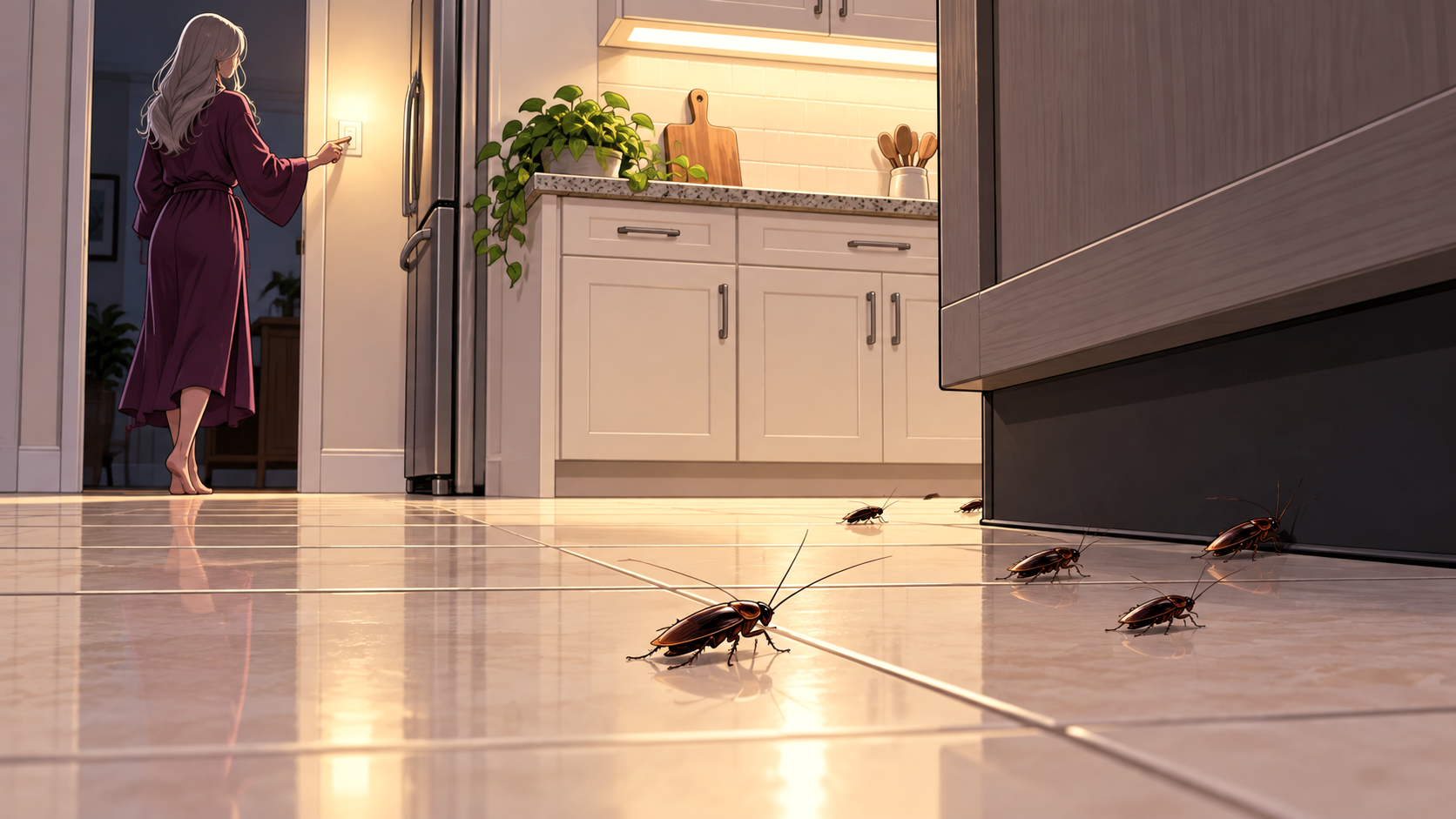
Not all cockroaches react to light the same way. Most common indoor cockroaches avoid bright light, but certain outdoor species are attracted to illuminated windows, porch lights, and other artificial light sources. German cockroaches generally retreat toward darkness, while Asian cockroaches and male wood cockroaches may approach lights or enter buildings through illuminated openings.
A cockroach appearing beside a lamp does not necessarily mean the light attracted it. The insect could already have been nearby, entered through a window, or become visible when the room was illuminated. Its species and behavior offer better clues than the location alone.
Which Cockroaches Are Attracted to Light?
Light responses vary considerably among cockroach species, and even individuals of the same species may behave differently depending on their surroundings.
| Cockroach species | Typical response to light | What you might observe |
|---|---|---|
| German cockroach | Generally avoids illumination | Runs toward cover when a light is switched on |
| American cockroach | Usually avoids direct illumination | Retreats from bright light or exposed surfaces |
| Oriental cockroach | Generally prefers darkness | Remains concealed rather than approaching lamps |
| Brown-banded cockroach | Generally avoids bright exposure | Occupies protected areas away from direct illumination |
| Asian cockroach | Strongly attracted to artificial lights | Approaches lamps, windows, and illuminated walls |
| Pennsylvania wood cockroach | Adult males are attracted to lights | Appears around porch lights during seasonal flights |
| Smokybrown cockroach | May approach outdoor lighting | Appears near illuminated building exteriors |
The University of Florida’s public-health pest management manual describes negative phototaxis, movement away from light, as common among cockroaches. However, this general tendency does not apply equally to every species.
An insect flying repeatedly toward an illuminated window therefore deserves a different interpretation from one running beneath a refrigerator when the kitchen light comes on.
Asian Cockroaches Actively Seek Illuminated Surfaces
Asian cockroaches (Blattella asahinai) are among the clearest exceptions to the usual light-avoidance behavior of household cockroaches.
These insects normally live outdoors in lawns, mulch, and other vegetated areas. As evening approaches, adults become active and may fly toward illuminated buildings. Their attraction is not limited to porch bulbs; light reflected from pale walls, windows, and doorways can also draw them closer.
According to Texas A&M University’s Asian cockroach research, adults may settle on illuminated lampshades, television screens, and walls after entering a building. They can even move between rooms in response to changes in lighting.
Asian cockroaches closely resemble German cockroaches, including the two dark stripes behind the head. Their behavior can provide a useful clue when appearance alone is inconclusive. A small, tan cockroach actively flying toward a lamp is more consistent with an Asian cockroach than a typical German cockroach.
The University of Florida’s observations of Asian cockroach activity describe insects flying toward bright surfaces around homes, particularly where nearby landscaping supports outdoor populations.
An illuminated room may attract these cockroaches from outside without being their primary living environment.
Why Do German Cockroaches Run Away When You Turn on the Light?
German cockroaches (Blattella germanica) generally avoid exposed, brightly illuminated environments. Their response involves both sensitivity to light and a tendency to seek physical shelter.
Laboratory research published in the Journal of Insect Physiology found that constant illumination suppressed German cockroach movement. The experiment also demonstrated that different wavelengths of light affected their activity rhythms differently.
A separate study published in the Journal of Economic Entomology examined German cockroach movement under different lighting conditions. Fluorescent light reduced the proportion of time adult males spent moving, although movement speed and responses differed according to sex and experimental conditions.
These findings suggest a more complicated response than simply treating all light as an immediate threat. Sudden illumination may coincide with other disturbances, including human movement, vibration, and changes in the surrounding environment.
A German cockroach that disappears when a kitchen light comes on is exhibiting familiar avoidance behavior. However, leaving a lamp switched on continuously does not guarantee that nearby cockroaches will remain hidden or stop moving when they need resources.
American Cockroaches Can Detect and Avoid Different Light Wavelengths
American cockroaches (Periplaneta americana) have been used in experiments investigating how insects respond to illumination.
A study published in the Journal of Insect Physiology measured American cockroach avoidance of monochromatic light. The researchers found that avoidance depended on both light intensity and wavelength, with different parts of the spectrum producing stronger responses under different conditions.
This means that cockroach light avoidance is not governed solely by whether a lamp is visibly bright to a human observer. The insect’s visual system detects light differently, and its response changes with the characteristics of the illumination.
Nevertheless, color alone does not establish whether a particular light will attract or repel every cockroach species. Evidence from American cockroach avoidance experiments cannot automatically be applied to light-attracted Asian cockroaches.
Why Do Wood Cockroaches Appear Around Porch Lights?
Adult male wood cockroaches, particularly members of the genus Parcoblatta, are frequently encountered around outdoor lighting during their seasonal activity.
The Penn State Extension wood cockroach guide explains that males can fly and are sometimes attracted to porch lights, especially around wooded properties. Females have reduced wings in some species and are less frequently encountered flying toward buildings.
A male may reach an illuminated doorway, land nearby, and subsequently crawl indoors through a gap. Someone discovering it on the floor may assume it originated inside the house, even though it was attracted from an outdoor habitat.
Wood cockroaches generally do not establish persistent indoor populations. Consequently, repeated arrivals around a porch light may reflect ongoing outdoor flight activity rather than reproduction inside the building.
The differences between male and female cockroaches can help explain why most light-attracted wood cockroaches encountered near homes are males.
Does Leaving the Lights On Keep Cockroaches Away?
Keeping a room illuminated may discourage some light-avoiding cockroaches from moving into exposed spaces, but it is not a dependable way to prevent cockroach activity or eliminate an infestation.
Light cannot remove a population sheltered inside cabinets, behind appliances, or within structural gaps. Insects may remain concealed while illumination is present and move when conditions become more favorable.
The concentrated activity associated with cockroach harborages also means that many individuals can remain present without being visible on illuminated surfaces.
For light-attracted outdoor species, leaving lights on can have the opposite effect. A bright porch lamp may draw Asian or male wood cockroaches toward an entrance, particularly when nearby vegetation supports their populations.
Lighting is therefore an unreliable general-purpose deterrent because species respond differently.
Can Changing Outdoor Lighting Reduce Cockroach Visitors?
Reducing unnecessary exterior lighting can help limit encounters with cockroaches that approach artificial light. The effect is most relevant to outdoor species rather than established indoor populations.
For wood cockroaches, Penn State Extension recommends turning off unnecessary lights during periods when adult males are flying. For Asian cockroaches, the University of Florida recommends considering less attractive outdoor lighting, including yellow incandescent bulbs or sodium-vapor lighting.
Changing lighting may reduce attraction, but it does not create a barrier that prevents every insect from approaching. Results depend on the cockroach species, available lighting alternatives, and environmental conditions.
A brightly illuminated doorway also provides a potential entrance when the door is open. The routes cockroaches use to enter buildings remain relevant even if the insects were initially drawn toward the property by light.
Outdoor lighting changes should therefore be understood as a way to reduce some encounters, not as proof that cockroaches cannot enter.
Does Seeing a Cockroach Near a Light Mean It Came From Outside?
A cockroach near an illuminated window may have arrived from outdoors, but the light alone cannot establish its origin.
A small cockroach actively flying around a lamp could be an Asian cockroach, particularly in a region where the species occurs. A larger insect arriving at a porch light from nearby woodland might be a male wood cockroach. Both situations differ from discovering a German cockroach walking across an illuminated kitchen counter.
An insect already living indoors may also cross a bright surface when disturbed or searching for resources. Its presence in the light does not establish that it prefers illumination.
Repeated observations provide more context. Cockroaches consistently approaching windows from outside suggest a different source than individuals repeatedly emerging from the same interior crack. The location and frequency of cockroach sightings can reveal whether activity is concentrated around an indoor refuge.
A photograph showing the insect’s body, wings, and markings is particularly useful when behavior suggests an outdoor species. Light attraction is a valuable identification clue, but it should support identification rather than replace it.