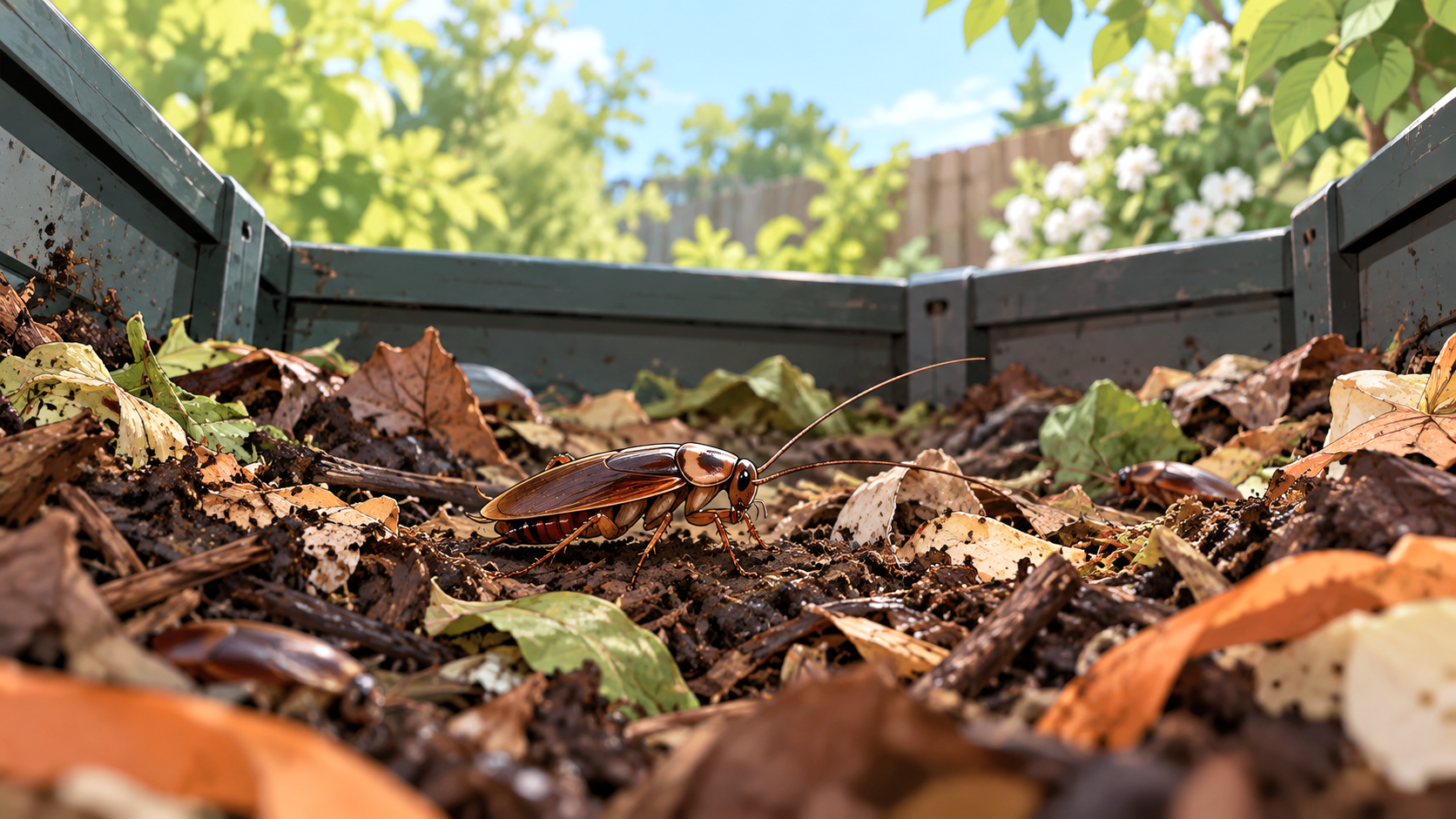
Finding cockroaches beneath the lid of a compost bin can be unsettling, especially when dozens scatter as you turn the pile. However, their presence does not automatically indicate a composting failure or a household infestation. Decomposing vegetation provides food and shelter for numerous organisms, including some cockroach species.
Cockroaches in compost are usually not a serious problem when they remain outdoors and the compost is properly managed. Many feed on decaying plant material and participate in the breakdown process. Concern becomes more justified when large numbers gather near the house, enter through nearby openings, or appear alongside persistent moisture and exposed food waste.
The appropriate response is usually to adjust the composting conditions rather than attempt to kill every insect in the pile.
Which Cockroaches Live in Compost?
Not every cockroach found in compost is a household pest. The species encountered depends on the local climate, surrounding vegetation, and materials inside the bin.
Wood cockroaches, including Parcoblatta species found in North America, naturally inhabit leaf litter, decaying logs, and other outdoor organic material. They may enter compost because it resembles their normal environment. According to Penn State Extension’s research-based account of wood cockroaches, these insects feed on decomposing vegetation and generally fail to survive or reproduce inside ordinary homes.
Oriental cockroaches (Blatta orientalis) can also occur around composting areas, particularly where damp material accumulates near the ground. Their preference for moist leaf litter, mulch, and decaying organic matter makes them plausible occupants of outdoor compost piles.
American and other outdoor-associated cockroaches may investigate similar conditions in suitable climates. However, finding a brown insect in compost does not establish its species. Some beetles and other decomposer insects can resemble cockroaches at a glance.
The different cockroach species associated with homes and outdoor habitats should be identified before assuming that insects in a garden bin represent an indoor pest population.
Are Cockroaches Helping the Compost Break Down?
Cockroaches that feed on decaying organic matter can contribute to compost decomposition. By chewing plant fragments, they reduce some material into smaller particles, making it more accessible to microorganisms.
They are not the primary organisms responsible for compost production. Bacteria and fungi perform much of the biochemical decomposition, assisted by earthworms and other invertebrates.
The University of Maryland’s composting guidance explains that larger decomposer organisms fragment coarse organic material, increasing the surface area available for microbial activity.
New Mexico State University specifically addresses cockroaches in compost, explaining that these insects may participate in decomposition without necessarily creating a problem for nearby homes. Its horticultural guidance on cockroaches in compost piles recommends considering their location and the surrounding conditions before attempting control.
A few cockroaches therefore do not mean the pile is dirty in a way that prevents composting. Their presence may simply reflect the insect community occupying the material.
The broader ecological functions of wild cockroaches include processing decaying vegetation, but compost does not depend on cockroaches being present to break down successfully.
Why Some Compost Bins Attract Large Numbers
A neglected compost pile can develop sheltered pockets containing moist food scraps, partially decomposed vegetation, and relatively stable temperatures. These conditions may be suitable for cockroaches already living nearby.
The insects are not necessarily attracted to an unpleasant smell. They may occupy the lower and outer portions of a pile because those areas provide protective spaces among the material.
Compost conditions vary considerably. A freshly turned, well-aerated pile with balanced ingredients differs from a compacted mass of wet vegetable scraps. The latter can create persistent moisture and expose food waste at the surface.
The EPA’s composting guidance recommends using approximately two to three parts dry, carbon-rich material to one part nitrogen-rich material by volume, covering fresh food scraps, and maintaining moisture comparable to a wrung-out sponge.
Cockroach populations are also influenced by the surrounding environment. A compost bin in a warm region with abundant outdoor cockroaches is more likely to receive visitors than an identical bin in a colder area with few resident populations.
Their presence does not provide a dependable measurement of compost quality or temperature.
When Cockroaches in Compost Become a Household Concern
The location of the bin matters more than the mere presence of insects.
A few wood cockroaches in a compost pile at the far end of the garden are unlikely to justify pest treatment. Repeated cockroach sightings around doors, windows, or the house foundation deserve closer examination, particularly when the compost sits directly against the building.
New Mexico State University’s compost guidance explains that a compost pile may support cockroaches without causing problems when it is sufficiently separated from the house. Cockroach activity near an entrance, however, warrants attention to the route insects could use.
Consider the following differences:
| What you observe | Likely significance |
|---|---|
| A few cockroaches beneath decomposing leaves | Normal outdoor insect activity may be involved |
| Numerous cockroaches in wet, compacted compost | The pile may provide favorable shelter and moisture |
| Cockroaches gathering around the bin and a nearby exterior door | Potential movement between the compost area and the building |
| Small cockroaches repeatedly appearing inside the kitchen | Investigate the indoor population rather than assuming the compost is responsible |
| Cockroaches appearing only when the pile is turned | Disturbance is exposing insects that were sheltered in the material |
A cockroach seen near both the compost bin and the house does not prove that the bin is its original source. Insects may already occupy mulch, drainage structures, or other nearby refuges.
The distances cockroaches travel while searching for resources can make several nearby outdoor shelters part of the same activity area. An established indoor German cockroach population, meanwhile, may have little relationship to the compost pile.
Adjust the Compost Without Destroying the Decomposer Community
Compost management provides a way to reduce conditions favorable to nuisance cockroaches while preserving the organisms needed for decomposition.
Bury fresh fruit and vegetable scraps beneath a substantial layer of existing compost or dry brown material. Avoid leaving newly added scraps exposed on top, where insects can reach them easily.
Oregon State University’s composting troubleshooting guidance identifies exposed food waste as a common reason insects gather around compost bins. Covering scraps with browns is an appropriate corrective measure.
If the pile is soggy or produces a strong, unpleasant odor, incorporate dry leaves, shredded untreated cardboard, or small wood chips. Turn the material to improve airflow, taking care not to compact it again immediately afterward.
The EPA’s explanation of compost feedstocks and aeration describes how excessive moisture and inadequate oxygen can interfere with decomposition. A pile that is too dry also performs poorly, so removing all moisture is not the objective.
Avoid adding meat, fish, dairy products, grease, and large quantities of cooked food to an ordinary backyard compost system. These materials can attract unwanted animals and complicate household composting.
Regularly checking moisture and covering fresh scraps is generally more useful than repeatedly disturbing a healthy pile solely because insects are present.
Would a Closed Compost Bin Keep Cockroaches Out?
A properly fitted lid and well-maintained container can reduce insect access, although ordinary compost bins are not necessarily cockroach-proof.
Cockroaches can exploit openings around lids, ventilation holes, poorly fitting panels, and gaps at ground level. Small nymphs may pass through openings that appear insignificant.
For gardeners who repeatedly encounter nuisance cockroaches, an enclosed tumbler or a more securely constructed bin may be preferable to an open pile. However, the container must still provide sufficient ventilation and allow excess moisture to drain.
The EPA recommends secure lids and limiting openings in compost bins, particularly to discourage unwanted animals. Its general advice includes preventing gaps larger than one-quarter inch, although that opening size should not be interpreted as a guarantee against small cockroaches.
Positioning the bin away from doors and foundation walls also helps reduce opportunities for insects associated with compost to enter the house. There is no universal minimum distance that guarantees exclusion, but separating the pile from building entrances and maintaining a clear, inspectable space around it is sensible.
The conditions that allow cockroaches to enter clean homes include structural openings that compost management alone cannot correct.
Should You Spray Insecticide Into Your Compost?
Routine pesticide treatment inside an active compost pile is not recommended.
Compost contains microorganisms and invertebrates involved in breaking down organic matter. Applying insecticides indiscriminately may harm organisms that are not creating a problem.
Many household cockroach sprays are not labeled for application to compost intended for garden use. Applying them directly to decomposing material can also introduce unnecessary chemical residues into a product that may eventually be spread around plants.
An Ask Extension response specifically addressing cockroaches in compost advises against routinely treating the pile because doing so can harm beneficial decomposers. The response also notes that eliminating every cockroach from compost may not be practical without disrupting the other organisms present.
Diatomaceous earth is sometimes suggested as a remedy, but it is not selective for cockroaches and can affect other arthropods. Its effectiveness also declines when wet, making it poorly suited to a properly moist compost environment. It should not be assumed safe or appropriate for compost application without checking the specific product label.
If substantial numbers of pest cockroaches are repeatedly entering the home, any necessary treatment should be directed toward confirmed problem locations using appropriately registered products, rather than automatically treating the compost itself.
The EPA’s integrated pest management principles favor monitoring, habitat modification, and targeted interventions over unnecessary broad pesticide applications.
Can You Use Compost That Contains Cockroaches?
Finding cockroaches in a pile does not automatically make the finished compost unsuitable for gardening. The more relevant question is whether the organic material has decomposed adequately and whether the composting process has been managed appropriately.
Finished compost should generally be dark, crumbly, and earthy-smelling, with little recognizable original food material. The EPA’s home-composting instructions recommend allowing compost to finish curing after active decomposition before applying it to the garden.
Cockroaches may leave the material when it becomes less favorable, although finding a few insects during screening is not proof that the compost is unfinished. Remove visible insects if necessary and screen out larger undecomposed pieces before use.
Do not assume that ordinary backyard composting has sterilized the entire pile. Temperature varies between the center and outer layers, and small home systems may not maintain conditions sufficient to destroy every pest, weed seed, or pathogen.
If cockroaches are particularly abundant, allow the compost to mature fully and consider screening it outdoors before transferring it to planting areas near the house.
What if You Want to Compost Without Encouraging Cockroaches?
Gardeners who find outdoor cockroaches especially troublesome can consider changing the composting method rather than abandoning organic waste recycling entirely.
A sealed, properly managed tumbler may reduce access compared with an open heap. Another option is producing leaf mold primarily from fallen leaves, which decomposes more slowly and does not require frequent additions of kitchen food scraps.
The Ask Extension guidance on compost-associated cockroaches specifically identifies leaf mold as an alternative for people who want to avoid maintaining a conventional food-scrap compost pile in an area with numerous cockroaches.
The best choice depends on whether insects are merely present or are causing a genuine nuisance. A few wood cockroaches in a garden compost bin rarely justify major changes. Persistent populations moving toward the house, particularly where wet food scraps and structural access coincide, deserve adjustments to the bin and its immediate surroundings.