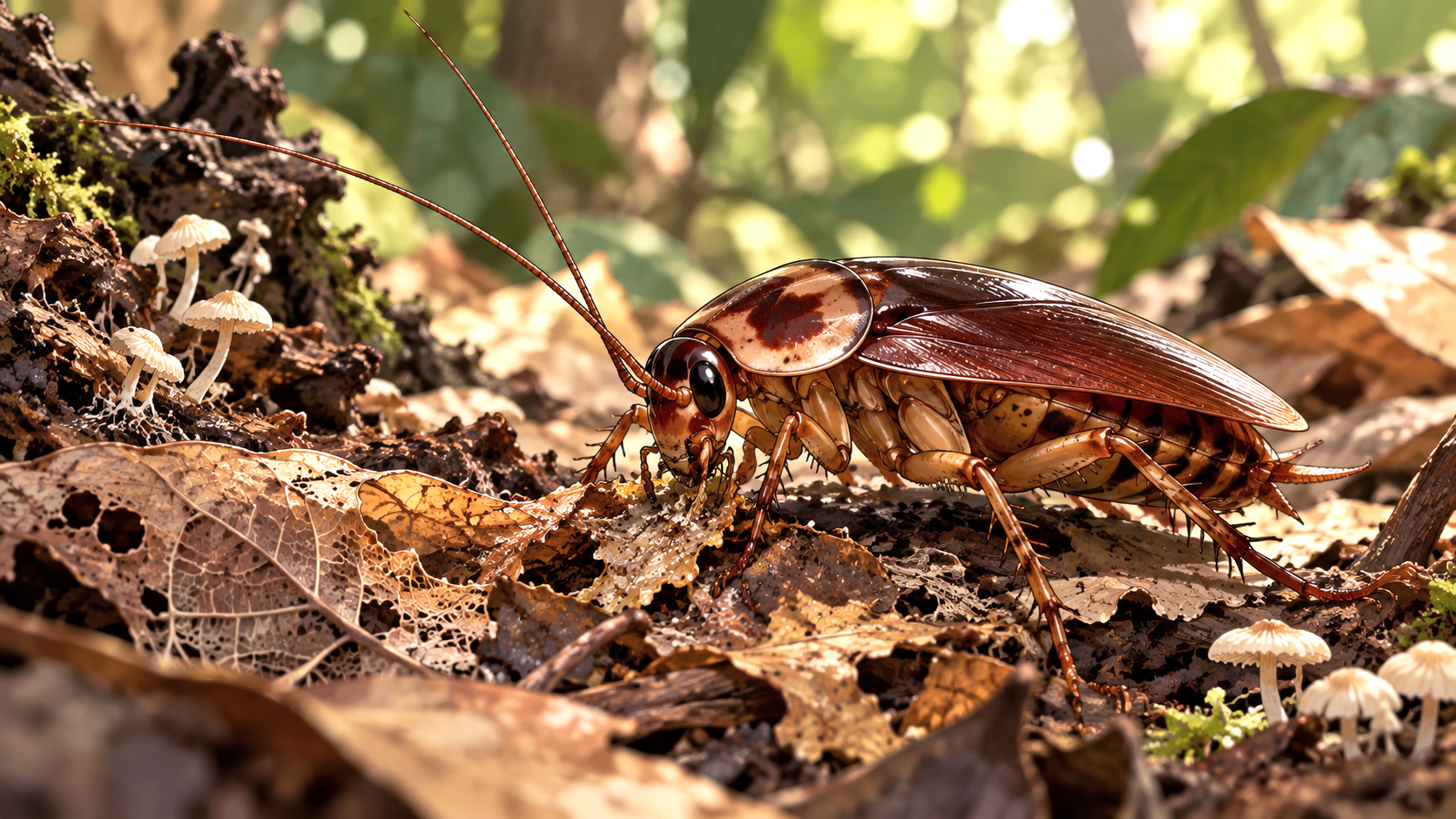
The cockroach that appears beneath a kitchen cabinet is only a tiny part of a much larger group of insects. Thousands of cockroach species inhabit forests, grasslands, caves, and other natural environments, where many help process dead organic material, support nutrient cycling, and provide food for other animals. A few species even pollinate flowers.
Cockroaches exist as part of natural ecosystems, not specifically as household pests. Their ecological importance comes from the interactions they have with plants, microorganisms, predators, and decaying materials. Although most people associate cockroaches with dirty buildings, the overwhelming majority of species do not depend on human homes.
Most Cockroaches Are Wild Insects, Not Household Pests
Scientists recognize approximately 4,600 species of cockroaches, although the precise total changes as species are described and classifications are revised. Only a small proportion regularly causes problems in human environments.
A Smithsonian overview of cockroach diversity estimated that roughly 30 of approximately 4,500 recognized species were considered pests. The familiar German, American, and Oriental cockroaches represent only a small fraction of the group.
Many wild species spend their lives in habitats that people seldom inspect. Forest-dwelling cockroaches may occupy leaf litter, decomposing logs, spaces beneath bark, or vegetation. Others live in dry environments or have specialized relationships with particular habitats.
The North Carolina State University account of cockroach ecology describes cockroaches as predominantly scavenging or omnivorous insects distributed across tropical, subtropical, and temperate environments.
Their habitats influence their ecological functions. An insect living inside rotting timber interacts with decomposing wood and its microorganisms, while a species occupying vegetation may feed on different resources and encounter different organisms.
The different types of cockroaches found around the world therefore cannot all be assigned the same ecological role. Their contributions depend on where they live and what resources they use.
Cockroaches Help Break Down Dead Organic Material
One of the most widespread ecological functions of wild cockroaches is detritivory, the consumption of dead organic matter.
In forests, fallen leaves, dead plant fragments, and decaying wood accumulate on the ground. Cockroaches living in these environments can consume portions of this material, breaking it into smaller particles as it passes through their digestive systems.
This contributes to decomposition alongside the activities of fungi, bacteria, earthworms, millipedes, and numerous other organisms.
The scientific review of arthropod–microorganism relationships in ecosystems identifies wild cockroaches as ecologically relevant detritivores while emphasizing that their contribution remains understudied compared with that of pest species.
Cockroaches do not independently transform all dead plant material into fertile soil. Fungi and bacteria perform much of the biochemical breakdown, and different decomposer organisms act on different materials.
By consuming and fragmenting organic matter, cockroaches participate in this broader process. Their waste also returns processed organic material to the environment, where microorganisms can continue decomposition.
These activities contribute to the movement of carbon and nutrients through terrestrial food webs, although their importance varies between habitats.
Wood-Eating Cockroaches Work With Microorganisms
Some wild cockroaches have unusually close relationships with microorganisms that allow them to use difficult-to-digest materials.
Wood-feeding cockroaches in the genus Cryptocercus inhabit decaying logs and feed on wood containing cellulose and other complex plant compounds. Their digestive systems contain communities of protists and bacteria that help break down these materials.
Research on microorganisms shared by wood-feeding cockroaches and termites demonstrates how specialized intestinal symbionts participate in cellulose digestion.
The relationship is especially important because wood contains abundant carbon but relatively little nitrogen. Animals relying heavily on wood must obtain enough nitrogen to build proteins and other essential molecules.
A 2016 study published in Applied and Environmental Microbiology found that bacteria associated with gut protists in Cryptocercus punctulatus possessed genes for nitrogen fixation. Researchers also obtained experimental evidence that these microorganisms could incorporate atmospheric nitrogen.
The investigation of nitrogen-fixing bacteria in wood-feeding cockroaches demonstrates how several organisms cooperate within the cockroach’s digestive system.
These microbial partnerships allow cockroaches to exploit resources that would otherwise be nutritionally difficult to use. Their contribution to decomposition therefore involves both the insects and the microorganisms living inside them.
Cockroaches Participate in Nutrient Cycling
Decomposition and nutrient recycling are related, but they are not identical. Breaking down dead material changes its physical and chemical form; nutrient cycling concerns how elements such as nitrogen move between organisms and their environment.
Cockroaches contribute to these processes through feeding, digestion, waste production, and their relationships with microorganisms.
Many species also contain internal bacterial symbionts called Blattabacterium, which help them make use of limited nitrogen supplies. A study published in Proceedings of the National Academy of Sciences demonstrated that Blattabacterium can recycle nitrogen from urea and ammonia into compounds useful to its cockroach host.
This is primarily an internal nutritional process, not direct fertilization of the surrounding soil. Nevertheless, it helps explain how certain cockroaches can survive on nutritionally poor resources and participate in food webs based on decomposing vegetation.
The ecological contribution is not restricted to nitrogen. Carbon incorporated into cockroach tissues may subsequently pass to predators, while organic residues and waste reenter decomposer pathways.
The actual rate at which cockroaches contribute to nutrient cycling remains poorly quantified across natural environments. It would be inaccurate to claim that cockroaches alone are responsible for maintaining soil fertility or that every species contributes equally.
Some Cockroaches Pollinate Flowers
Pollination is a less familiar ecological function of cockroaches, but it has been demonstrated in scientific investigations.
In a lowland tropical forest in Sarawak, Malaysia, researchers studied Uvaria elmeri, a woody climbing plant whose flowers attract insects with an odor resembling decaying wood or mushrooms.
Cockroaches visited the flowers at night, feeding on floral secretions and pollen. They contacted the reproductive structures and transferred pollen between flowers. The 1997 study published in the American Journal of Botany identified cockroaches as the principal pollinators, with fruit flies providing a secondary contribution.
Another investigation in French Guiana documented cockroach pollination of Clusia aff. sellowiana, a plant growing on exposed rocky habitats called inselbergs.
The cockroach Amazonina platystylata visited both male and female flowers, and researchers found pollen grains attached to its body. Their study of pollination in Clusia identified the cockroach as an important pollinator at the investigated site.
These relationships show that cockroaches can provide ecological services beyond decomposition. However, flower pollination is not a demonstrated major activity of most cockroach species, and it should not be generalized to common household pests.
Cockroaches Transfer Energy Through Food Webs
Wild cockroaches also serve as prey. Nutrients and energy incorporated into their bodies become available to animals that capture and consume them.
Their predators include various insect-eating reptiles, amphibians, birds, mammals, and arthropods. The precise relationships depend on habitat, predator size, and which cockroach species are locally available.
A forest-floor cockroach feeding on decomposing vegetation, for example, can transfer energy from a detritus-based food web to a hunting spider or lizard. Its contribution is therefore not limited to the material it consumes.
The natural predators that eat cockroaches include both opportunistic hunters and species with more specialized relationships. Cockroach eggs and immature stages can also become resources for other organisms.
These interactions help connect decomposer communities with higher levels of the food web.
However, being eaten does not make cockroaches uniquely indispensable to every predator. Many animals consume several prey types, and the importance of cockroaches to a particular predator’s diet varies with local conditions.
Why Household Cockroaches Are Different From Beneficial Wild Species
The ecological contributions of wild cockroaches do not mean that cockroaches should be tolerated in kitchens, hospitals, or other occupied buildings.
German cockroaches, for example, can establish indoor populations that contaminate surfaces and contribute to allergen exposure. Their presence in a dwelling is not equivalent to a wood-feeding cockroach participating in forest decomposition.
The EPA’s guidance on cockroach-related indoor contaminants identifies cockroach droppings and body materials as sources of allergens that may affect susceptible individuals.
Moreover, an insect being part of a natural food web does not make its presence beneficial in every setting. The same general biological activities that allow cockroaches to exploit organic materials outdoors can become undesirable when they occur around human food and household waste. The different materials cockroaches consume help explain their adaptability, but their feeding habits must be understood in the context of the environment they occupy.
Similarly, the social grouping behavior of some household cockroaches can support concentrated indoor populations without providing a corresponding household benefit.
Protecting wild cockroach diversity and managing indoor cockroach infestations are therefore compatible goals. One concerns natural organisms performing ecological functions in appropriate habitats; the other concerns preventing pest populations from occupying spaces where they create health and sanitation problems.
2 thoughts on “Why Do Cockroaches Exist?”