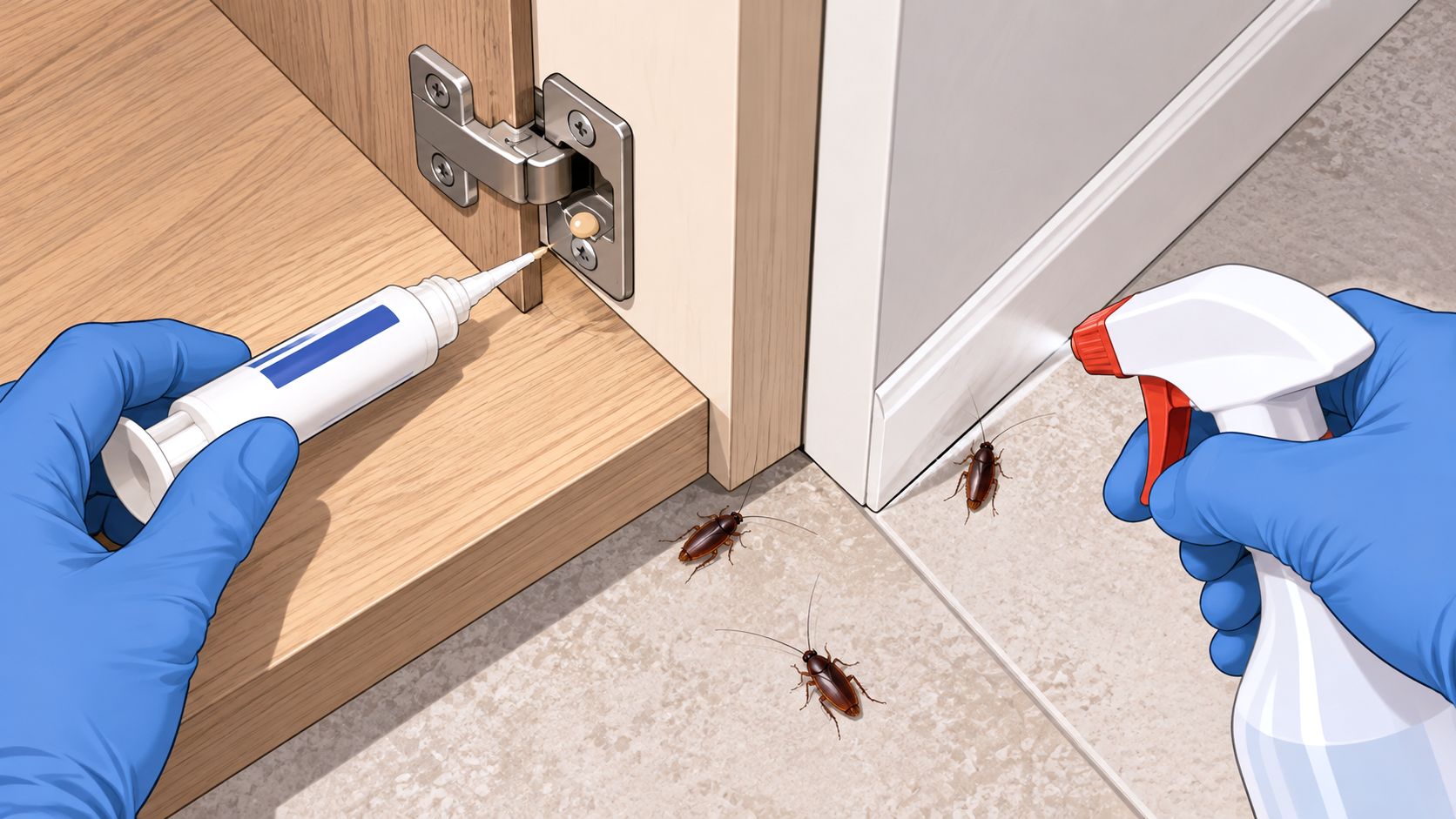
A cockroach spray can knock down an exposed insect within minutes, while gel bait may take hours or days to produce visible results. That makes sprays seem more powerful at first, but the fastest product is not necessarily the one that produces the greatest reduction in an infestation.
Gel bait is generally the better first choice for an established indoor German cockroach infestation. Sprays are more appropriate for specific contact or residual treatments where their labels permit use. Gel depends on cockroaches feeding on an insecticidal formulation, whereas sprays typically expose insects through direct contact or residues left on treated surfaces.
The choice affects more than killing speed. It determines where pesticide remains, whether cockroaches are likely to encounter it, how much exposed surface is treated, and whether two products can be used together without interfering with one another.
Gel Bait vs Spray: Which Performs Better?
A field study comparing cockroach gels with aerosol insecticides found substantial differences in both the speed and durability of control. Researchers tested fipronil and imidacloprid gels against propoxur and pyrethroid sprays in infested homes and catering establishments.
The study published in the Journal of Vector Borne Diseases reported that propoxur spray reduced cockroach numbers more quickly during the first week, but its effectiveness subsequently declined. After 12 weeks, fipronil gel achieved a 96.8% reduction and imidacloprid gel achieved 90.9%, compared with 77.5% for propoxur. The tested pyrethroid aerosol did not produce the desired reduction.
These results favor the tested gels under those particular conditions, but they do not establish that every gel outperforms every spray. Active ingredients, application methods, cockroach susceptibility, and treatment conditions influence outcomes.
| Feature | Cockroach gel bait | Cockroach spray |
|---|---|---|
| How insects are exposed | Primarily through feeding on bait | Direct contact or contact with treated residues |
| Initial results | Often delayed | Can produce rapid knockdown |
| Established indoor infestations | Usually preferable when bait is accepted | Performance varies considerably by formulation |
| Residual activity | Continues while bait remains attractive and effective | Depends on the active ingredient, treated surface, and environmental conditions |
| Cockroach avoidance | Formulated to encourage feeding | Some ingredients are repellent |
| Exposure concerns | Accessible pesticide deposits, accidental ingestion | Spray drift, inhalation, treated surfaces |
| Most useful role | Reducing populations in occupied indoor spaces | Specific labeled contact, residual, or perimeter applications |
The EPA’s household pest-control recommendations favor targeted pesticide applications and appropriately placed baits over unnecessary widespread spraying.
Why Gel Bait Can Outperform Faster-Acting Sprays
A gel bait contains insecticide mixed into an edible formulation designed to encourage cockroaches to feed. Once an insect consumes a sufficient dose, the active ingredient begins taking effect. The resulting delay varies among formulations and is not necessarily evidence of poor performance.
Some gels also produce secondary mortality when unexposed cockroaches encounter contaminated feces, regurgitated material, or carcasses. The extent of this effect depends on the active ingredient and conditions; it should not be interpreted as a guarantee that one poisoned cockroach will eliminate an entire population.
A 2014 laboratory and field study of indoxacarb gel found substantial reductions in German and American cockroach populations after treatment. In the studied homes, reductions became more pronounced over the following two weeks rather than appearing immediately.
Gel formulations differ in food ingredients and insecticides, so the choice among cockroach gel baits should account for the target species and active ingredient rather than brand recognition alone.
Sprays face a different limitation: the chemical must reach the insect directly or remain on a surface it subsequently contacts. A cockroach that avoids treated areas or remains within an untreated crevice may receive little exposure.
The concealed daytime locations occupied by cockroaches make reliance on exposed surface spraying particularly unreliable against established indoor populations.
When a Cockroach Spray Makes More Sense
Sprays are not all interchangeable. Their formulation and intended use determine whether they are suitable for an isolated insect, a protected structural opening, or an outdoor entry point.
A contact aerosol may be useful when a visible cockroach must be dealt with immediately and a suitable product is available. Residual sprays are intended to leave insecticide deposits that can affect insects later, provided the treated surface and application comply with the label. Some professional flushing products deliberately disturb concealed insects, but that activity does not necessarily kill every insect driven from shelter.
Sprays may also be appropriate against outdoor-associated cockroaches entering around particular building openings. An American or Oriental cockroach wandering indoors is not necessarily evidence of the same type of infestation as numerous German cockroach nymphs developing inside a kitchen.
The differences between household cockroach species therefore influence whether indoor baiting or a specific labeled surface treatment is the more relevant option. For outdoor populations, cockroach activity around a property’s exterior may require an approach different from treating insects inside occupied rooms.
Sprays containing pyrethroids can also encounter resistant populations. The reduced susceptibility of some cockroaches to insecticides is one reason rapid knockdown should not be used as the sole measure of performance.
Can Gel Bait and Spray Be Used Together?
Sometimes, but using both indiscriminately can undermine treatment. Cockroach gels rely on feeding, while some sprays repel insects or alter their movement. Spraying over bait deposits or applying a repellent insecticide across the routes leading to them may reduce the likelihood that cockroaches encounter or consume the gel.
The interaction is not as simple as saying every spray destroys bait effectiveness. A 2005 study of cockroach bait contamination found that certain contaminants reduced consumption or performance, particularly