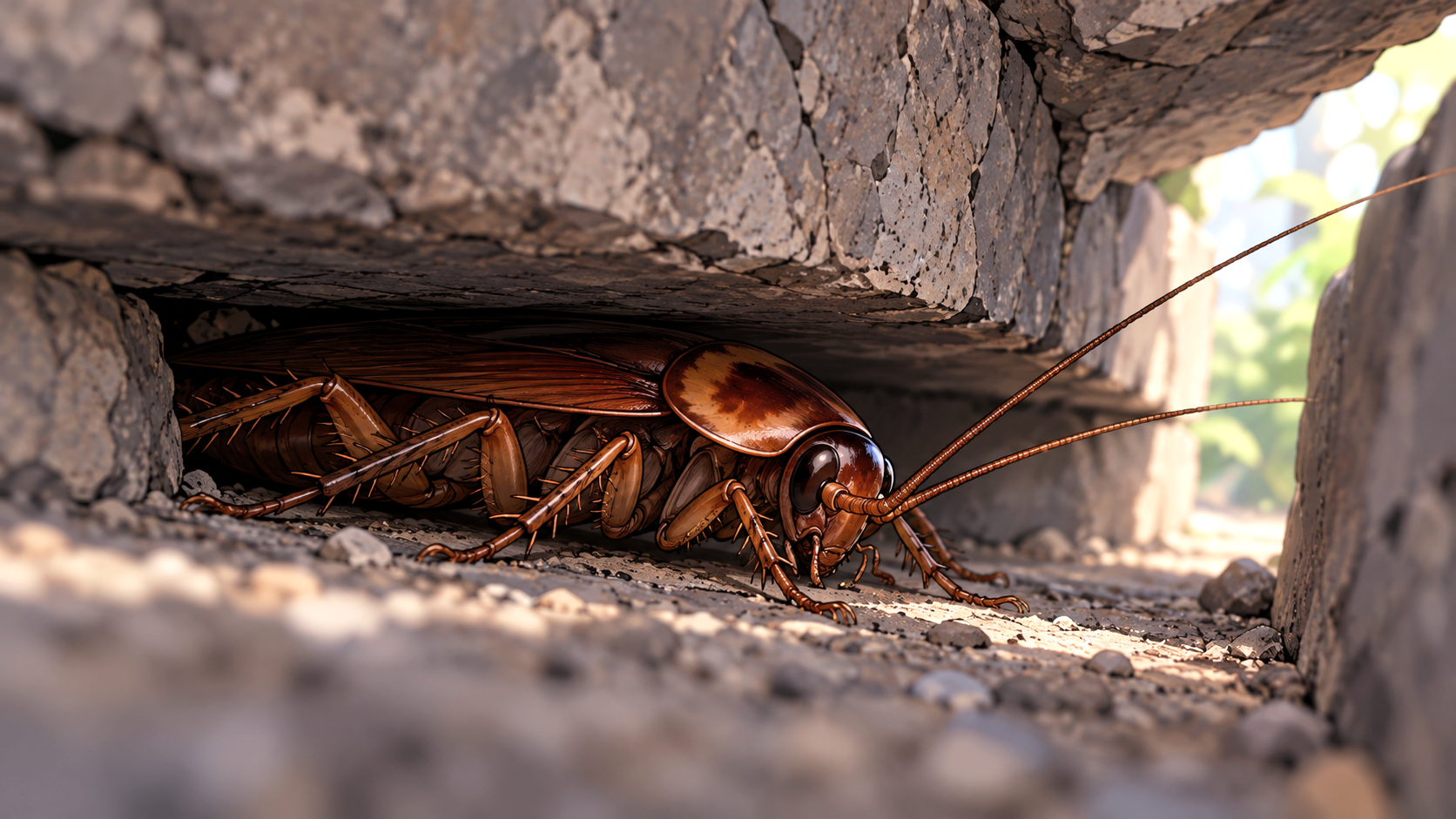
Cockroaches are difficult to eliminate because several survival advantages work together. They can squeeze into extremely narrow spaces, survive periods without food, reproduce quickly, and develop resistance to insecticides. Killing an individual cockroach is often straightforward; eliminating an established population is considerably harder.
German cockroaches present a particular challenge because they live closely alongside humans and have evolved resistance to multiple insecticides. A spray may kill exposed insects while leaving others sheltered in inaccessible spaces. Even a substantial reduction in visible cockroaches does not establish that the surviving population has been eliminated.
Cockroaches Can Survive Insecticides That Previously Killed Them
Insecticide resistance is among the strongest reasons German cockroaches have become difficult to control.
A 2025 scientific review examined 102 studies covering German cockroach populations from 23 countries. Researchers documented resistance involving 60 different insecticidal active ingredients, with particularly severe resistance reported for some pyrethroids.
The review of worldwide German cockroach insecticide resistance identified several mechanisms that allow exposed insects to survive chemicals that would ordinarily be lethal.
Some cockroaches produce greater quantities of detoxification enzymes, including cytochrome P450 monooxygenases, esterases, and glutathione S-transferases. These enzymes can break down or modify insecticides before they reach their intended targets.
Others possess genetic changes affecting the proteins that insecticides are designed to disrupt. Certain populations also exhibit reduced penetration of chemicals through their outer body covering.
These mechanisms can operate together. A cockroach with several resistance traits may tolerate exposure that would kill a susceptible individual of the same species.
Resistance is not universal, however. Different populations can have very different susceptibility profiles, even within the same geographic region.
Resistance Can Extend Across Different Insecticides
Changing products does not always overcome resistance.
In a field study published in Scientific Reports, Purdue University researchers evaluated several insecticide strategies against German cockroaches. They found that some populations developed resistance to chemicals they had not previously encountered, a phenomenon called cross-resistance.
The 2019 investigation of insecticide resistance management also demonstrated that treatments using a single active ingredient could successfully eliminate populations when their initial resistance was low.
Cross-resistance can arise when a biological defense protects against multiple chemicals. For example, enhanced detoxification enzymes may affect more than one insecticide, even when the products have different active ingredients.
Repeated exposure can further favor individuals carrying resistance traits. Susceptible cockroaches die, while survivors reproduce and pass inherited characteristics to subsequent generations.
The resulting population may become progressively harder to control with the same insecticide.
However, a surviving cockroach is not automatically resistant. Inadequate exposure, poor treatment placement, or movement into untreated areas can also explain survival.
Their Bodies Allow Them to Escape Into Extremely Narrow Gaps
A cockroach can avoid an otherwise effective treatment simply by remaining beyond its reach.
American cockroaches have flexible bodies that allow substantial compression without serious injury. Researchers at the University of California, Berkeley, demonstrated that these insects could pass through openings smaller than one-quarter of their normal standing height.
The 2016 study of cockroach body compression found that individuals could tolerate compressive forces approaching 900 times their body weight without injury under experimental conditions.
These measurements help explain their ability to negotiate confined environments. They should not be interpreted as evidence that cockroaches are impossible to crush or that their bodies are immune to mechanical damage.
The practical difficulty lies in exposure. An insect that disappears into a narrow cabinet joint may avoid direct contact with a treatment applied to the surrounding surface.
Cockroaches can also occupy multiple interconnected refuges. The concentrated activity found in cockroach harborages means a treatment may reach the most obvious group while missing insects elsewhere.
Simply spraying every visible surface cannot guarantee that a chemical reaches the spaces where cockroaches spend much of their time.
Some Cockroaches Have Evolved to Reject Poisoned Food
Cockroach resistance is not limited to surviving a toxic chemical after exposure. Some populations have evolved ways to avoid consuming it. Certain German cockroaches possess an inherited trait called glucose aversion. These insects perceive glucose, a sugar normally attractive to cockroaches, as an unpleasant or bitter stimulus.
Researchers demonstrated that changes in taste receptor neurons cause glucose-averse cockroaches to reject glucose-containing food. This adaptation can reduce exposure to poisoned food formulations containing that ingredient.
A 2024 review published in Current Opinion in Insect Science also described how glucose-averse cockroaches can learn to associate particular odors with unpleasant feeding experiences. The research on behavioral resistance to insecticidal baits illustrates how an inherited sensory change can influence subsequent feeding decisions.
Such adaptations do not mean cockroaches recognize all insecticides or understand that a particular substance is poisonous. Their avoidance involves specific sensory responses and learned associations.
An insect that refuses to feed on one formulation may still be susceptible to its active ingredient if exposed through another suitable method. The precise reasons cockroach baits sometimes fail depend on several additional factors beyond physiological resistance.
A Population Can Recover After Many Adults Are Killed
The survival of eggs and immature cockroaches can make a substantial reduction in visible adults temporary.
A female German cockroach can produce multiple egg cases during adulthood, each containing numerous developing eggs. If some reproductive females or viable egg cases survive, additional cockroaches may appear after the initial treatment.
The number of eggs produced by different cockroach species varies considerably, so population recovery cannot be predicted from the number of adults observed.
Eggs also develop within protective capsules called oothecae. Their location and the timing of treatment can limit exposure, particularly when a product does not reliably affect eggs.
The incubation periods of cockroach eggs differ among species and environmental conditions. Consequently, newly emerged nymphs may become visible after many previously exposed adults have died.
Not every insecticide affects every developmental stage equally. A treatment that kills exposed adults may leave viable eggs, while some products act more slowly or influence development rather than immediately killing the insect.
An infestation therefore involves more than the adult cockroaches currently visible. Its persistence depends on which reproductive and immature stages remain alive.
Cockroaches Can Survive Periods of Limited Food
Cockroaches possess physiological adaptations that allow some species to endure extended food shortages, particularly when water remains available.
Their ability to conserve energy and use stored reserves helps them survive temporary deprivation. The duration depends on species, temperature, reproductive condition, and access to moisture.
The survival of cockroaches without food can extend for weeks under certain experimental conditions, although food deprivation eventually impairs survival and reproduction.
This endurance complicates attempts to eliminate a population simply by removing accessible food. Restricting resources can reduce favorable conditions, but surviving insects may remain concealed while searching for alternative sources.
Water availability is especially important. A cockroach capable of enduring a prolonged food shortage may die considerably sooner when deprived of water.
Household sanitation remains valuable, but starvation alone is not a dependable method for eliminating established populations.
Treatment Exposure Is Often Uneven
A product cannot kill an insect that never encounters a lethal exposure.
Cockroach infestations frequently extend across concealed and accessible spaces. Treatment may contact insects crossing exposed areas while leaving others protected inside structural gaps, equipment housings, or adjoining rooms.
Different insecticides also require different forms of exposure. Some act through contact, others through ingestion, and their residual performance depends on the product and application conditions.
The EPA’s integrated pest management guidance emphasizes combining monitoring, sanitation, habitat modification, and appropriate pest-control methods rather than relying exclusively on chemical applications.
For cockroaches, reducing available resources and addressing accessible shelter conditions can improve control by limiting opportunities for survivors.
The movement of cockroaches between rooms and connected structures further complicates treatment because insects may occupy areas outside the immediately affected room.
Poor exposure can resemble insecticide resistance. If cockroaches continue appearing after treatment, their survival does not establish which explanation is responsible.
Why One Cockroach Can Be Easy to Kill While an Infestation Persists
A single cockroach has no special biological immunity to physical injury or appropriately effective insecticides. Many individuals die readily when subjected to sufficient exposure.
An established infestation is different because the insects do not all occupy the same location, share identical susceptibility, or exist at the same developmental stage.
Consider a treatment that kills most exposed adults. Surviving individuals may include those concealed beyond the treated surfaces, cockroaches with inherited resistance, and immature stages that were not adequately affected. Remaining females may subsequently reproduce, while insects in connected areas continue moving through the building.
The University of California’s cockroach management recommendations emphasize inspection and monitoring because visible activity alone provides an incomplete picture of the population.
A dramatic initial reduction may therefore represent successful control of exposed insects without proving complete elimination.
Continued monitoring is necessary to distinguish a declining population from one that remains established. Repeated captures of live cockroaches after treatment indicate continuing activity, but the observations must be interpreted alongside the species, locations, and treatments involved.
The biological challenge is not that every cockroach is exceptionally difficult to kill. It is that different members of the same population can survive for different reasons, allowing an infestation to persist even when many individuals have been eliminated.
One thought on “Why Are Cockroaches So Hard to Kill?”