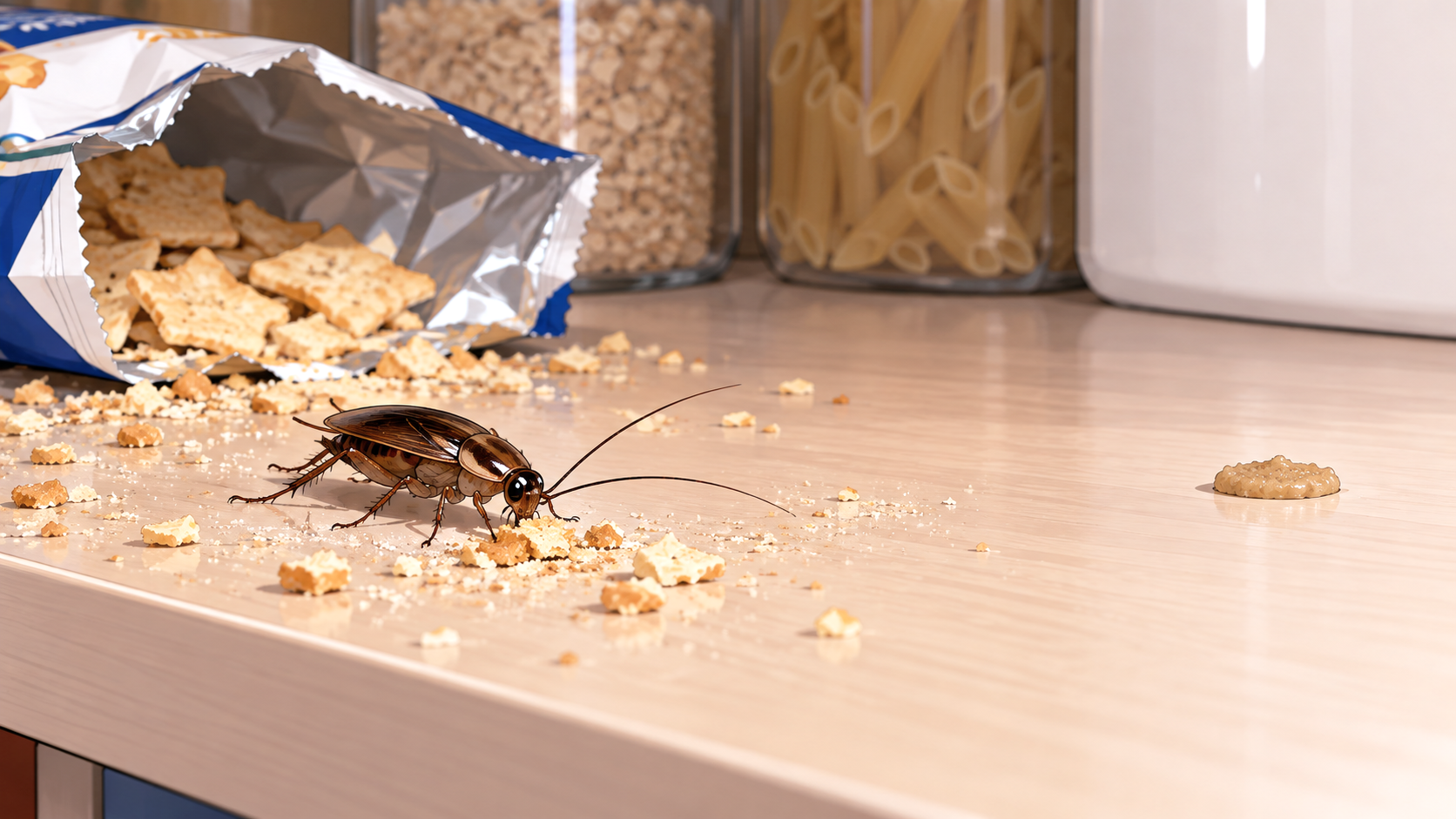
A cockroach walking past a fresh bait station without stopping can make an otherwise promising treatment seem useless. Sometimes the insects are feeding elsewhere. In other cases, the bait has become contaminated, dried out, or contains ingredients that the local cockroach population avoids. A bait that is readily consumed can also perform poorly when the insects have reduced susceptibility to its active ingredient.
The most common reasons cockroach bait fails are inadequate access, competing food, contamination, poor bait acceptance, and insecticide resistance. Before replacing the product, determine whether cockroaches are eating it at all. Bait that remains untouched requires a different response from bait that disappears while live cockroaches continue appearing.
First, Determine Whether Cockroaches Are Eating the Bait
An apparently ineffective bait can fail at two different stages: the cockroach may never consume it, or it may consume enough to survive because the insecticide is insufficiently effective against that population.
Examine the bait after the inspection interval specified on its label. Fresh gel may show feeding marks or a reduction in volume, although drying can also change its appearance. Bait stations are harder to evaluate because their contents may not be visible. A nearby sticky monitor can help establish whether cockroaches remain active in the same area.
The Rutgers University German cockroach guidance emphasizes monitoring and placing bait close to established activity because cockroaches spend considerable time inside protected spaces. A product can be effective against the species listed on its label yet accomplish little if the insects rarely encounter it.
If traps consistently capture cockroaches beside an untouched bait, investigate feeding avoidance or contamination. If the bait is being consumed but captures remain substantial over successive monitoring periods, reduced susceptibility becomes a more credible possibility. Neither observation alone establishes insecticide resistance.
Competing Food Can Make the Bait Less Attractive
Cockroaches do not necessarily prefer a commercial bait to whatever food is already available. Grease deposits, crumbs, pet food, spilled dry goods, and accessible rubbish can all compete with a bait formulation.
The EPA’s cockroach management training material explicitly identifies alternative food sources as a cause of poor bait performance. The document also warns that contamination from cleaning products and sprays can prevent baits from working as intended.
The situation becomes more complicated when the competing food is located closer to the insects than the bait. Research on food preferences and toxic bait consumption in German cockroaches found that feeding behavior varies with developmental stage and reproductive condition. A formulation attractive to one group of cockroaches may receive less attention from another.
Removing accessible food residue can improve the opportunity for insects to encounter bait, although the wide range of materials cockroaches can eat makes complete elimination of alternative food impractical. The goal is to reduce significant competition, not to assume cockroaches will starve until they consume a particular product.
Cleaning Products and Insecticide Sprays Can Contaminate Bait
A gel that initially attracts cockroaches may become unappealing after exposure to household cleaners, fragrance products, nicotine, or insecticide residues. Spraying the surrounding area can also introduce chemicals that discourage insects from approaching.
The Cornell Integrated Pest Management program warns that repellent sprays may interfere with cockroach baits when the products come into contact.
This can happen when someone applies an aerosol insecticide around existing bait deposits, washes a treated crevice with detergent, or places fresh bait onto a surface carrying residual cleaning chemicals. The problem is not necessarily that the insecticide inside the bait has stopped working; the cockroaches may no longer recognize the contaminated material as acceptable food.
Avoid spraying or cleaning directly over active bait. If contamination has occurred, consult the product label for safe removal and replacement rather than adding another pesticide on top.
The difference between gel bait and contact spray treatments becomes particularly important when both have been used around the same cockroach activity.
Cockroaches May Reject the Bait’s Food Ingredients
Not every refusal to feed indicates that the insect has become resistant to the poison. Some German cockroach populations have developed behavioral aversion to ingredients that ordinarily encourage feeding.
A well-documented example involves glucose. Certain German cockroaches perceive glucose differently from susceptible populations and reject foods containing it. Research published in Science established that glucose aversion involves changes in gustatory responses.
A separate study of behavioral and physiological resistance to gel baits investigated a German cockroach strain that avoided several bait formulations. Changing the non-insecticidal food ingredients improved bait performance, demonstrating that the active ingredient was not the only factor affecting effectiveness.
When cockroaches repeatedly encounter a fresh, uncontaminated bait but do not feed, a different formulation may be appropriate. Changing brands is not necessarily sufficient if the products contain similar food attractants. Conversely, switching between different food matrices containing the same insecticide may improve feeding without addressing chemical resistance.
The choice of cockroach gel bait should therefore account for formulation as well as active ingredient, particularly when earlier products have been rejected.
The Bait Has Dried Out or Become Unusable
Gel bait is designed to remain attractive long enough for cockroaches to encounter and consume it. Heat, airflow, dust, grease, and repeated wetting can change its consistency or make it less accessible.
A hardened deposit may no longer offer the same feeding properties as fresh gel. However, appearance alone does not establish whether a product remains effective; formulations differ in how they tolerate aging and environmental exposure.
Inspect deposits for obvious drying, contamination, removal, or damage. The appropriate replacement interval for cockroach gel bait depends on the manufacturer’s instructions and the condition of the material, not a universal number of days.
Avoid interpreting every reduction in gel volume as feeding. Moisture loss can make a deposit shrink without a cockroach consuming it. Where consumption is uncertain, monitor insect activity independently.
The Product May Be Intended for a Different Cockroach Species
A bait’s effectiveness against German cockroaches does not guarantee the same performance against American, Oriental, or other species. Products differ in their labeled targets, food formulations, and intended application environments.
Species also influence whether insects will encounter a particular formulation. An outdoor-associated cockroach entering a building occasionally may have little reason to feed at an indoor bait station before leaving or dying naturally.
The University of California’s cockroach management recommendations distinguish species that commonly establish indoor populations from those primarily associated with outdoor environments. Identification is therefore necessary before concluding that the bait itself has failed.
A recurring capture of large outdoor-associated cockroaches rather than German cockroaches may indicate that the product and target population are poorly matched. Check the exact label rather than relying on packaging that simply advertises effectiveness against roaches.
Insecticide Resistance Can Explain Continued Survival
When cockroaches are consuming a suitable bait yet remain active, insecticide resistance becomes a legitimate concern. Resistance occurs when inherited characteristics allow some insects to survive exposures that would kill susceptible individuals.
A 2021 study of field-collected German cockroaches in California evaluated several commercial bait formulations and found reduced susceptibility in multiple populations. The results showed that performance could vary substantially among active ingredients and field strains.
Further research involving German cockroach populations from Thailand documented resistance to fipronil, imidacloprid, and other insecticides, including reduced effectiveness of commercial gel baits.
Resistance is not established merely because cockroaches remain visible after treatment. Insufficient feeding, contaminated bait, and continued introductions can produce similar observations.
If monitoring indicates that bait is being eaten but the population remains substantial, a pest-management professional may recommend an insecticide with a different mode of action. Repeatedly switching between brands containing closely related active ingredients may accomplish little, particularly where cross-resistance is present.
The broader insecticide resistance of cockroaches does not imply that every local population is resistant to every available bait.
Cockroaches May Be Arriving From an Untreated Area
Bait may be working against insects already present while additional cockroaches continue entering the monitored area.
This is especially relevant in multifamily properties, where connected spaces and shared building conditions can complicate treatment. A persistent pattern near a doorway, plumbing penetration, or shared wall may warrant investigation beyond the immediate room.
The EPA’s guidance for multifamily housing managers emphasizes coordinated monitoring and management because pest activity may involve more than one residential unit.
Distinguish ongoing introductions from survival by recording where live insects appear and whether captures involve adults, nymphs, or both. The signs used to establish whether cockroaches are gone become more meaningful when observations cover the same locations over time.
Repeated introductions cannot be solved simply by increasing the quantity of bait already present.
When Should You Change Cockroach Bait?
Changing products makes sense when the available evidence identifies a reason the existing formulation is unsuitable. Untouched bait despite nearby activity may justify trying a different food matrix. Confirmed feeding followed by persistently poor population reduction may justify investigating resistance or selecting another active ingredient.
Do not replace a bait solely because cockroaches remain visible the next morning. Many formulations require time to produce mortality, and populations do not necessarily decline at a uniform rate.
A study of reduced bait susceptibility and secondary mortality in German cockroaches demonstrated that some resistant field populations survived commercial bait exposures that killed susceptible laboratory strains. Such findings support evidence-based treatment changes rather than repeatedly adding the same product without evaluating results.
If several appropriate baits have performed poorly, professional assessment is preferable to mixing additional insecticides indiscriminately. The most useful information to provide is the product used, the active ingredient, whether feeding was observed, and how cockroach captures changed during treatment.