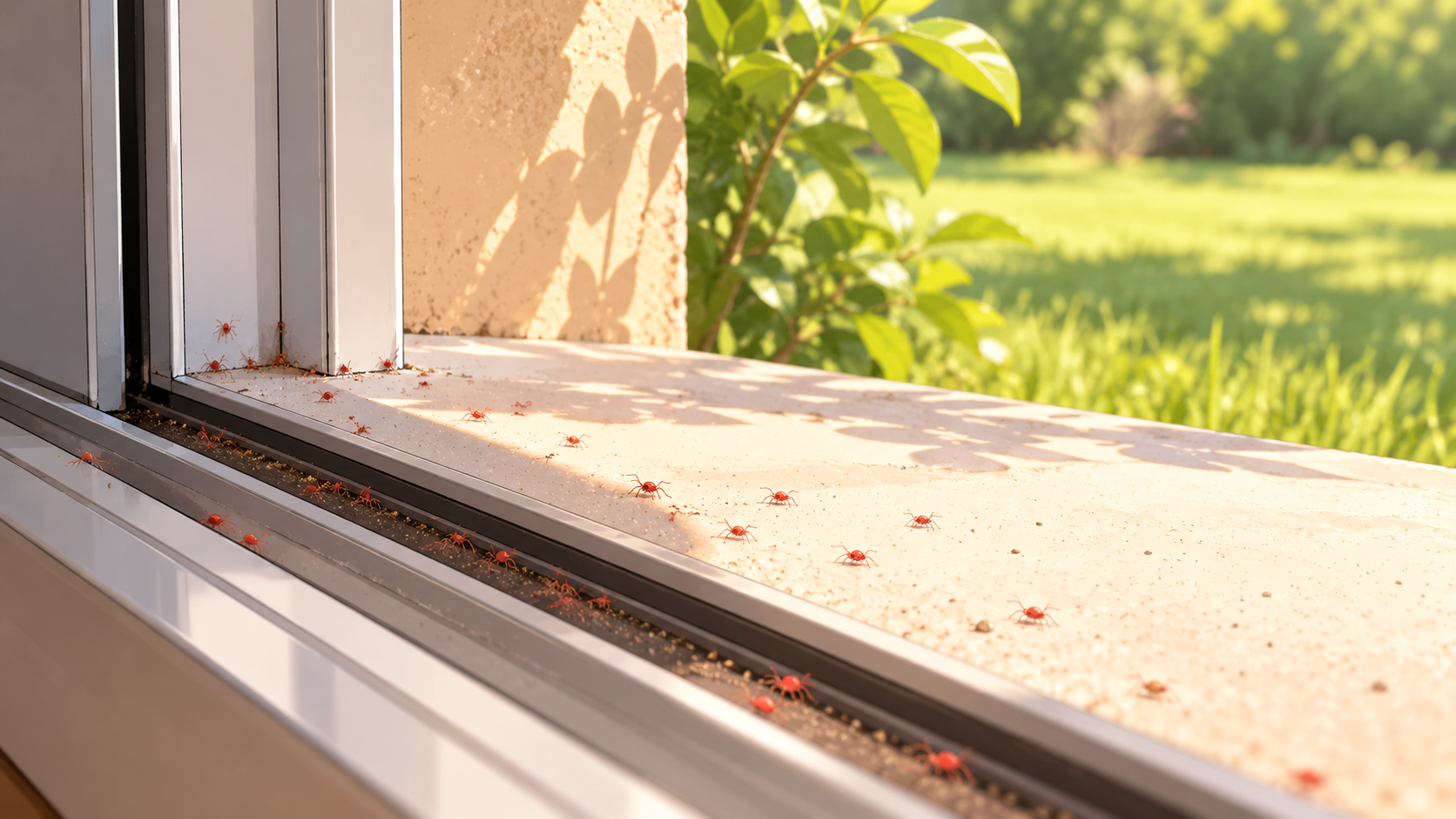
There is not good evidence that clover mites are attracted to light itself in the way positively phototactic insects deliberately move toward a light source. They are strongly associated with sunny areas, but the better-supported explanation is their response to warmth and temperature, particularly on sun-heated surfaces.
Sunlight and Light Attraction Are Not the Same Thing
Clover mites regularly congregate on sunny parts of buildings. South- and west-facing walls are particularly common activity areas, and mites can become conspicuous on windows and other surfaces receiving plenty of sun.
It is tempting to turn that observation into “clover mites are attracted to light,” but sunlight changes more than illumination. It also warms the surfaces it strikes. Clover mites are highly sensitive to temperature, and their movements respond to those temperature differences.
Once inside, clover mites can move upward as the sun warms the surface above them or move toward a warmer surface. If that surface becomes too hot or too cold, they begin roaming again in search of more favorable conditions. That is direct evidence for a temperature response, not proof of phototaxis.
We would therefore avoid using “attracted to light” as the explanation when warmth already accounts for the documented behavior.
Why Clover Mites Gather in Sunny Areas
Sunny exterior surfaces can provide the moderate warmth that encourages clover mite activity during cooler weather. Clover mites commonly crawl up the sunny sides of foundations and walls on warm days, and south-facing walls frequently have heavier populations than shaded sides.
The pattern becomes particularly noticeable because clover mites are cool-season mites. They are often active during spring and fall, when sunshine can warm a wall substantially even though the surrounding air remains relatively cool. A surface receiving direct sun can therefore offer very different conditions from a shaded wall only a short distance away.
This also helps explain why their apparent attraction is not unlimited. A sun-heated surface that becomes excessively warm is no longer favorable. Clover mites can leave it and search for a location with a more suitable temperature. True attraction to brightness alone would not explain that temperature-dependent response nearly as well.
Artificial Light Is Not a Proven Clover Mite Attractant
There is no solid basis for treating porch lights, lamps, or other artificial lighting as important clover mite attractants. Unlike familiar night-flying insects that gather around bulbs, clover mites cannot fly and are not known for converging on artificial lights as a characteristic behavior.
Turning a light on near clover mites also should not be expected to draw them toward it in a predictable way. Their documented movements around buildings are much more closely associated with temperature, sun exposure, nearby vegetation, and suitable places to shelter.
That makes switching exterior lights off a poor strategy for a clover mite problem. If large numbers are appearing on one side of a building, sun exposure and surrounding property conditions provide more useful clues than the presence of a porch light.
Why Clover Mites Often Appear Near Windows
Windows complicate the light question because clover mites are so frequently seen around them. They commonly enter through tiny gaps around window frames, and sunny windows can occur on the same warm sides of a building where mite activity is already concentrated.
As a result, a bright window and a cluster of clover mites can appear together without the mites necessarily following the visible light. Their tendency to congregate on window sills can involve where they enter, the temperature of the surrounding surfaces, and their movement once they reach the window area.
That is why the window itself should not be treated as evidence of phototaxis. Clover mites certainly favor sunny locations under many conditions. What has not been established nearly as clearly is that light, independent of the warmth accompanying it, is what attracts them.
Other Questions About Clover Mites and Light
Are clover mites attracted to sunlight?
They commonly gather on sun-exposed surfaces, but sunlight also warms those surfaces. Their documented sensitivity to temperature makes warmth an important part of the explanation.
Will clover mites come toward a lamp?
Artificial light is not established as a significant clover mite attractant. They should not be expected to gather around lamps in the characteristic way many flying insects do.
Do clover mites prefer sunny or shaded walls?
Sunny walls generally experience more clover mite activity. South- and west-facing building surfaces are particularly common congregation areas.
Will turning off outdoor lights keep clover mites away?
There is no good evidence that turning off outdoor lighting will prevent clover mites. Their movement around buildings is more strongly associated with factors such as temperature, sun exposure, vegetation, and available entry points.