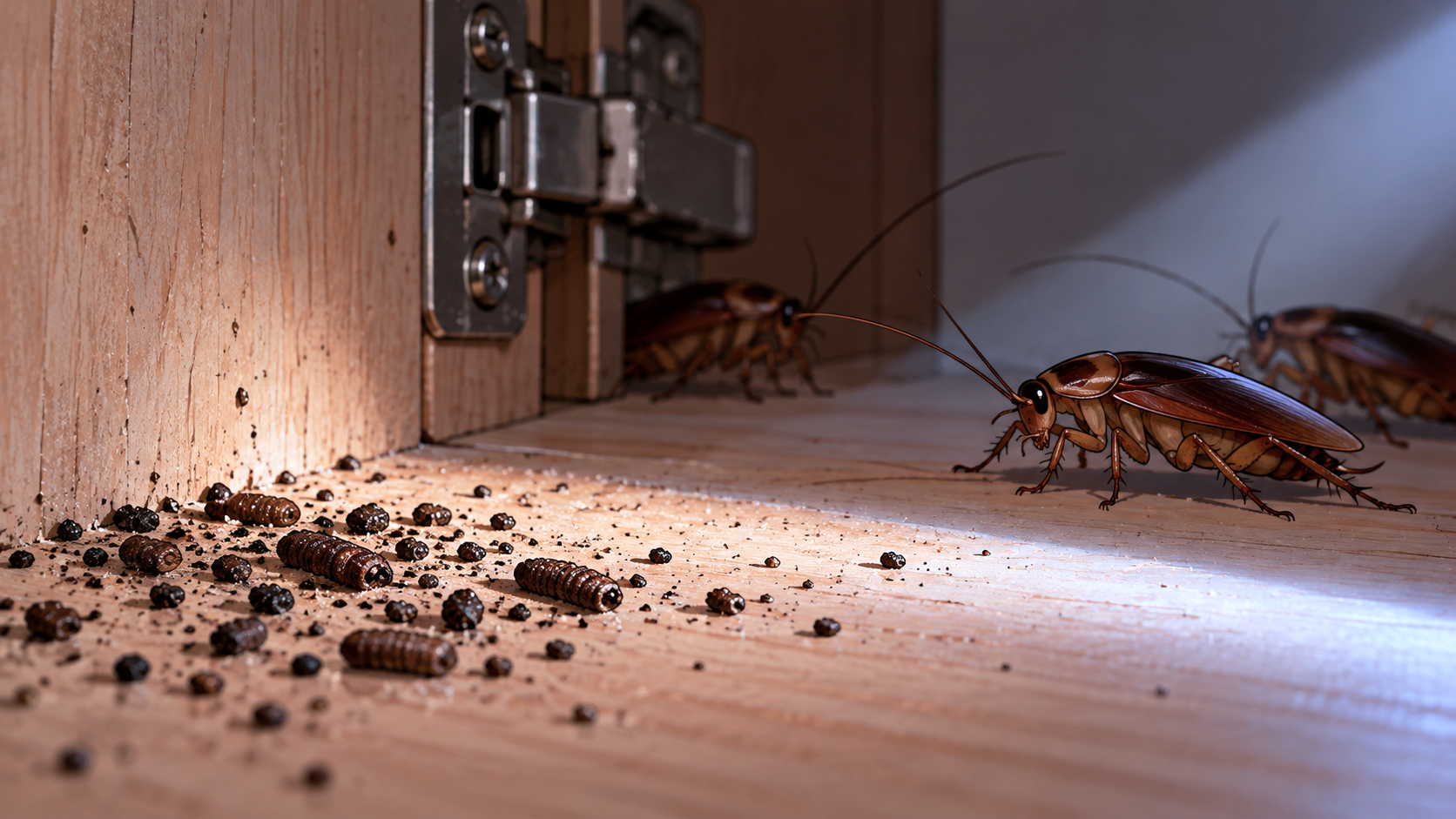
Cockroach poop usually looks like tiny black pepper flakes, dark coffee grounds, or small brown-to-black cylindrical pellets, depending on the size and species of the cockroach. German cockroaches leave fine specks and dark stains, while larger species, such as American and Oriental cockroaches, produce more noticeable solid droppings that may have blunt ends and faint lengthwise ridges.
Roach droppings are commonly discovered along cabinet corners, behind refrigerators, beneath sinks, inside drawers, and near other sheltered areas where the insects spend time. Their appearance provides a useful identification clue, but size, color, and location should be considered together because several other household materials can look similar.
What Cockroach Droppings Look Like Up Close
Cockroach feces do not always resemble neatly formed pellets. Small deposits can appear as individual granules, clusters of dark dots, or irregular stains on a surface. Larger deposits are more likely to retain a recognizable three-dimensional shape.
Typical appearances range from fine dark specks to larger cylindrical pellets.
There are three common appearances to recognize:
- Pepper-like specks: Very small dark particles resembling ground black pepper, especially associated with small cockroach species and young nymphs.
- Coffee-ground-like granules: Slightly coarser, irregular particles that may accumulate beneath appliances or inside protected cabinet corners.
- Cylindrical pellets: Larger, solid pieces that can resemble miniature dark rods, sometimes with longitudinal grooves and relatively blunt ends.
The San Diego County Department of Environmental Health identifies coffee-ground-like droppings along cockroach runways as a recognizable sign of activity.
Feces may also form dark spots rather than separate particles. When moist material is deposited against a wall, cabinet joint, or another surface, it can adhere and dry into a stain. Several deposits close together can create an irregular patch that looks more like dirt or ink than individual insect droppings.
How Big Is Cockroach Poop?
The size of cockroach droppings depends mainly on the species and developmental stage producing them.
Small cockroaches tend to leave minute deposits that can be difficult to distinguish individually without close inspection. Large adult cockroaches produce more substantial fecal pellets, although their droppings remain small compared with the insects themselves.
| Cockroach | Typical appearance | Approximate size |
|---|---|---|
| German cockroach | Pepper-like grains or dark spots | Often around 1 mm or smaller |
| Brown-banded cockroach | Fine dark specks, occasionally staining surfaces | Generally around 1 mm or smaller |
| American cockroach | Dark cylindrical pellets, sometimes ridged | Often approximately 2–4 mm |
| Oriental cockroach | Dark, relatively substantial pellets | Commonly a few millimeters |
| Cockroach nymphs | Extremely fine dark particles | Smaller than typical adult deposits |
These measurements are approximate identification ranges, not fixed dimensions for every dropping.
The University of Nebraska’s cockroach identification information documents substantial differences in body size among common household species. Those differences help explain the corresponding variation in fecal deposits.
A large adult American cockroach can leave a visible pellet, while a young German cockroach may produce material that resembles a dust particle.
Size alone cannot establish the species, particularly when the deposit is broken, partially dissolved, or mixed with other debris.
What Color Is Cockroach Poop?
Cockroach feces are usually dark brown, very dark reddish brown, or black. Fresh deposits can look glossy or damp in some circumstances, while older ones may appear duller or more granular.
The exact color is affected by the insect’s diet, moisture content, and the surface on which the material is deposited.
A dark speck on a white kitchen cabinet may appear almost jet black. Similar material on a wooden shelf can look brown, especially under warm lighting. Deposits against dark surfaces may remain unnoticed until they accumulate.
Cockroach droppings are not normally recognizable as bright green, white, or yellow pellets. Pale insect material found nearby may belong to something else.
Color is useful mainly when considered alongside size, shape, and distribution. A black particle is not automatically cockroach feces, and the shade of brown cannot reliably identify a particular cockroach species.
German Cockroach Droppings
The German cockroach (Blattella germanica) is responsible for many indoor infestations, particularly in kitchens and bathrooms.
Its droppings are usually extremely small, resembling ground pepper or finely crushed coffee grounds. They may appear as scattered dark specks or as concentrated staining in protected corners.
The deposits are especially noticeable along cabinet joints, beneath drawer runners, around appliance housings, and where two surfaces meet. German cockroaches spend much of their time in narrow hiding spaces, so fecal material often accumulates close to these locations rather than being evenly scattered across an entire room.
The University of Minnesota’s guidance on German cockroaches identifies cracks in cupboards and spaces beneath kitchen appliances as important areas of activity.
A cluster of pepper-like specks along a cabinet hinge may therefore be more suggestive of cockroaches than the same number of particles scattered randomly across a countertop.
German cockroach feces also contain chemicals involved in aggregation. Research published in the Proceedings of the National Academy of Sciences found that gut bacteria contribute to fecal chemical signals that attract other German cockroaches. This helps explain why deposits frequently occur where several insects gather.
American and Oriental Cockroach Droppings
American cockroaches (Periplaneta americana) and Oriental cockroaches (Blatta orientalis) are substantially larger than German cockroaches. Their feces are correspondingly more likely to appear as separate solid pellets.
These deposits are generally dark, cylindrical, and relatively short. Some have grooves running lengthwise along the sides, while their ends may appear blunt rather than sharply pointed.
The grooves are useful identification features when clearly visible, although they are not present or easily distinguishable on every pellet.
American cockroach droppings are often encountered in basements, utility spaces, and other sheltered areas where the insects move. Oriental cockroach droppings may occur in similar locations, especially near damp structural features.
The University of Alaska Fairbanks’ species descriptions identify American and Oriental cockroaches as large species associated with relatively protected, moisture-prone environments.
An individual pellet cannot reliably distinguish American from Oriental cockroaches. Their fecal appearance overlaps, and environmental conditions can alter the original shape.
If identification to species is important, an actual insect specimen provides more dependable evidence than the droppings alone.
Brown-Banded Cockroach Droppings
Brown-banded cockroaches (Supella longipalpa) also produce small, dark fecal specks. Their deposits can closely resemble those of German cockroaches, making appearance alone a poor way to separate them.
Their distribution within a building may be more informative.
Brown-banded cockroaches frequently occupy warmer, relatively dry locations, including upper cupboards, furniture, closets, and areas around electronic equipment. Their droppings can accumulate in elevated spaces where German cockroach activity is less typical.
The Cornell University cockroach identification guide explains that brown-banded cockroaches often occupy dry locations throughout buildings, while German cockroaches are more closely associated with kitchens and bathrooms.
Fine dark specks near the upper corner of a closet may therefore justify checking for brown-banded cockroaches. However, the location is only supporting evidence because insects can move outside their preferred areas.
Where Cockroach Poop Usually Accumulates
Cockroaches leave feces while resting, feeding, and moving between locations. The densest deposits often occur near frequently occupied hiding places.
Inside homes, characteristic locations include the backs of kitchen drawers, cabinet corners, hinges, spaces beneath sinks, gaps beside refrigerators and stoves, and narrow openings around plumbing or electrical penetrations.
In buildings with larger cockroach species, deposits may also occur around basement utility equipment, floor-level wall junctions, and sheltered service spaces.
The University of California’s cockroach identification and inspection guidance specifically identifies fecal spots beneath kitchen counters, behind drawers, and toward the backs of cabinets as useful evidence for locating cockroach activity.
Distribution can reveal more than an isolated particle. Consider a cabinet containing numerous dark specks packed into the rear corner while the front remains relatively clean. That pattern suggests repeated use of a protected location.
A few particles on an exposed shelf are less informative because ordinary dust, soil, crumbs, and other household material can accumulate there.
Fecal evidence is also commonly found near other signs of cockroach activity, such as shed skins. However, cockroach egg cases and fecal deposits are separate materials and should not be identified interchangeably.
Can Cockroach Poop Look Like Ink Stains?
Yes. Some cockroach fecal deposits appear as small dark stains rather than recognizable granules.
This happens when moist fecal material adheres to a surface or is deposited in narrow joints where individual spots overlap. Once dried, the deposits can look like tiny ink marks, smudges, or irregular brown-black patches.
Such staining can be particularly conspicuous on light-colored cabinet interiors, painted wood, plastic appliance components, and walls adjoining heavily used hiding spaces.
The texture depends partly on the original material and its age. A formed pellet may retain a distinct shape, whereas a liquid or semiliquid deposit may dry flat against the surface.
Cockroach fecal staining is sometimes mistaken for grease or general grime. Grease deposits, however, are not necessarily concentrated around the specific crevices used by cockroaches, and their appearance can differ under close inspection.
Dark stains do not become reliable evidence of cockroaches merely because they occur in a kitchen. Their arrangement, associated insect signs, and repeated appearance provide stronger support.
What Does Fresh Cockroach Poop Look Like?
Fresh cockroach droppings may appear darker, more cohesive, or slightly moist compared with older deposits. However, there is no dependable visual method for determining the exact age of cockroach feces.
Humidity can preserve moisture, while a dry, warm location may cause recently deposited material to harden quickly. Cleaning products, surface texture, and environmental dust can also alter appearance.
An old pellet may remain dark for a long time. Conversely, a fresh dropping can already look dry when discovered.
The most informative observation is whether new material appears in a location that was previously free of deposits. A dated photograph can document changes without requiring an estimate based on color or texture.
Repeated deposits in the same location suggest continuing activity, but the number of visible droppings should not be used to calculate the number of cockroaches present. Different species, life stages, and individuals produce different amounts of fecal material.
Dense accumulations can indicate repeated occupancy, yet one cannot reliably estimate an infestation’s size by counting specks.
What Does Cockroach Poop Feel Like?
Small, dried cockroach droppings can appear granular or powderlike, while larger pellets are more solid and retain a recognizable shape.
Some deposits adhere to the underlying surface, particularly when originally moist. Others remain loose and can be displaced by minor disturbance.
Texture can help explain why roach feces look different across locations, but physically handling unknown deposits is unnecessary for identification.
A close photograph, preferably with a ruler or another scale reference, allows the shape and size to be examined without crushing or rubbing the material. This is especially useful when a few millimeters separate a possible cockroach pellet from other household debris.
The surface itself also affects appearance. Fine specks may remain distinct on smooth plastic but become difficult to recognize against rough wood or porous cardboard.
Can Cockroach Poop Tell You Which Species Is Present?
Dropping appearance can narrow the possibilities, but it rarely identifies a cockroach species with certainty.
The strongest visual distinction is between the fine specks produced by smaller cockroaches and the larger formed pellets associated with bigger species. Within those categories, substantial overlap remains.
A useful interpretation combines fecal appearance with location:
| Finding | Possible interpretation |
|---|---|
| Fine pepper-like deposits in kitchen cabinet joints | German cockroach activity is plausible |
| Similar specks in elevated, dry furniture spaces | Brown-banded cockroaches are a possibility |
| Larger dark pellets near basement utility areas | American or Oriental cockroaches may be involved |
| Dark stains concentrated in narrow cracks | Repeated cockroach activity may have occurred |
| Isolated unidentified dark particles | Insufficient evidence for species identification |
The University of Maryland’s identification guide for household cockroaches describes species-specific differences in body size and preferred environments, which help contextualize where feces are discovered.
Actual insect identification remains more dependable. The same room may contain more than one species, and cockroach populations can leave deposits that overlap in size and appearance.
If the material is too small to distinguish clearly, photographing it alongside a scale and examining nearby hiding areas may provide more useful evidence than trying to infer an exact species from one speck.
When Dark Specks Are Not Cockroach Droppings
Ground pepper, coffee residue, ordinary dirt, deteriorating material, and other insect deposits can resemble small cockroach feces.
A dark particle found beside a coffee grinder has a different evidentiary value from a cluster of similar particles inside a concealed cabinet joint. Location and distribution should be considered before attributing the material to a pest.
Some household insects also leave small granular waste. The absence of visible cockroaches does not automatically rule them out, but it makes independent supporting evidence important.
The University of California’s cockroach monitoring guidance recommends combining fecal evidence with signs such as shed skins and observed insect activity, rather than relying on droppings alone.
A recurring accumulation concentrated in a protected crack is more suspicious than a few loose particles scattered across an exposed surface.
Feces can also remain after cockroaches have left an area. Old deposits establish that material was present, not necessarily that the insects are still occupying the location.
For identification, the most convincing evidence is a combination of the expected dropping shape, an appropriate hiding location, and additional signs of cockroaches nearby.
One thought on “What Does Cockroach Poop Look Like?”