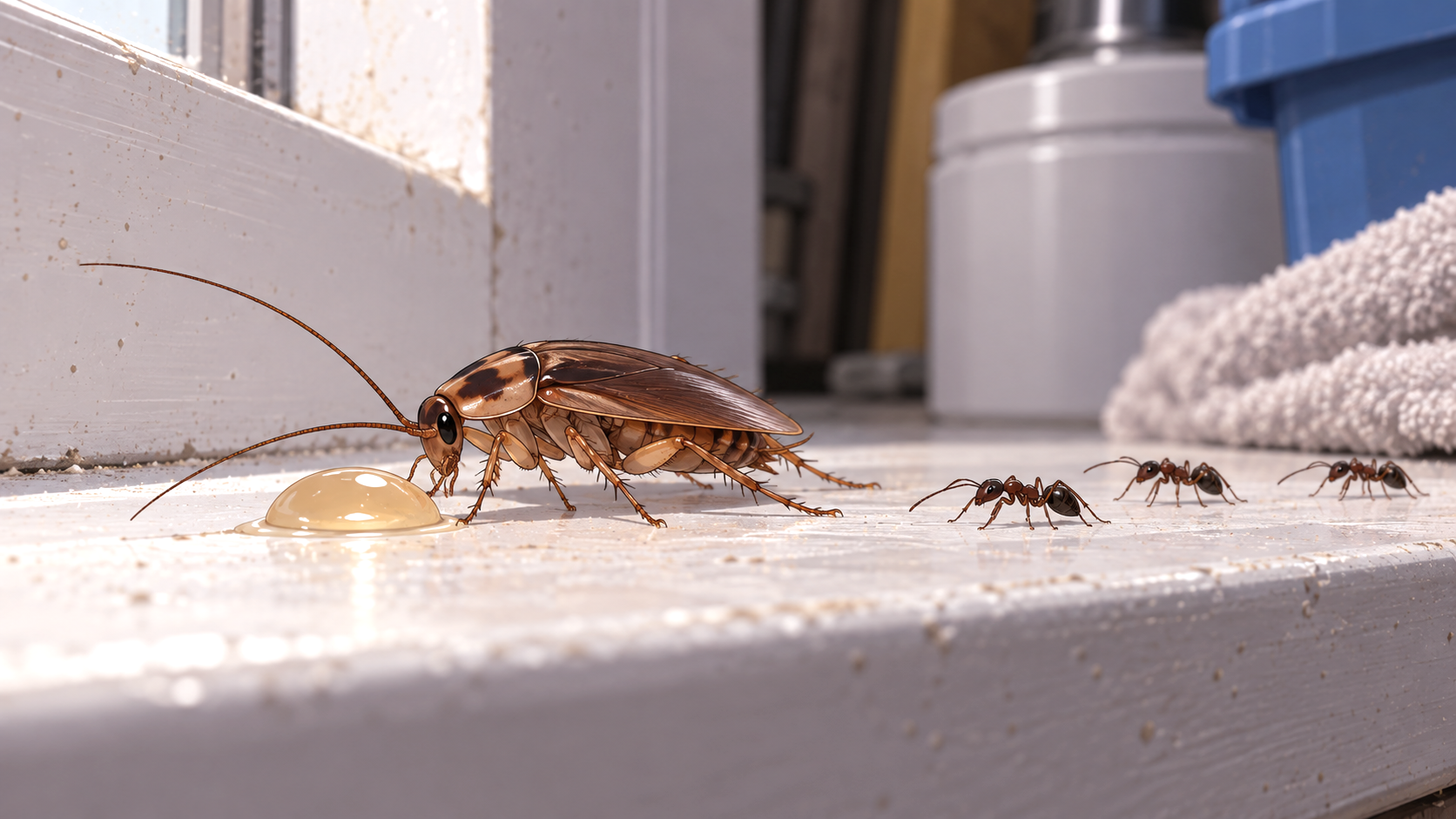
Ants sometimes gather around cockroach gel bait, feeding on the material or carrying small amounts away. Because many cockroach baits contain insecticides that are also toxic to ants, it is reasonable to wonder whether one product can control both pests.
Yes, cockroach bait can kill ants if they consume a lethal amount of a suitable insecticide, but that does not mean the product is approved or effective for ant control. Most cockroach-specific gels are formulated and labeled for cockroaches, and their food ingredients may not attract the ant species present. Killing a few foraging ants also does not establish that the colony has been controlled.
The product label, rather than the active ingredient alone, determines which pests it is intended to treat.
Why Cockroach Bait Can Poison Ants
Several insecticides used in cockroach baits are also found in products specifically formulated for ants. These include fipronil, indoxacarb, hydramethylnon, and certain other insecticidal compounds.
For example, Advion Cockroach Gel Bait contains 0.6% indoxacarb, while Advion Ant Gel contains 0.05% indoxacarb. Both use the same active ingredient, but their concentrations, food formulations, and registered target pests differ.
The EPA’s registration for Advion Cockroach Gel Bait identifies several cockroach species as its targets, whereas the registration for Advion Ant Gel lists numerous ant species.
An ant that consumes cockroach bait containing indoxacarb may be poisoned because its nervous system is susceptible to the insecticide. However, that possibility does not establish that the cockroach formulation delivers an appropriate dose under ordinary ant-feeding conditions.
The active ingredients used in cockroach gel baits vary considerably, making it impossible to generalize from one product to every gel, station, or granular bait sold for cockroaches.
Why Ants May Ignore Cockroach Bait
An insecticide cannot work through ingestion if the target insect refuses to eat its formulation.
Cockroach gels contain food ingredients selected to encourage cockroach feeding. Ant baits are designed around different feeding preferences, which can vary considerably between ant species and across seasons.
The University of California’s ant-management guidance explains that ants may prefer sugars, proteins, oils, or combinations of these materials. Argentine ants commonly accept sweet liquid baits, while certain other species respond more strongly to protein-rich or greasy formulations.
Consequently, ants may encounter cockroach bait without showing sustained interest. Others may feed on it readily, particularly if its ingredients happen to match their current nutritional preferences.
The feeding habits of cockroaches are broad, but a formulation attractive to a cockroach does not automatically appeal to ants.
Even when ants feed on a cockroach gel, the amount consumed may differ from the dose delivered by a properly formulated ant bait. Apparent attraction is therefore only one part of determining whether the product can provide effective control.
What Different Cockroach Bait Labels Allow
Products with similar names or insecticidal ingredients can have different approved uses.
| Product | Active ingredient | Ant-control label status |
|---|---|---|
| Advion Cockroach Gel Bait | Indoxacarb 0.6% | Cockroach-specific; ants are not listed as targets |
| Maxforce FC Magnum Roach Bait Gel | Fipronil 0.05% | Marketed and labeled for cockroach control, not as an ant bait |
| Advion Ant Gel | Indoxacarb 0.05% | Specifically registered for ants |
| Maxforce FC Ant Bait Stations | Fipronil | Specifically formulated and labeled for ants |
| Maxforce Complete Granular Insect Bait | Hydramethylnon | Includes ants and cockroaches among its labeled pests |
The California Department of Pesticide Regulation’s product record for Maxforce FC Magnum identifies it as a roach bait gel. By comparison, Maxforce Complete Granular Insect Bait is designed for multiple insect pests, including ants and cockroaches.
Some products genuinely have dual-pest labeling. That does not make every product containing the same insecticide interchangeable.
The EPA’s pesticide-use instructions require pesticides to be used consistently with their labeling. Using a cockroach-only bait deliberately to treat ants should not be assumed permitted simply because ants might die after consuming it.
Check the exact product name and current label, including any local restrictions, before using a bait against either pest.
Will Cockroach Bait Kill an Entire Ant Colony?
An ant dying after eating cockroach bait is not the same as an ant colony being eliminated.
Most visible ants are workers searching for food. Effective ant baits generally need to remain attractive long enough for workers to consume or transport the toxic food and distribute it to other colony members, potentially including queens and developing ants.
The University of California’s guidance on ant baiting explains that slow-acting, attractive formulations are important because workers must survive long enough to transport food back to their colonies.
Cockroach bait might kill individual workers without providing enough transferable food to affect the colony. A formulation that acts too quickly or is poorly accepted could produce visible deaths while leaving most ants unaffected.
Although certain cockroach insecticides can produce secondary effects among cockroaches occupying shared shelter areas, this does not establish successful toxin transfer throughout an ant colony. Ant social feeding behavior and colony organization require separate consideration.
A few dead ants near a cockroach bait placement therefore provide no dependable evidence of colony elimination.
What if Ants Are Already Eating Your Cockroach Gel?
Ants consuming an existing cockroach bait placement create two issues: possible unintended pesticide exposure and competition for bait intended for cockroaches.
If ants are removing substantial amounts of gel, less may remain available to the target cockroaches. However, seeing ants on a bait placement does not automatically explain why a cockroach treatment is performing poorly.
Do not add extra gel specifically to attract ants or move a cockroach-only product onto ant trails. Continue using the bait according to its registered directions and select a separate ant-labeled product if ant treatment is necessary.
The EPA-approved Advion Cockroach Gel Bait label specifies cockroach treatment sites and prohibits application where children and pets can easily access the material. Its directions do not authorize treating ant infestations simply because ants encounter the gel.
If cockroach control is also underway, avoid contaminating the existing gel with other sprays or cleaners. The conditions that reduce cockroach bait effectiveness can involve bait contamination, inaccessible placements, or poor feeding acceptance, none of which is corrected by adding unrelated pesticides.
Can You Use Ant Bait to Kill Cockroaches Instead?
The reverse assumption is equally unreliable. An ant bait may contain an insecticide toxic to cockroaches, but its formulation and label may be intended exclusively for ants.
Ant gels frequently contain sweet food bases designed around ant feeding preferences. Such formulations are not automatically attractive to German cockroaches, particularly populations displaying behavioral aversion to certain sugars.
The University of California’s cockroach management guidance recommends selecting cockroach treatments based on the species and the product’s intended use rather than relying on incidental insecticidal effects.
A dual-labeled product can be considered for both pests when its directions explicitly allow the intended applications. Otherwise, separate ant and cockroach baits are more appropriate, even when they contain chemically related ingredients.
There is also no reason to replace an effective cockroach bait solely because ants are present nearby. The differences between gel bait and spray treatments for cockroaches remain relevant to the cockroach treatment decision, independently of which product is selected for ants.
For a home with both pests, the most defensible approach is to choose products labeled for each target species, or a dual-labeled formulation that expressly includes both. Possible toxicity to an ant is not enough to establish appropriate, legal, or effective ant control.