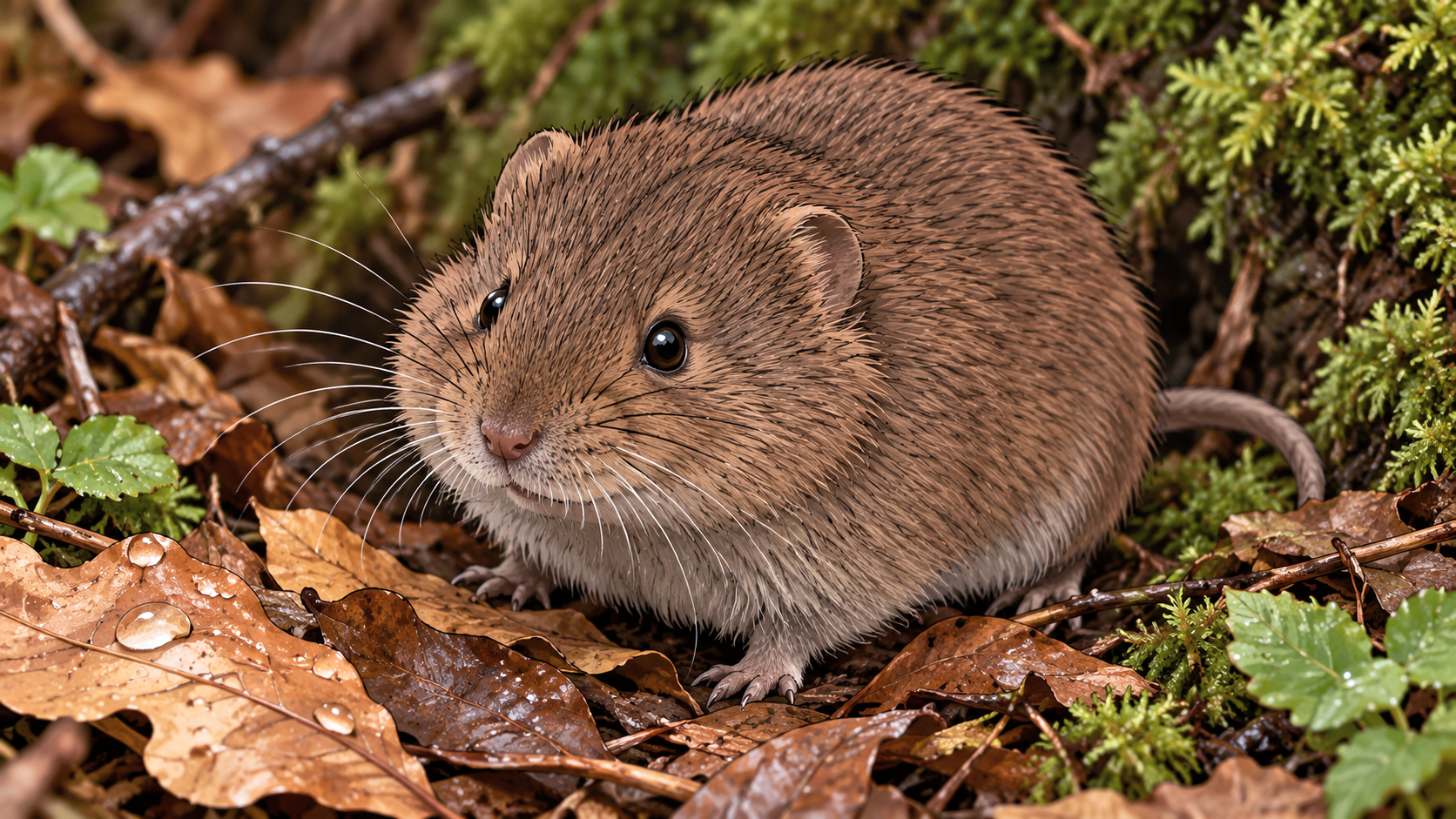
A vole looks like a small, plump mouse with a rounded body, blunt snout, short legs, small eyes, and ears that barely rise above its fur. Its tail is relatively short, and its dense coat gives the animal a compact, somewhat cylindrical appearance. Most voles have brownish or grayish fur, although their exact appearance varies among species.
The easiest feature to overlook is the head. A vole’s muzzle is broad and rounded rather than sharply pointed, while its small ears often blend into the surrounding hair. Together with its heavy body and short tail, these features create the characteristic vole silhouette.
The Rounded, Stocky Shape of a Vole
From the side, a vole has a low, thickset profile. Its back forms a gently rounded curve, and the body remains relatively broad behind the head rather than narrowing into a pronounced waist. The physical description of voles identifies their compact bodies, short legs, and small external ears as characteristic features. An animal sitting still in the grass can resemble a rounded bundle of fur, with only its nose and feet clearly projecting beyond the body.
The legs contribute to this appearance because they are short relative to the torso. When a vole walks, its belly remains close to the surface, and the feet may be partly concealed beneath the fur. The body looks especially elongated when the animal stretches forward while moving, but the underlying proportions remain thickset. The meadow vole’s cylindrical body is a recognizable example of this general shape. Differences among the various types of voles mean that individuals will not all have identical proportions.
What Does a Vole’s Face Look Like?
A vole’s face is dominated by its short, rounded muzzle and small, dark eyes. The nose projects only a modest distance beyond the rest of the head, producing a blunt facial profile. Fine whiskers extend from either side of the muzzle, while the eyes sit within the surrounding fur without appearing especially prominent. Close photographs of the common vole (Microtus arvalis) show this characteristic arrangement of a blunt snout, small ears, and compact head.
The ears are rounded and covered with fine hair. Although they remain visible in many individuals, they usually do not project far above the head. The Illinois Department of Natural Resources’ meadow vole description identifies ears that are almost hidden in the coat. Depending on the viewing angle, a vole may appear to have tiny ear openings rather than the distinct upright ears people expect on a small mammal.
A photograph taken directly from above can conceal the muzzle’s shape and make the ears difficult to judge. A side view usually reveals more of the facial proportions. Where the animal has been photographed from several angles, look for the same blunt head profile rather than relying on one image.
What Does Vole Fur Look and Feel Like?
Voles have dense fur that gives their bodies a full, rounded outline. The coat consists of softer underfur beneath longer outer hairs, and its texture can appear slightly coarse or uneven in close photographs. The fur structure described for meadow voles includes a dense undercoat covered by longer guard hairs. This helps explain why the animal’s actual body outline is less sharply defined than its overall furry silhouette.
Most familiar North American voles have subdued brown or grayish coats, often with darker hairs mixed through the back. The belly may appear lighter, but the contrast varies. A vole’s fur can also conceal the upper portions of its legs and part of its ears, making the body appear more rounded than it would without the coat. The full range of vole fur colors is broader than a single brown or gray description, so coat color alone is a weak identification feature.
What Does a Vole’s Tail Look Like?
The tail is short relative to the animal’s body and is covered with fine hair. It is usually narrow, slightly tapered, and much less conspicuous than the rounded torso. In a clear side photograph, the tail looks like a modest extension behind the hindquarters rather than a dominant part of the animal’s outline.
The University of California’s vole identification guidance describes a short, furred tail alongside the compact body and partially concealed ears. Tail proportions vary by species, and the exact relationship between body length and tail length is more useful when making a vole-versus-mouse identification than when describing a vole’s general appearance.
A tail may disappear beneath grass, lie against the ground, or be hidden by the viewing angle. A photograph that does not show one clearly should therefore be assessed using the visible head, body, and ear proportions rather than assuming the animal is tailless.
How to Recognize a Vole in a Photograph
A clear profile photograph offers the strongest starting point because the head, body, legs, and tail can be considered together. We would look first at the overall silhouette, then examine the muzzle and ears. A rounded torso with short legs, a blunt nose, small fur-covered ears, and a relatively short tail provides a consistent set of vole characteristics.
One useful check is to inspect whether the apparent roundness comes from the animal’s body or simply from its posture. An animal curled into a ball can look unusually compact, while one stretching forward can look slender. Compare several views when possible, particularly if the first photograph shows only the face or back.
Photographs of young voles can present additional difficulty because immature animals do not always show adult proportions as clearly. Even with a good image, the general appearance may establish that an animal is a vole without identifying its exact species.
For the clearest assessment, use an uncropped image that includes the entire animal, especially its nose and tail. If you encounter a vole outdoors, photograph it from a safe distance without handling or cornering it. Several sharp images showing different angles provide more useful identification evidence than one close-up of an isolated body part.
One thought on “What Does a Vole Look Like?”