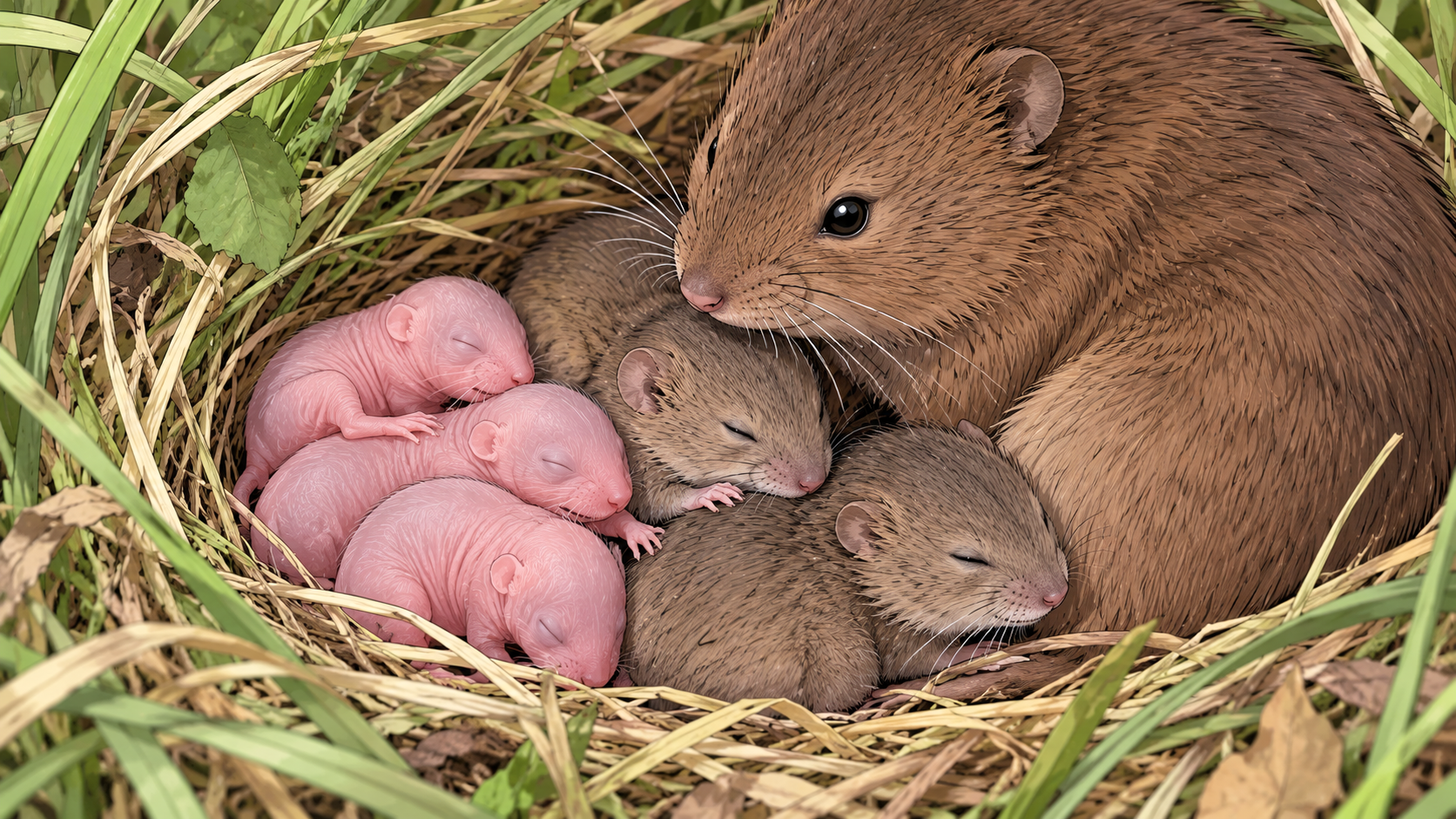
Baby voles are born pink, hairless, blind, and extremely small, with short tails, closed ears, and undeveloped facial features. Within days, their skin darkens and fine fur begins appearing. By approximately two weeks old, many have open eyes, a complete coat, and the compact proportions of miniature adult voles.
Their appearance changes rapidly enough that a newborn and a two-week-old juvenile can look like entirely different animals. The rate of development also varies between vole species, so age estimates based on fur or eye development are approximate rather than exact.
What a Newborn Vole Looks Like
A newborn meadow vole weighs approximately 1.6–3 grams. Its nearly transparent pink skin reveals the underlying pigmentation, while its disproportionately large head and rounded abdomen give it an appearance unlike the stocky, fully furred body of an adult vole. The legs are short, the feet are delicate, and the tail is already relatively small.
The eyelids remain sealed at birth, and the external ears are undeveloped. These features reflect the animal’s immature condition rather than a permanent absence of functional eyes or ears. Newborn meadow voles are born with both eyes and ears closed, becoming progressively more developed during their first days.
Freshly born voles also lack visible incisors. In montane voles, the front teeth begin emerging approximately three to five days after birth. Their early tooth and sensory development occurs before they have acquired their complete juvenile coat.
Because newborn mice and several other small mammals have almost identical hairless features, the appearance of a pink baby rodent is rarely sufficient for identifying it as a vole.
How Their Appearance Changes Day by Day
Fur develops before the young animals acquire all the proportions associated with older voles. Their skin initially becomes darker, followed by short hairs that gradually cover the back and sides. The belly may remain sparsely furred for a short period after the rest of the body becomes noticeably furry.
In meadow voles, fur begins developing around the fourth day, with the eyes and ears opening around the eighth day. Other species mature on slightly different schedules.
| Approximate age | Visible features |
|---|---|
| Newborn | Pink, hairless, eyes closed, ears undeveloped |
| 3–4 days | Darkening skin and the first visible hairs |
| 5–7 days | Increasing fur coverage, particularly across the back |
| 8–12 days | Eyes opening, fuller coat, increasingly coordinated movement |
| Around 2 weeks | Fully furred juvenile with recognizable vole proportions |
| 3–4 weeks | More developed body and the beginning of adult-type coat changes in some species |
These stages describe a general progression, not a universal developmental timetable. Tundra voles, for example, develop a coat within approximately five days but typically open their eyes between days eleven and thirteen.
A young animal with closed eyes and visible fur is therefore not necessarily abnormal. The species and its individual development both influence when particular features appear.
What Does a Furry Baby Vole Look Like?
Once the coat fills in, a juvenile vole has a rounded body, a blunt snout, small ears that may be partly concealed by fur, and a relatively short tail. Its head can still appear large compared with the rest of its body, particularly before it has completed its early growth.
The juvenile coat is not necessarily the same shade as the adult coat. Meadow voles initially develop fur that is often darker than mature fur, while their coloring can change with subsequent growth and molts. The broader range of vole coat colors should not be used to assign an exact age to a small individual.
Young prairie voles begin replacing their first coat at approximately 24 days old. Their transition toward adult fur is gradual, meaning a fully mobile juvenile can still have a coat that differs from that of an older animal.
Body size is equally misleading without context. An unusually small vole might be immature, but species differ in their normal dimensions. Comparing the sizes reached by different voles helps prevent a naturally small species from being mistaken for a much younger animal.
How to Tell a Baby Vole From a Baby Mouse
Identification becomes easier after the animal has grown enough fur to reveal its overall proportions. Juvenile voles generally have more compact bodies, blunter faces, smaller-looking ears, and shorter tails than similarly developed house mice.
The tail is often the clearest visible clue. A young house mouse develops a relatively long, slender tail, whereas a vole’s tail usually appears much shorter in proportion to its body. The ears of a mouse also tend to look more prominent.
These characteristics become useful only after sufficient development. Hairless newborns can be practically indistinguishable without knowing which species produced the litter.
The differences between voles and mice are best evaluated using several features together. A close-up photograph of the head alone may conceal the tail and overall body shape, which are often more informative than the face.
Nest surroundings can provide supporting clues, although they are not definitive. Meadow voles construct nests from grasses and other plant material, and their young develop within sheltered nests. Other rodents also use shredded vegetation, so a grass-lined nest does not prove that its occupants are voles.
When Do Baby Voles Stop Looking Like Babies?
The most obvious visual transformation occurs when the eyes open and the body becomes fully covered in fur. At that point, the animal begins resembling a small adult, even though its growth is far from complete.
Prairie voles may reach adult body size within approximately two months, while meadow vole growth varies with season. Animals born during different parts of the year can therefore develop at different rates despite belonging to the same species.
A juvenile with developed incisors, open eyes, and a complete coat should not automatically be classified as an adult. Its proportions, body size, and coat may continue changing well after those early milestones.
Nor does the presence of several juveniles of different sizes necessarily indicate separate species. Vole reproduction can produce successive litters, making it possible for young animals at different developmental stages to occur in the same general habitat.
For identification, the most useful photograph shows the entire animal from the side or slightly above, including its tail, ears, and overall body proportions. Very young hairless specimens may remain impossible to identify confidently from appearance alone.
2 thoughts on “What Do Baby Voles Look Like?”