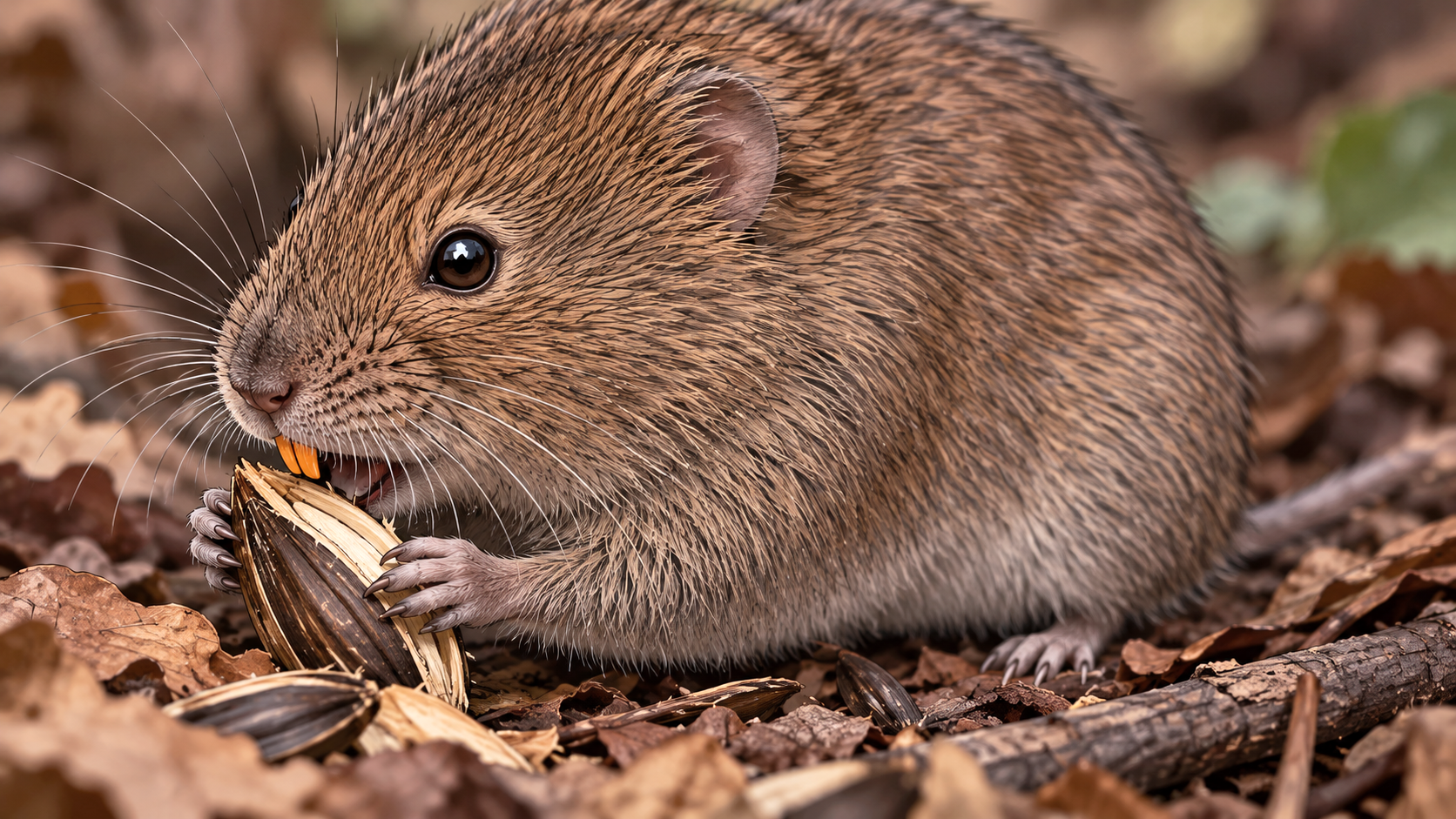
Voles are rodents. They belong to the mammalian order Rodentia, the family Cricetidae, and the subfamily Arvicolinae. Their closest relatives include lemmings and muskrats, while hamsters and several groups of mice and rats belong to the same broader family. Voles possess the continuously growing front teeth characteristic of rodents, making their classification a matter of shared anatomy and evolutionary ancestry rather than superficial resemblance.
The word rodent describes a scientifically recognized group of mammals, not simply any small animal that looks like a mouse. Squirrels, beavers, porcupines, and voles all qualify despite substantial differences in size, behavior, and habitat.
Where Voles Fit in the Rodent Family Tree
The scientific classification of voles places them within a series of increasingly specific taxonomic groups. Each level identifies a shared ancestry, with the subfamily providing a more precise description of their relationship to other rodents.
| Classification | Scientific name |
|---|---|
| Kingdom | Animalia |
| Phylum | Chordata |
| Class | Mammalia |
| Order | Rodentia |
| Suborder | Myomorpha |
| Superfamily | Muroidea |
| Family | Cricetidae |
| Subfamily | Arvicolinae |
The order Rodentia contains the entire rodent group, while Myomorpha includes numerous mouse-like rodents. Within that suborder, the superfamily Muroidea includes voles, hamsters, mice, rats, gerbils, and related mammals. The family Cricetidae contains voles alongside hamsters and several groups of New World mice and rats. Other familiar rodents, including house mice and brown rats, belong to the separate family Muridae.
Arvicolinae is the most informative classification when examining a vole’s close relatives. This subfamily contains voles, lemmings, and muskrats, which share evolutionary relationships that are more specific than their general membership in Rodentia. However, the everyday name vole does not correspond to one genus. Commonly encountered meadow and prairie voles belong to Microtus, while other animals called voles are classified in different genera.
Consequently, the different types of voles cannot all be assigned the scientific name Microtus. That name identifies a particular genus, not every animal commonly called a vole.
What Makes a Vole a Rodent?
The defining characteristic of rodents is their specialized incisor teeth. Voles possess one pair of incisors in the upper jaw and another in the lower jaw. These teeth grow continuously and are adapted for gnawing. The Smithsonian Institution’s explanation of rodent teeth describes how hard enamel on the front of each incisor wears more slowly than the softer material behind it, maintaining a sharp cutting edge as the animal gnaws.
Rodents also lack canine teeth, leaving a gap between the incisors and the cheek teeth. This gap is called a diastema. Behind it, the molars grind food after the incisors have cut through plant material or other suitable food. Voles typically have three molars on each side of both jaws, giving them 16 teeth in total. Their cheek teeth have distinctive enamel patterns associated with processing vegetation.
The relationship between tooth structure and feeding becomes apparent in the plants and other foods voles consume. Their incisors cut vegetation, while the cheek teeth process it for digestion. The anatomy of arvicoline rodents also includes digestive specializations for handling fibrous plant material, including a well-developed cecum and large intestine.
A vole’s teeth place it unmistakably among rodents, but gnawing alone does not establish an animal’s classification. Other mammals also have prominent front teeth or chewing adaptations. Taxonomists consider the complete set of anatomical characteristics and evolutionary relationships rather than relying on one visible behavior.
Are Voles Related to Mice and Rats?
Voles share a more distant common ancestry with mice and rats through their membership in the rodent superfamily Muroidea. They are not members of the same subfamily as the familiar house mouse (Mus musculus) or brown rat (Rattus norvegicus), which belong to Murinae within the family Muridae.
This explains why calling a vole a type of mouse is scientifically imprecise, even though the animals are related. The term field mouse is also used informally for some voles, but common names do not establish taxonomic membership. A vole remains an arvicoline rodent regardless of whether people in a particular region call it a meadow mouse, field mouse, or vole.
Their shared rodent ancestry does not make these animals interchangeable. The differences between voles and mice involve more than their classification, while the vole-versus-rat relationship places animals from different rodent families or subfamilies into the same everyday comparison.
Hamsters are another recognizable relative. They belong to Cricetinae, a separate subfamily within Cricetidae. A hamster is therefore classified in the same family as many voles, but it is not an arvicoline. The American Society of Mammalogists’ taxonomic database recognizes these family and subfamily relationships while maintaining separate scientific identities for individual species.
Are Moles and Shrews Rodents Too?
Moles and shrews are not rodents. They belong to the mammalian order Eulipotyphla, which also includes hedgehogs and several related insect-eating mammals. Their evolutionary lineage is separate from Rodentia, even though certain species spend much of their lives underground or inhabit the same general environments as voles.
The classification of moles and shrews reflects their distinct ancestry. Moles belong to the family Talpidae, while true shrews belong to Soricidae. Neither family is part of the rodent order.
The confusion is understandable because small mammals are frequently grouped together by appearance or the places where people encounter them. However, a vole and mole represent different mammalian orders, as do a vole and shrew. Similar habitats do not establish close evolutionary relationships.
Naked mole-rats provide an unusual naming exception. Despite their name, these animals are genuine rodents belonging to the family Heterocephalidae. Their resemblance to burrowing moles reflects adaptations to underground living rather than membership in the mole family. The Smithsonian National Zoo’s naked mole-rat profile identifies their specialized rodent teeth and subterranean lifestyle.
Why Scientific Classification Matters
Recognizing voles as rodents helps establish their evolutionary relationships and shared anatomical characteristics, but classification alone cannot identify an unfamiliar animal or predict every aspect of its behavior. The order Rodentia includes animals with remarkably different diets, habitats, and lifestyles. Even among voles, species differ in their degree of social organization, habitat preferences, and feeding activity.
For accurate identification, the scientific name should be matched to the animal rather than inferred from the general word rodent. A label identifying an animal only as a rodent could refer to a vole, mouse, rat, squirrel, or numerous other mammals. More precise identification requires characteristics and geographic information associated with the particular species.
This precision also prevents common-name confusion. An animal described informally as a field mouse may belong to a vole genus, while an actual mouse belongs elsewhere in the rodent family tree. Recording the animal’s location and obtaining clear photographs provides a better starting point for determining its scientific identity than relying on an informal name.
One thought on “Are Voles Rodents?”