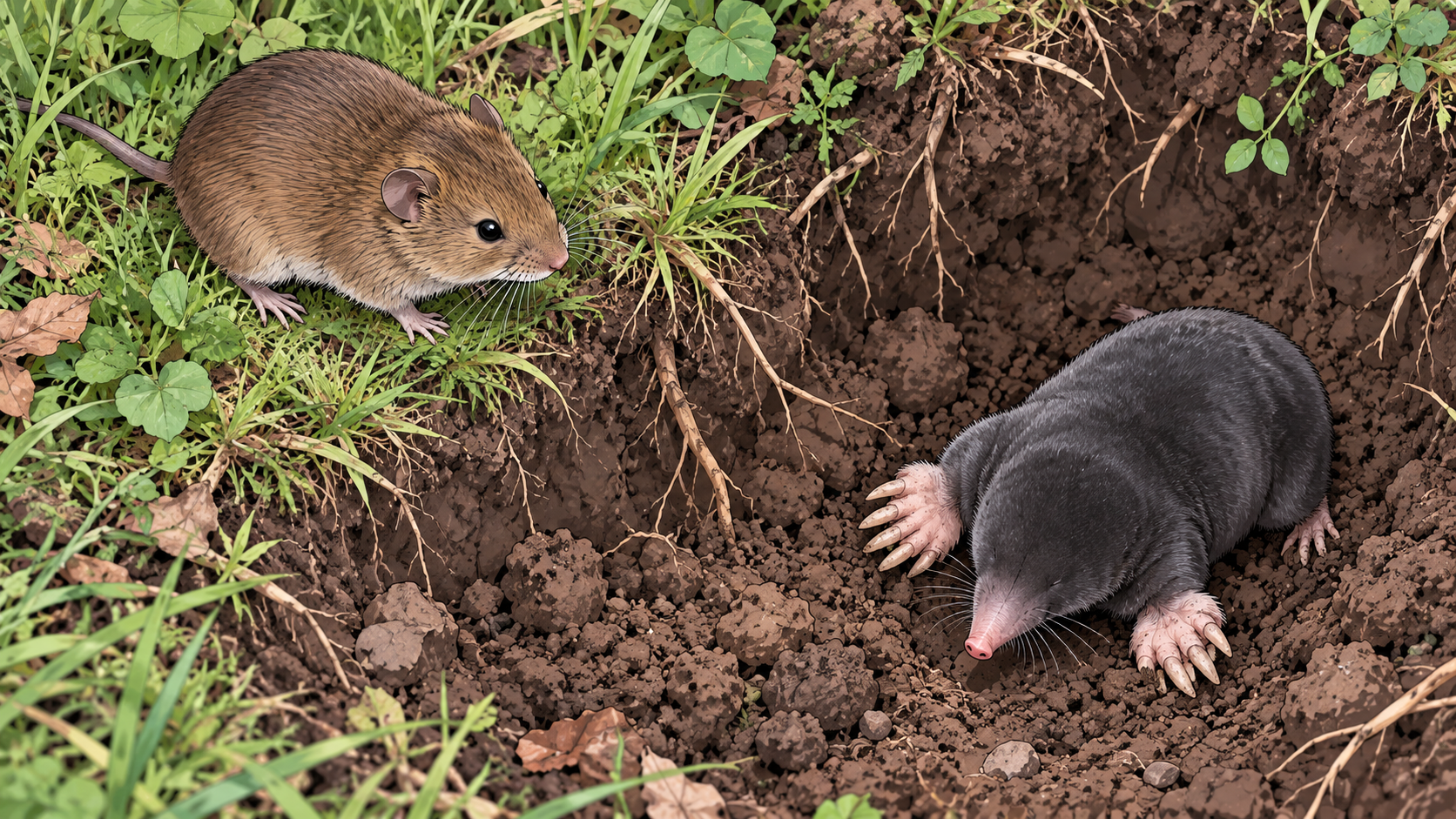
A vole looks like a stocky mouse with a blunt nose, small visible eyes, and ordinary front feet, while a mole has a pointed snout, tiny concealed eyes, and broad, outward-facing front feet built for digging. Voles are rodents that feed mainly on vegetation. Moles belong to a different mammalian order and hunt earthworms, insects, and other soil-dwelling invertebrates.
A quick look at the front feet is often enough to separate the two animals. If the animal is already gone, the feeding evidence and ground disturbance provide useful clues, although the same yard can support both.
Vole vs. Mole: The Main Differences
| Feature | Vole | Mole |
|---|---|---|
| General appearance | Stocky, mouse-like body | Cylindrical body specialized for digging |
| Snout | Short and blunt | Elongated and pointed |
| Eyes | Small but generally visible | Very small and concealed by fur |
| Ears | Small, often partly visible | No projecting external ear flaps |
| Front feet | Small, rodent-like paws | Broad, outward-facing digging feet with strong claws |
| Fur | Dense, generally brown or grayish | Short, dense, velvety fur |
| Main food | Grasses, seeds, roots, and other plant material | Earthworms, insects, grubs, and other invertebrates |
| Typical movement | Surface pathways and shallow burrows | Extensive underground tunnels |
| Common evidence | Narrow grass trails, gnawed plants | Raised soil ridges and excavated earth |
| Animal group | Rodent | Eulipotyphlan mammal |
The combination of specialized front feet, tiny eyes, and a pointed muzzle is particularly useful when identifying a mole. A vole has a more familiar mouse-like silhouette, but its short tail and rounded face make it different from many common mice.
A Mole’s Front Feet Look Nothing Like a Vole’s
Moles have exceptionally broad front feet that face outward, with strong claws extending from the digits. These feet are adapted for pushing through soil, allowing the animal to excavate tunnels while keeping its body underground. The eastern mole (Scalopus aquaticus) provides a recognizable example, with its large forefeet extending away from the sides of the body.
A vole’s front feet are considerably smaller and point more naturally forward. They serve ordinary walking and digging functions without the exaggerated paddle-like appearance of a mole’s forelimbs. The Penn State identification characteristics for moles and voles include this difference alongside the position of their eyes and the shape of their snouts.
Their faces are equally distinctive. A mole’s pointed muzzle extends forward from a head with no obvious neck, while its small eyes are difficult to see beneath the fur. A vole has a more rounded muzzle, small ears, and eyes that remain visible in a clear photograph. The overall appearance of voles varies among species, but none of the familiar garden voles possesses the enlarged digging forefeet characteristic of a true mole.
Neither animal should be identified from fur color alone. Brown and gray occur in both groups, and lighting can make their coats appear similar in photographs. A clear view of the head and forelimbs provides much stronger evidence.
Their Diets Explain Much of the Damage They Cause
A partially eaten tulip bulb and a raised tunnel running beneath otherwise healthy grass suggest different feeding activity. Voles eat plant material directly, including grasses, seeds, roots, and tender stems. They also gnaw bark on woody plants. Moles principally consume animals found in the soil, especially earthworms and insect larvae.
The difference is evident in the feeding habits of moles. Their underground searches target living invertebrates, not garden vegetables. Their digging can nevertheless disturb roots, loosen plants, and interfere with turf. Moles may therefore cause damage without consuming the affected plants.
Voles create more direct feeding injuries. Their incisors cut through vegetation, and repeated gnawing can injure the lower stems or roots of ornamentals. The plants and other foods voles consume explain why a property with damaged bulbs, clipped grass, or chewed bark deserves a different assessment from one showing only disturbed soil.
A particularly misleading situation occurs when voles use tunnels excavated by moles. The University of Maryland’s mole identification guidance explains that plant damage blamed on moles is frequently caused by voles. An animal responsible for digging a passage is not necessarily responsible for every damaged plant nearby.
The Ground Tells You How Each Animal Moves
The clearest difference in their ground activity is whether the animal travels through grass or pushes soil upward from beneath it. Meadow voles often create narrow, flattened pathways by repeatedly moving through and clipping vegetation. Moles excavate passages below the surface, producing raised ridges as they displace soil. The National Institute of Environmental Health Sciences’ comparison documents these contrasting patterns of movement and ground disturbance.
The surface trails made by voles can be especially visible after snow melts, when flattened grass and clipped vegetation become exposed. Mole activity tends to produce more obvious soil displacement. Their underground movements can lift sections of sod, creating uneven ground even where the grass remains intact.
Not every vole species follows the same pattern. Woodland voles, also called pine voles, spend considerably more time underground than meadow voles. Their subterranean habits and physical adaptations make a simple aboveground-versus-underground rule unreliable when these species are involved.
An individual opening in the soil is also insufficient for identifying the animal responsible. The differences between vole holes and mole holes must be assessed alongside soil disturbance and other evidence, rather than treating every small entrance as proof of one particular animal.
Why You Might See a Vole but Rarely See a Mole
Voles regularly move through vegetation above the soil, although they may remain hidden by grass, mulch, or ground cover. Moles spend most of their lives underground, using their specialized limbs to excavate and travel through soil. Their body shape, short velvety fur, and lack of projecting external ears are particularly suited to moving through confined passages.
The University of Maryland’s observations of mole behavior establish that moles rarely come to the surface. When they do appear aboveground, their movements are noticeably different from those of ordinary surface-dwelling rodents because their enlarged forefeet are specialized for digging.
A small brown animal running through grass is therefore more consistent with a vole than with a mole, provided its physical features also match. The absence of sightings, however, proves very little. Both animals can remain concealed while leaving visible evidence of their activities.
Can Voles and Moles Live in the Same Yard?
Yes. A lawn can support both because the animals use different food resources and may occupy overlapping underground spaces. Moles pursue invertebrates in the soil, while voles exploit plant material at the surface and belowground. Voles can also enter tunnels originally excavated by moles.
This overlap creates a common identification mistake. A homeowner discovers raised soil ridges near damaged plants and assumes one animal is responsible for everything. The ridges may result from mole excavation, while a vole using the same passage causes the feeding injury.
The Canadian government’s description of mole and vole activity documents both the shared use of tunnels and the different types of damage. Finding evidence of one species does not exclude the other, particularly in established gardens with extensive underground passages.
How to Decide Which Animal Is Responsible
Examine the strongest evidence first. A photograph showing broad, outward-facing forefeet establishes a mole far more convincingly than a tunnel does. If no animal has been seen, distinguish freshly displaced soil from vegetation that has been clipped or gnawed. Investigate the affected plants rather than assuming that nearby ground disturbance identifies the feeding animal.
Damage involving stripped bark deserves particular attention because voles can injure trees without creating conspicuous mole-like ridges. Natural Resources Canada’s documentation of vole feeding injury describes characteristic bark damage and clipped seedlings. The appearance and location of vole damage to trees can help establish whether the problem involves feeding rather than incidental disturbance from digging.
We would avoid selecting traps, poisons, or other treatments from tunnel appearance alone. Methods intended for plant-feeding rodents are not automatically appropriate for insect-eating moles, and incorrect identification can expose other wildlife to unnecessary risks. A reliable diagnosis should identify the animal and the damage it is actually causing before any control decision is made.