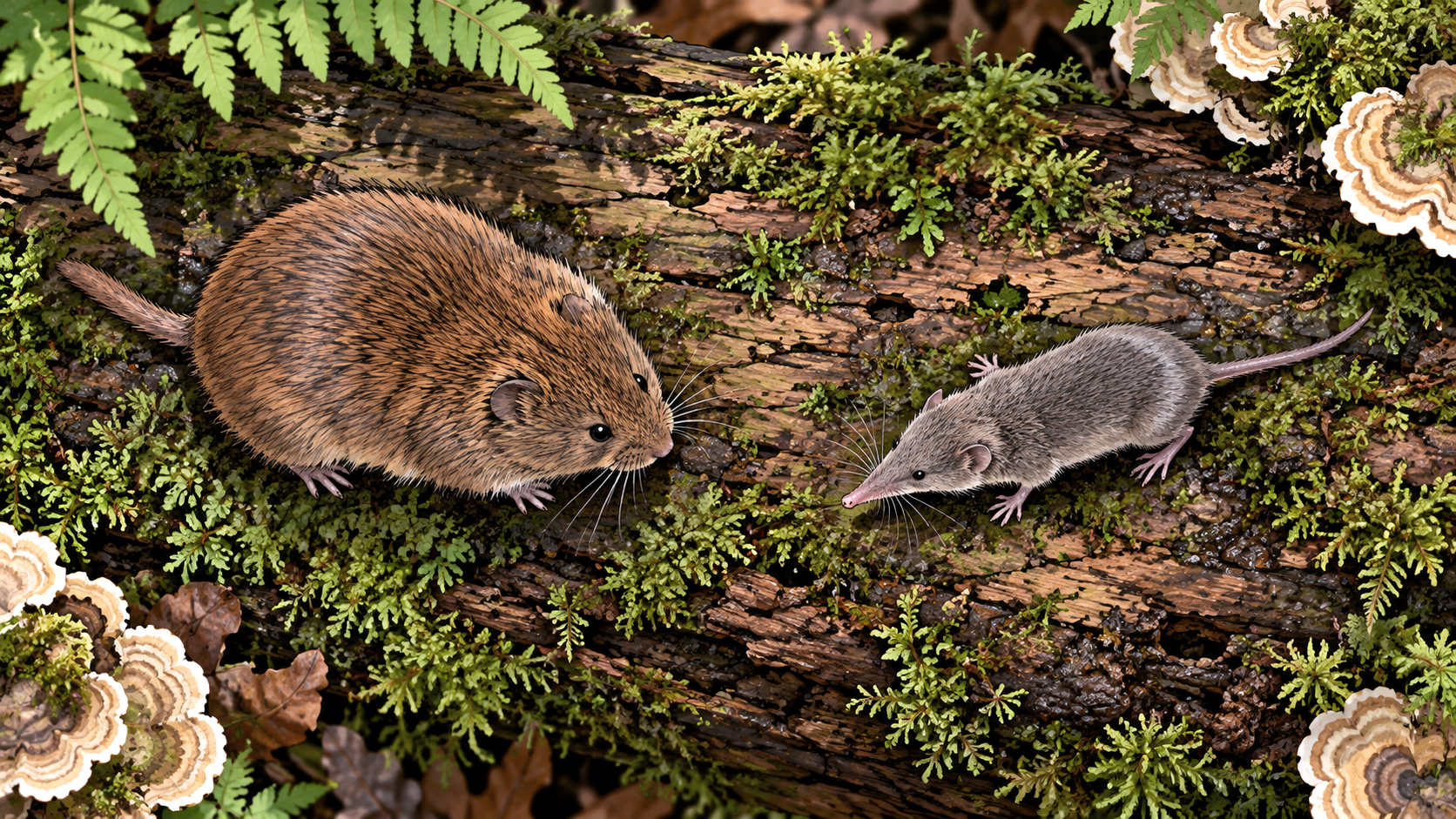
A vole has a rounded, blunt nose, a stocky body, and prominent gnawing incisors, while a shrew has a long, pointed snout, tiny eyes, and sharp teeth adapted to catching small animals. Voles are rodents that eat mainly vegetation. Shrews belong to a separate mammalian order and feed primarily on insects, worms, and other invertebrates. Both occur in gardens, fields, and wooded areas, making them easy to confuse during a brief encounter.
The most useful feature is the shape of the face. A shrew’s nose extends forward beyond its mouth, producing a pointed profile that remains recognizable even when the animal is moving. A vole’s shorter muzzle blends into a broader head. Feeding evidence can help when the animal disappears before you get a close look.
Vole vs. Shrew: Physical Differences
| Feature | Vole | Shrew |
|---|---|---|
| Snout | Short, broad, and blunt | Elongated and pointed |
| Body | Stocky, rounded | Often slender, although short-tailed shrews can be chunky |
| Eyes | Small but visible | Extremely small and often difficult to see |
| Ears | Small, partly hidden in fur | Usually concealed by fur |
| Front teeth | Broad, chisel-shaped incisors | Sharp, pointed teeth for grasping prey |
| Tail | Usually short and fur-covered | Short or long, depending on species |
| Fur | Dense, often brownish or grayish | Fine, dense, often velvety |
| Main diet | Grasses, seeds, roots, and other vegetation | Insects, earthworms, spiders, and other small animals |
| Typical feeding evidence | Clipped plants and gnawed vegetation | Little direct plant-feeding damage |
The physical identification characteristics of voles include the rounded muzzle and specialized gnawing teeth. Shrews have a different dental arrangement and a narrower facial profile, although their body shapes vary enough that size alone cannot reliably separate the two groups.
A Shrew’s Pointed Snout Is Its Most Recognizable Feature
A shrew’s muzzle projects conspicuously beyond the mouth, creating a tapered head with a mobile, sensitive nose. The nostrils sit near the tip, while the eyes and ears are much less noticeable. This profile is particularly recognizable in long-tailed shrews belonging to the genus Sorex, although short-tailed shrews in the genus Blarina also possess projecting snouts.
Voles have a broader facial outline. Their nose ends closer to the front of the mouth, and their rounded heads blend into compact bodies. The Missouri Department of Conservation’s shrew descriptions document the projecting muzzle across several shrew species, including the least shrew (Cryptotis parva) and northern short-tailed shrew (Blarina brevicauda).
A short-tailed shrew can complicate identification because its chunky body resembles that of a vole. Its ears are concealed, the eyes are tiny, and its tail is short. A photograph showing only the back may therefore reveal little. The profile of the nose becomes far more useful than the animal’s general roundness.
The presence of whiskers does not resolve the identification because both animals possess them. Instead, examine how far the muzzle projects and whether the head narrows noticeably toward the nose.
Their Teeth Reveal Two Different Feeding Adaptations
The differences become unmistakable when examining their teeth. Voles possess the paired, chisel-shaped incisors characteristic of rodents. These front teeth grow continuously and are used to cut and gnaw material. Behind the incisors is a gap separating them from the cheek teeth, which grind food.
Shrews have numerous sharp teeth adapted for grasping and processing prey. Their front teeth do not form the same broad, continuously growing gnawing arrangement. The Canadian Museum of Nature’s examination of small-mammal skulls demonstrates how dental structure separates shrews from voles and mice, even when their external appearances are similar.
Some shrews also have darkly pigmented tooth tips. In species belonging to Sorex and Blarina, reddish pigmentation can make the teeth appear strikingly different from the familiar incisors of a rodent. The precise tooth arrangement is especially useful to mammalogists identifying skulls or skeletal remains.
For a homeowner, dental characteristics are best treated as supporting evidence from clear photographs or professionally examined specimens. Capturing an unfamiliar wild mammal to inspect its mouth creates unnecessary risks and is not needed for ordinary identification.
Why Voles Damage Plants While Shrews Hunt Invertebrates
The most practical difference between the two animals concerns what they eat. Voles consume substantial amounts of plant material, particularly grasses, herbaceous vegetation, seeds, and underground plant tissues. Shrews hunt small animals, including insect larvae, beetles, earthworms, spiders, slugs, and other invertebrates.
A masked shrew (Sorex cinereus) may consume different prey depending on its geographic location. Populations studied in Michigan fed heavily on ants, while insect larvae were prominent in observations from New Brunswick. Coastal populations in Nova Scotia consumed additional invertebrates associated with their local environments.
Vole feeding produces a different kind of evidence. Clipped grass, damaged roots, and gnawed stems are consistent with the plant-based feeding habits of voles. Shrews may consume occasional plant material, particularly certain short-tailed species, but vegetation is not their principal food source.
This has a useful consequence for garden identification. Finding a shrew beside a damaged flower bed does not demonstrate that it ate the flowers. It may be hunting insects or other invertebrates living beneath the plants. Direct evidence of gnawing or clipped vegetation provides a stronger reason to investigate a plant-feeding rodent.
The University of New Hampshire’s orchard wildlife guidance identifies this feeding difference when distinguishing woodland and meadow voles from northern short-tailed shrews. The animals may occupy the same cultivated area without causing the same type of injury.
Why Shrews Can Move Through Vole Runways Without Being Voles
A narrow pathway beneath grass does not necessarily contain only the animal that created it. Voles repeatedly travel through vegetation, producing recognizable surface routes. Shrews can use existing passages while searching for invertebrate prey, particularly where those routes provide sheltered access beneath dense vegetation.
The National Institute of Environmental Health Sciences’ identification information documents shrews using tunnels and runways established by other small mammals. This shared use can mislead homeowners who assume the most recently observed animal created every nearby passage.
Voles are more closely associated with the formation of surface runways through grass. Shrews generally exploit suitable cover and existing passages rather than producing the characteristic networks of clipped vegetation associated with meadow voles.
Imagine finding a narrow grass trail and then watching a pointed-nosed animal disappear into it. The animal may be a shrew hunting within a passage previously used by voles. Its presence does not establish which species originally formed the trail or whether the vegetation damage nearby resulted from the same animal.
Their Behavior Offers Supporting Clues, but Movement Alone Is Unreliable
Shrews are active predators that investigate leaf litter, soil surfaces, and other sheltered places where small prey lives. They often move quickly, stopping to investigate crevices or capture food. Their feeding requirements are high relative to their size, and the documented feeding habits of North American shrews reflect the substantial energy demands of these small mammals.
Voles also move rapidly and regularly explore their surroundings, but their movements are often associated with established routes and feeding areas. Seeing an animal dart beneath a shrub therefore does not identify it as either a shrew or a vole. Both can react quickly to disturbance.
The setting may provide additional context. A shrew searching through damp leaf litter may be hunting invertebrates, while a vole clipping grass follows a different feeding pattern. However, vole habitat preferences overlap with environments supporting several shrew species, particularly sheltered grasslands and wooded edges.
Sound, speed, and the time of a sighting should remain secondary evidence. Both groups include species with different activity patterns, and a brief movement through vegetation reveals little about the animal’s identity.
Which Animal Did You Find in Your Garden?
A clear side photograph can often settle the general identification without capturing the animal. Look first at the muzzle. A distinctly elongated, pointed nose favors a shrew, while a blunt face favors a vole. Examine the eyes, ears, and overall body shape next, particularly when the photograph includes enough detail to show how the head joins the body.
If the animal has already disappeared, examine the actual damage rather than relying on its last location. Clipped grass and gnawed plants support the presence of plant-feeding animals, while a shrew hunting through leaf litter may leave little obvious feeding damage. The presence of both animals on the same property remains possible.
The differences between voles and mice can also become relevant when an animal’s nose and tail are difficult to see, since several small mammals share superficially similar coats and body sizes. Likewise, vole and mole identification involves another animal that may occupy overlapping ground-level habitats but has markedly different digging adaptations.
We would photograph the animal from a distance and preserve the original image, including the full head and tail. Record where it appeared and any direct feeding behavior you observed. Avoid setting traps or using pesticides simply because a small mammal was seen near damaged plants. Misidentifying a shrew as a vole can lead to unnecessary treatment while leaving the actual source of plant damage unresolved.