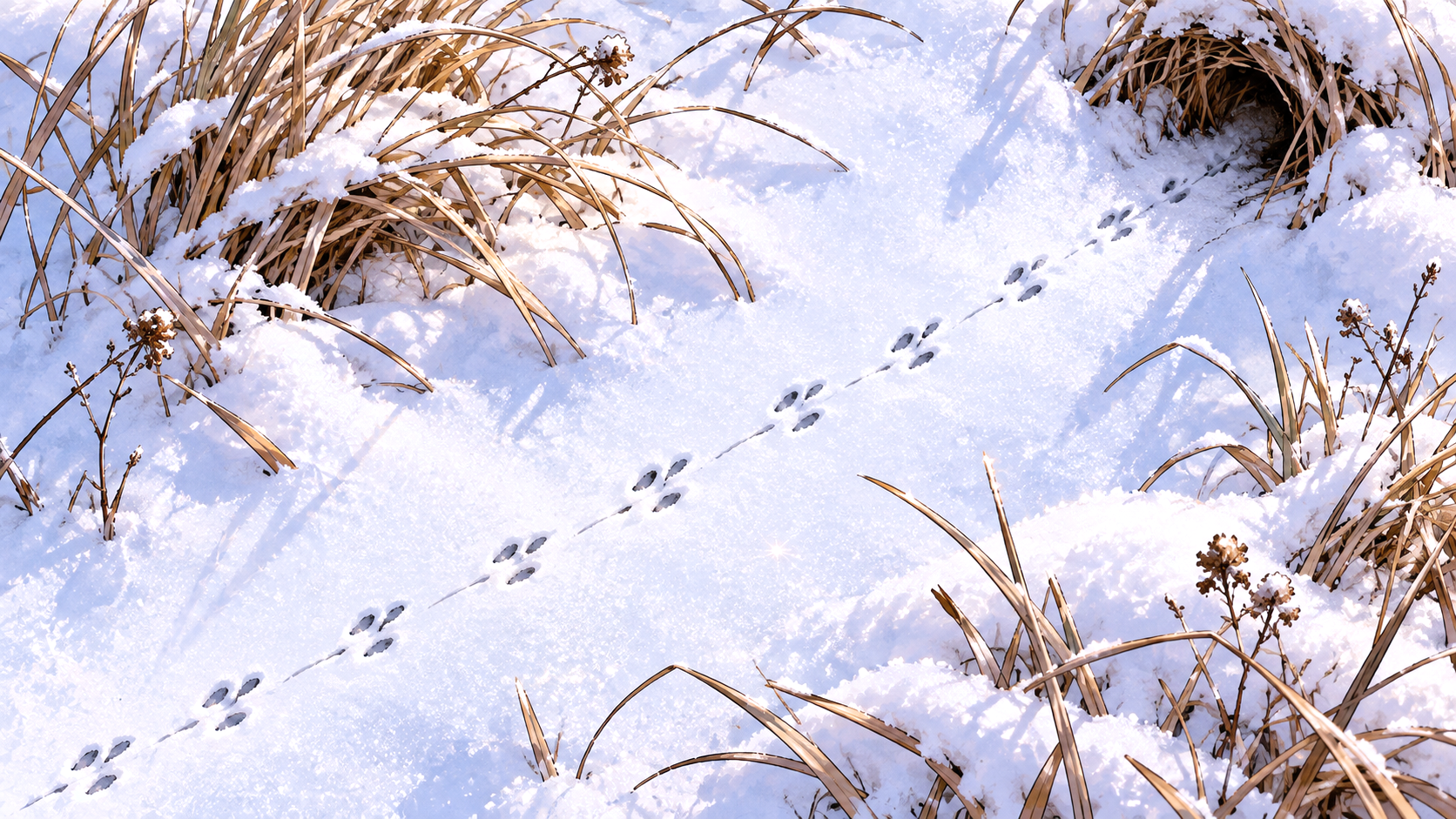
Vole tracks in snow look like tiny, closely spaced footprints forming an alternating or paired pattern across the surface. Meadow voles typically leave impressions smaller than an inch, with four toes on each front foot and five on each hind foot. Their tracks may resemble two uneven rows of small marks, sometimes interrupted by a smooth stretch of snow where the animal moved quickly or disappeared beneath the snowpack.
Unlike many mice, which frequently leave recognizable bounding patterns and tail-drag lines, voles commonly walk or trot across snow. Their relatively short tails make continuous drag marks less characteristic, although neither gait nor tail marks alone can establish the animal’s identity.
What Individual Vole Footprints Look Like
A clear meadow vole footprint resembles a miniature paw print, with slender toes extending from a small central pad. The front feet have four toes, while the hind feet have five. In firm snow, individual toes may register distinctly, but claws are not always visible. The front prints are approximately 0.15–0.25 inches across, with hind footprints measuring approximately a quarter-inch.
These measurements describe meadow voles rather than every species. The different types of voles vary in their body dimensions, and the tracks of larger species need not match those of smaller grassland voles. Snow texture also influences the apparent width of a footprint, making a print in soft powder look different from one pressed into a firm surface.
Individual impressions rarely preserve every anatomical detail. A clear front print may show four thin toe marks surrounding a tiny pad, but overlapping footprints can obscure the pattern. Hind feet sometimes land partly or completely on earlier front prints, creating a single mark that appears larger or more complicated than either foot alone.
The combination of four front toes and five hind toes is useful for recognizing a small rodent. It does not distinguish voles from mice, however, because both groups share the same basic toe arrangement.
Voles Often Leave a Walking or Trotting Pattern
A meadow vole crossing an exposed patch of snow commonly travels using a walking or trotting gait. Its footprints form alternating marks on either side of the direction of travel, sometimes producing a pattern resembling small beads arranged in a loose chain.
During a trot, the hind foot can land near or directly on the impression made by the front foot. This overlapping placement is called direct registration. When the feet register together, the trail may appear to contain fewer footprints than the animal actually made.
Meadow vole tracks commonly occur in closely grouped pairs, with front and hind feet appearing together on alternating sides. The arrangement becomes easier to recognize by following several consecutive groups rather than examining one isolated footprint.
Voles can also change their gait. A frightened animal moving rapidly across exposed snow may leave a different arrangement from one walking through sheltered vegetation. An unusual sequence of marks does not automatically exclude voles, particularly where the animal changes direction, accelerates, or encounters uneven snow.
How to Distinguish Vole Tracks From Mouse Tracks
The difference is often clearer in the overall trail than in an individual footprint. Meadow voles commonly produce a sequence of alternating or closely grouped impressions, while deer mice frequently move across exposed snow by bounding. Their hind feet land ahead of the front feet, leaving repeated clusters of four footprints.
A mouse’s proportionally longer tail may drag along the snow, creating a thin line between successive clusters. Voles have shorter tails, so their trails less frequently display an obvious continuous tail mark. The Ottawa Field-Naturalists’ Club comparison of winter tracks illustrates the different patterns produced by meadow voles and deer mice.
The physical differences between voles and mice explain why the animals leave somewhat different movement patterns. However, track arrangement cannot substitute for a clear view of the animal. Mice sometimes walk, voles can bound, and both may leave incomplete impressions.
A trail with four-print clusters and a frequent tail mark is more consistent with a mouse. Alternating pairs without an obvious drag line are more consistent with a vole. Neither pattern alone identifies the exact species.
Why Vole Tracks Sometimes Disappear Into the Snow
A line of tiny footprints may end at a dark opening in the snow, with no visible continuation on the surface. The animal may have descended into the sheltered space between the ground and the snowpack, where voles commonly travel during winter.
Meadow voles spend much of the cold season beneath snow rather than crossing its exposed surface. Their movements can therefore remain invisible until they emerge through an opening, traverse a short distance, and return below. The winter movements of meadow voles can leave short, necklace-like track sequences that begin and end at openings in the snow.
Where snow cover is deep, the absence of surface footprints does not establish that voles have left the area. Voles remain active beneath winter snow, even when no animal has crossed its upper surface.
The opening at the end of a trail should not automatically be described as an underground burrow entrance. It may simply be a passage through the snowpack, connecting the surface with the sheltered space below.
Fresh Powder and Melting Snow Can Distort the Tracks
Footprints register differently depending on the snow’s depth, moisture, and surface condition. Thin snow over firm ground can preserve distinct toe marks when the animal’s weight compresses the surface. Loose powder may collapse around the feet, leaving rounded depressions with little recognizable detail.
Melting and refreezing change the appearance further. As a print warms, its edges can soften and widen, causing an originally small impression to appear considerably larger. Wind can partially fill the marks, while additional snowfall may conceal them completely.
Wildlife tracks can reveal movement and behavior, but their interpretation depends on the conditions in which they were formed and subsequently preserved. A sequence of indistinct depressions cannot be assigned to a vole simply because each mark appears small.
Direction changes and interruptions are also important. A track crossing compacted snow may look crisp for several inches before disappearing into softer material. The animal has not necessarily gone underground at that point; its feet may simply have stopped leaving recognizable impressions.
For the clearest observations, examine the trail before wind, melting, or additional snowfall alters its appearance. Photographing the prints with a ruler beside them preserves their apparent size and spacing.
How Much Can Snow Tracks Tell You About Voles in Your Yard?
A convincing vole track sequence establishes that a small rodent has crossed the snow, especially when the pattern agrees with a direct sighting. It cannot establish how many voles occupy the property, where every animal travels, or whether the same route is used regularly.
A single animal may cross an area several times, producing multiple trails. Conversely, several voles may use the same opening in the snow without leaving distinguishable individual routes. The number of voles present in a yard cannot be calculated by counting track lines.
The timing of vole activity during daylight and darkness also means footprints found in the morning cannot automatically be attributed to nighttime movement. Tracks establish that an animal passed through an area after the snow surface formed, not the exact hour of its passage.
If an animal is observed crossing snow, a photograph showing its body and tail can strengthen the identification. The appearance of a vole provides evidence that individual footprints alone may not preserve.
When no animal is visible, follow the sequence far enough to recognize its gait, record the snow conditions, and compare multiple undisturbed prints. A short trail with unclear toe marks is best treated as evidence of an unidentified small mammal rather than a confirmed vole.