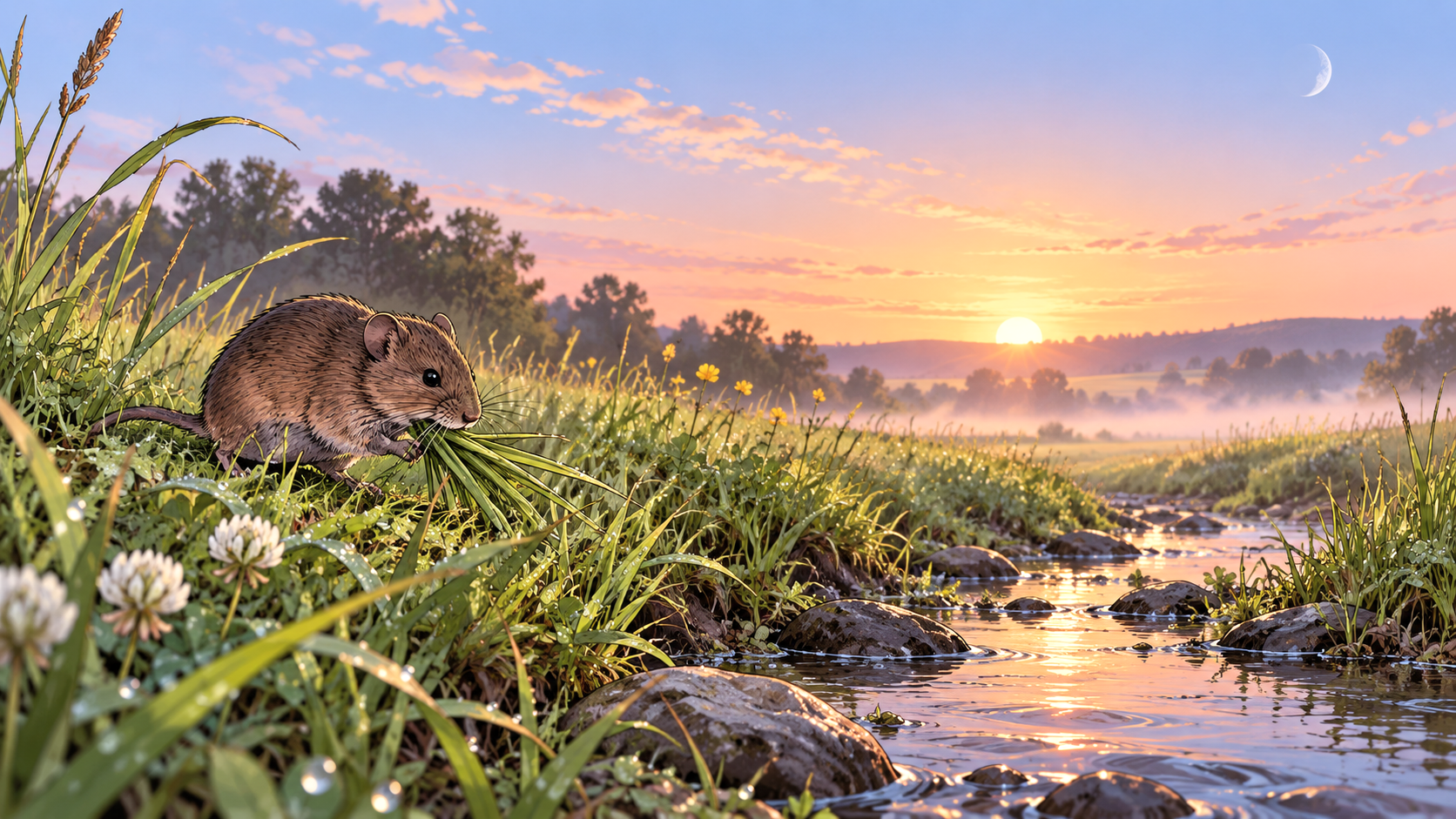
Voles are active during both the day and night, although their busiest hours vary by species and environmental conditions. Meadow and woodland voles commonly show increased activity around dawn and dusk, while some common voles are predominantly active during daylight. Prairie voles alternate between short periods of activity and rest throughout the 24-hour cycle. Seeing a vole in broad daylight is therefore entirely normal.
Their schedules also differ from the uninterrupted nighttime activity people often associate with nocturnal animals. Many voles follow several shorter activity cycles rather than remaining awake throughout the night and resting continuously during the day. The timing of those cycles can shift with temperature, daylight, vegetation cover, and the animal’s immediate surroundings.
Voles Do Not All Follow the Same Daily Schedule
Research on the common vole (Microtus arvalis) provides a particularly interesting example of daytime activity. In an outdoor enclosure study, researchers monitored animals moving between burrows, pathways, and feeding sites. The recorded activity patterns of common voles showed that most surface movement occurred during daylight, with little activity detected along pathways at night. Burrowing and food-storage activity also occurred predominantly during the day, particularly around dawn and dusk.
The animals followed a short-term rhythm of approximately two hours during daylight. They emerged repeatedly rather than remaining continuously active, and their movements were synchronized across the population. Interestingly, voles kept in cages within the enclosure showed extensive nighttime wheel-running activity even when their free-moving counterparts remained largely underground. Laboratory movement therefore did not accurately reproduce every aspect of their natural surface behavior.
Prairie voles (Microtus ochrogaster) show a different pattern. A study recording their spontaneous movement and heart rate found no significant difference between average daytime and nighttime activity. Instead, the animals followed recurring active and resting periods lasting approximately two to four hours. This pattern is known as an ultradian rhythm, meaning the cycle repeats more frequently than once every 24 hours.
Such findings explain why a vole can appear in the same grassy area during the morning, afternoon, and evening without exhibiting abnormal behavior. The different types of voles cannot all be assigned one daily schedule, even when they occupy similar environments.
Dawn and Dusk Are Common Periods of Activity
Meadow voles (Microtus pennsylvanicus) and woodland voles (Microtus pinetorum) are active during daylight and darkness, with increased activity often occurring around sunrise and sunset. These periods provide changing light conditions while allowing the animals to continue feeding and moving through familiar areas.
The documented daily behavior of meadow and woodland voles identifies dawn and dusk as common activity peaks. However, a vole observed at midday does not contradict this pattern. Peak activity refers to periods when movement is especially frequent, not exclusive hours during which the animal is awake.
European bank voles (Clethrionomys glareolus, also published as Myodes glareolus) provide another example of activity concentrated around particular light conditions. In a controlled study of bank vole feeding and movement, males showed their greatest activity during dusk, while females exhibited less predictable schedules. Solitary females sometimes displayed an additional morning activity peak.
Differences among individuals can therefore exist within a single species. Sex, reproductive condition, and local conditions influence how activity is distributed across the day. An animal’s appearance at an unexpected hour is insufficient evidence that it belongs to another species.
Temperature and Seasonal Conditions Can Change Their Active Hours
Cold weather can alter the balance between daytime and nighttime movement. Research on common voles found that nighttime activity decreased during colder periods. The seasonal investigation of common vole behavior identified temperature, reproductive condition, age, and habitat structure among the variables associated with these changes.
The study also demonstrated that juveniles and reproductively active animals showed different activity patterns from other individuals. Voles occupying habitats with extensive underground passages exhibited greater nocturnality, showing that the structure of the environment can influence when animals move.
A study of root voles (Microtus oeconomus) further documented daytime-biased activity in outdoor enclosures, with pronounced movement around sunrise and sunset. The recorded activity cycles of root voles included approximately seven bouts of movement during a 24-hour period.
These changes concern the daily timing of movement. The broader question of vole activity during winter involves additional seasonal behavior and should not be inferred solely from whether animals are visible during daylight.
Artificial Lighting Can Affect Vole Activity
Natural sunlight is not the only source of illumination capable of influencing a vole’s behavior. Artificial lighting can change when animals use particular areas, even at relatively low intensities.
Researchers investigated bank vole populations in outdoor enclosures exposed to low-intensity nighttime lighting over seven months. The experiment involving artificial light and bank vole movement found changes in nocturnal activity and space use. Under certain moonlight conditions, animals exposed to artificial lighting were more active at night than those in unlit enclosures.
The effects were not identical under every lighting condition. Lunar illumination interacted with artificial lighting, demonstrating that the brightness of the environment can influence behavior in more complicated ways than a simple preference for darkness.
A porch light illuminating a garden should therefore not be treated as a reliable vole deterrent or as a means of predicting exactly when an animal will emerge. The experimental findings establish behavioral responses to illumination, not a universal rule for residential lighting.
Why You Might See More Voles at Certain Times
A homeowner’s sightings reflect when voles become visible, which is only part of their daily activity. An animal moving beneath thick grass can remain concealed even while feeding or traveling. When it crosses exposed soil, a walkway, or a short section of lawn, the same activity becomes much easier to notice.
Vegetation influences these encounters because the surface pathways used by voles frequently pass beneath protective grass. The characteristics of suitable vole habitats also affect how much activity takes place out of view.
A particularly useful comparison comes from research on free-living bank voles in the Netherlands. Researchers analyzed 17,065 camera-trap recordings and found that activity was generally concentrated between sunset and sunrise. The observed rhythms of wild bank voles also shifted seasonally, with changes in the timing of activity peaks as daylight hours changed.
One afternoon sighting cannot establish that a vole is primarily diurnal, just as one nighttime sighting cannot establish nocturnality. Repeated observations over several days provide a more meaningful record of when the animal uses a particular location.
When Should You Watch for Voles in Your Yard?
Early morning and evening are reasonable observation periods for properties where meadow or woodland voles are suspected, but daylight inspections can also reveal active animals. There is no need to wait until midnight or assume the absence of sightings during one period means the animals are inactive.
For a more useful record, observe the same location at different times without disturbing the vegetation. Note whether the animal was moving through exposed ground, crossing a grass pathway, or feeding. A stationary camera aimed at an existing travel route can document activity without requiring someone to remain outside watching continuously.
We would avoid interpreting activity timing as evidence of an infestation’s size. The signs of voles occupying a yard are more informative when assessed alongside actual ground and plant evidence. Frequent sightings may reflect an exposed travel route or favorable observation conditions rather than a larger number of animals.
The most useful observation is a repeatable pattern tied to a particular location. Recording when and where an identifiable vole appears gives you information about its movements without assuming that every vole follows the same clock.