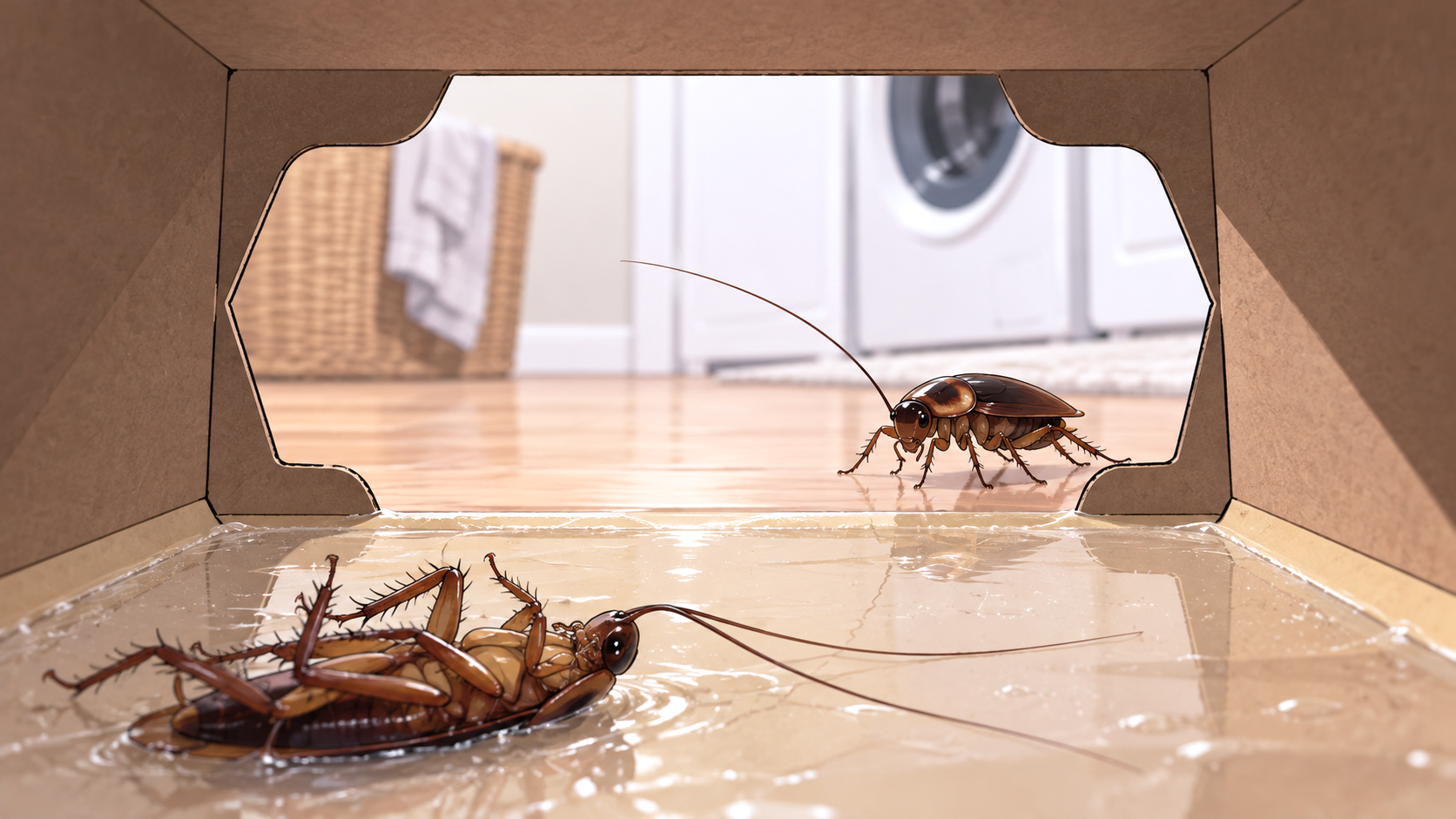
A Roach Motel promises an easy way to catch cockroaches without spraying insecticides around your home. The small cardboard enclosure contains an attractant and sticky adhesive that traps insects when they enter. But catching a few cockroaches is not necessarily the same as eliminating the population they came from.
Black Flag Roach Motel traps work for capturing cockroaches and monitoring their activity. Their adhesive can retain insects that enter, and the enclosed design keeps captured cockroaches largely out of sight. However, Roach Motels are not a dependable standalone treatment for an established infestation because they only capture insects that encounter the trap. They are most useful for detecting cockroach activity, identifying heavily affected locations, and checking whether other control measures are reducing the population.
What Is Inside a Roach Motel?
The original Black Flag Roach Motel is a rectangular cardboard trap containing sticky adhesive and an attractant intended to encourage cockroaches to enter. Both ends remain accessible to crawling insects, while the enclosure hides much of the captured material.
Unlike a poisoned bait station, the standard Roach Motel contains no insecticidal active ingredient. It relies on physical entrapment rather than a chemical that the cockroach must ingest. Captured insects become stuck to the adhesive and eventually die, but death is not necessarily immediate.
The product is marketed for cockroaches, palmetto bugs, waterbugs, crickets, spiders, and certain other crawling arthropods. These claims describe the kinds of insects the adhesive can capture, not proof that the trap will eradicate populations of every listed pest.
This distinction is particularly relevant when dealing with different cockroach species. A small German cockroach and a much larger American cockroach may both become trapped, but differences in their movements and habitats affect how frequently they encounter an indoor monitor.
Has the Roach Motel Been Scientifically Tested?
Yes. An early field study directly compared Black Flag Roach Motel with two versions of Raid cockroach traps, providing evidence beyond manufacturer advertising. The 1978 study published in Insecticide and Acaricide Tests examined three trap designs in Indianapolis apartments with severe German cockroach infestations. The products included a Zoecon Black Flag Roach Motel containing attractant, a Raid trap without attractant, and a Raid trap with attractant. Researchers positioned traps in several kitchen and storage locations to compare their capture performance.
The study establishes that Roach Motel was included in controlled field comparisons. However, it does not establish that the current formulation is superior to every competing product or that trapping alone eliminates a breeding population.
More broadly, the University of California’s cockroach management guidance identifies commercial glue traps as effective tools for detecting activity and comparing conditions across affected areas.
For a homeowner, the practical value is straightforward: a Roach Motel can provide physical evidence of cockroaches that might otherwise remain unseen.
Where Should You Put Roach Motels?
Placement is the main factor a homeowner can control. A trap in an open area where cockroaches rarely travel may remain empty, even when several insects are active nearby.
Black Flag recommends positioning Roach Motels in corners, along walls, beneath sinks, inside cabinets, and behind appliances. These locations give crawling cockroaches opportunities to encounter the trap during ordinary movement.
The EPA’s school pest-management manual explains that sticky traps perform best along established cockroach travel routes and should not be expected to attract insects from distant hiding places.
A Roach Motel should therefore be positioned against an accessible edge rather than isolated in the middle of a room. Keep its entrances unobstructed, and avoid locations where water, dust, or loose debris can interfere with the adhesive.
For example, a trap beside a refrigerator may catch cockroaches moving along the adjoining wall, while one placed on a kitchen island may receive few visitors. The distance cockroaches travel while foraging varies, but even active insects do not necessarily encounter every trap in a room.
How Long Does a Roach Motel Take to Work?
A cockroach can become trapped as soon as it enters, but you may not catch anything immediately after opening the package.
Black Flag instructs users to allow three to four days before judging a newly positioned trap. If it remains empty, the manufacturer recommends moving it to another location.
An empty trap after one night does not demonstrate that the room is cockroach-free. The insects may be using different travel routes, remaining concealed, or simply not encountering the opening.
If several traps are being used, record their locations and the number of cockroaches collected at each inspection. The University of Florida’s assessment-based cockroach management guidance recommends numbering and dating monitoring traps so changes in captures can be evaluated consistently.
A trap that repeatedly catches insects provides stronger evidence of nearby activity than one that catches a single cockroach over several weeks.
When Should You Replace a Roach Motel?
Black Flag’s Roach Motel has an unusual feature: when one adhesive side becomes full, the manufacturer instructs users to flip the trap over and use the other side. Once both sides are full, the entire trap should be discarded.
Replacement may also be necessary when the adhesive becomes ineffective through dust, dirt, or other contamination. An empty but dirty trap should not be assumed to remain useful indefinitely.
The University of Florida recommends replacing sticky monitors when their adhesive becomes covered, wet, or contaminated with dust. These conditions interfere with effective capture, regardless of how long the trap has been installed.
Black Flag does not specify a universal calendar replacement interval for every Roach Motel. Actual service life depends on the number of insects caught and the condition of the adhesive.
Because the trap may contain living insects, avoid opening the cardboard enclosure to inspect or remove individual cockroaches. Dispose of a spent trap in a sealed rubbish bag, and prevent children or pets from handling it.
Are Roach Motels Safe Around Children and Pets?
The standard Roach Motel’s absence of insecticide eliminates the specific concern of exposure to a poisoned bait ingredient. However, pesticide-free does not mean the trap presents no hazards.
The adhesive is extremely sticky and may attach to skin, hair, fur, or household materials. Its enclosure can also contain trapped insects and biological debris.
Black Flag recommends keeping used traps away from children. If the adhesive contacts skin, the manufacturer advises gently rubbing the affected area with vegetable oil before washing with soap and water.
Roach Motels should be positioned where pets cannot reach or disturb them. A curious dog or cat may pull the cardboard enclosure apart or come into contact with the adhesive.
The EPA’s pest-control guidance for housing managers recognizes glue traps as useful monitoring devices while emphasizing appropriate pest-management practices around occupied buildings.
For households concerned about chemical exposure, a correctly positioned Roach Motel offers a pesticide-free way to detect cockroaches without introducing insecticide into the immediate area.
Why Roach Motels Usually Cannot Eliminate an Infestation
An established infestation may contain adults, immature cockroaches, reproductive females, and insects occupying inaccessible spaces. A Roach Motel only affects individuals that enter its adhesive enclosure.
The University of Maryland Extension explicitly states that sticky traps are not effective as a primary method of controlling cockroach populations. Their principal value lies in detecting insects, locating concentrated activity, and evaluating other interventions.
A trap catching ten cockroaches might appear successful, but the capture tells you little about how many individuals remain elsewhere. The number of eggs female cockroaches can produce also means an established population can continue developing while some foraging adults are removed.
The manufacturer itself recommends using additional pest-control measures for heavy infestations, treating the Roach Motel primarily as a means of trapping and continued observation.
If catches remain high over successive checks, the results suggest that the problem requires attention beyond installing more cardboard traps. The evidence used to determine whether cockroaches are gone depends on sustained monitoring rather than a single trap reaching capacity.
Is a Roach Motel Worth Buying?
A Roach Motel is worth considering when you want a simple, pesticide-free method for collecting cockroaches and identifying where they are active. Its enclosed construction is convenient for households that prefer not to see trapped insects, and its two usable adhesive sides make it practical for continued monitoring.
It is less suitable when the expectation is complete extermination. The trap cannot reach cockroaches that never enter it, and a heavily infested home may contain far more insects than several Roach Motels can capture.
For an isolated cockroach sighting, the trap may provide useful evidence about whether additional activity occurs. For a confirmed infestation, its strongest role is measuring the outcome of other management efforts.