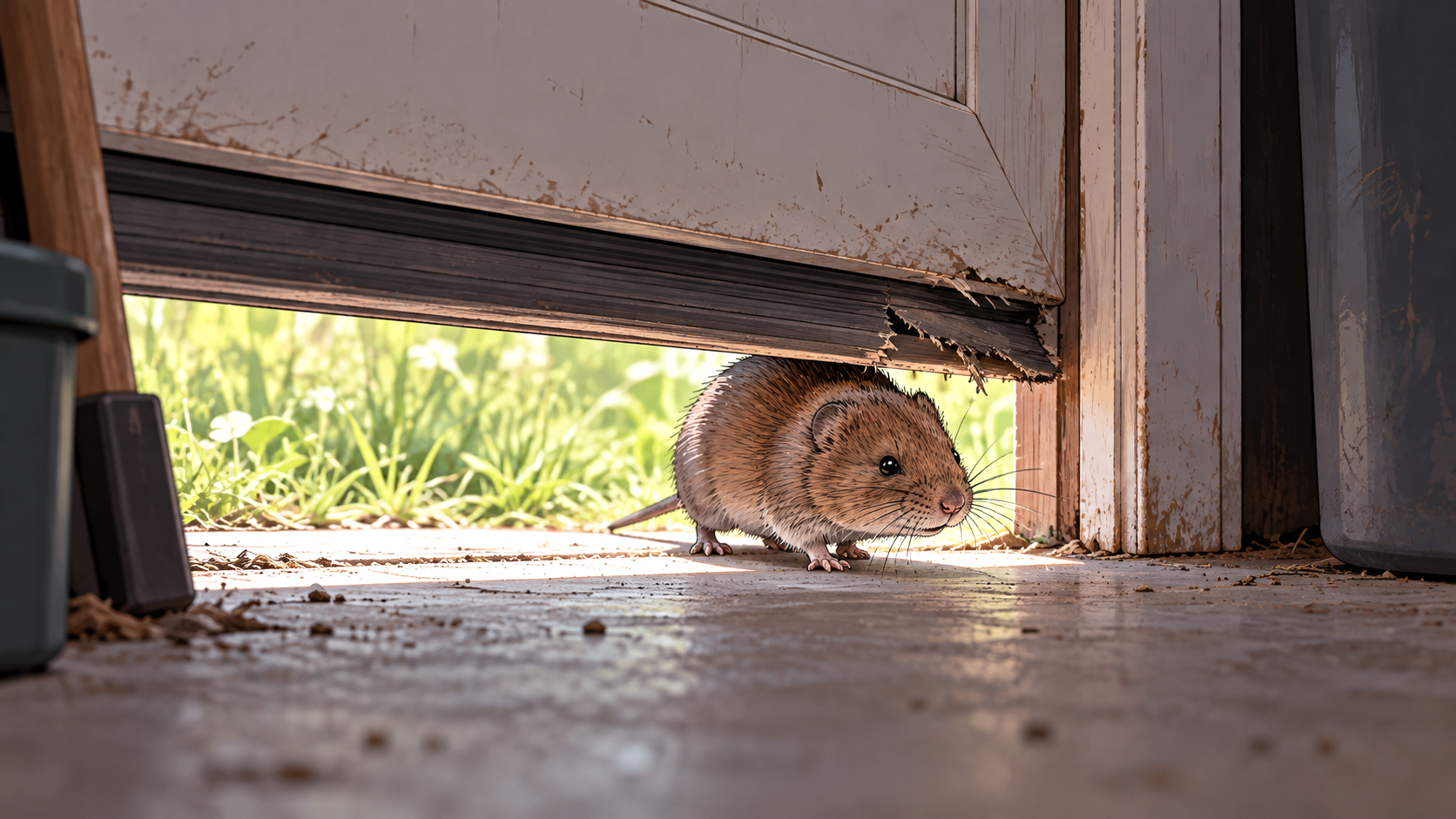
Voles can get into your house, but indoor encounters are uncommon and usually accidental. Unlike house mice, which readily establish themselves inside buildings, voles are primarily outdoor rodents. When one enters a home, it has usually taken advantage of an existing ground-level opening rather than deliberately seeking an indoor nesting site.
A vole might appear in an attached garage, basement, or other space with direct access to the outdoors. Finding one does not automatically mean there is an infestation inside the walls. Identifying the animal correctly is especially important because a juvenile mouse can resemble an adult vole, and the two animals behave differently around buildings.
Why Voles Rarely Live Inside Houses
Voles normally occupy environments where they can move beneath vegetation and feed on plants. Their usual activities take place in lawns, fields, gardens, and other sheltered outdoor areas rather than kitchens, attics, or household storage spaces. Even when a substantial population occupies the surrounding landscape, indoor activity remains unusual.
Their ground-dwelling habits and preference for dense vegetation help explain why they seldom become established indoors. A vole entering a building encounters a different environment from the grassy or vegetated surroundings in which it ordinarily lives. The animal may explore the space or remain temporarily concealed, but occasional entry should not be confused with a resident population.
The vegetation and shelter found in vole habitats are generally absent from finished indoor rooms. Voles also feed mainly on grasses, seeds, roots, and other plant material, whereas house mice readily exploit the varied foods and nesting materials available indoors.
These differences are substantial enough that indoor vole invasions are considered rare. Nevertheless, occasional entry is documented, and a vole observed indoors should not automatically be dismissed as a misidentified mouse.
How a Vole Can Enter a Building
An accidental indoor encounter is most plausible when an existing opening connects the building with the surrounding ground. A gap beneath an exterior door, an open garage entrance, or an unsealed opening around a low utility penetration can provide access to a small rodent.
Voles are not specialized climbers and generally remain near ground level. Their occasional accidental entry into buildings is consistent with their predominantly terrestrial behavior. Consequently, the location of an encounter can help narrow the possible entry routes.
A vole discovered in an attached garage, for example, may have entered through an open vehicle door or a gap beneath the garage door. A basement with an exterior entrance presents another possible route. An animal found upstairs requires more caution in identification, since house mice are considerably better adapted to traveling through and occupying buildings.
The ability to pass through a particular opening depends on the animal’s dimensions. House mice can enter openings approximately ¼ inch wide, but that figure should not be presented as a proven minimum opening size for every vole species. Their bodies differ, and an opening accessible to one rodent is not necessarily accessible to another.
Can Voles Enter Through Foundation Cracks?
A foundation crack can provide access if it forms a continuous opening large enough for the animal to pass through. The same applies to gaps around pipes, cables, and other services entering near ground level.
The mere presence of a crack does not establish that a vole used it. An opening may be too narrow, end within the wall, or lead somewhere inaccessible. A suspected entry route becomes more plausible when a vole is observed nearby and the gap connects directly with an area where the animal appeared indoors.
Exterior openings around utility penetrations and foundations are recognized entry points for small rodents generally. The strongest evidence of an actual vole entry route is direct observation rather than assuming every accessible-looking crack was used.
An entrance near a garden bed or grassy foundation border is plausible because voles already occupy sheltered outdoor ground cover. However, outdoor vole activity does not mean the animals will cross into the building. The overwhelming majority of encounters remain outside.
A Vole in the Garage Is Different From an Indoor Infestation
A garage can provide a temporary hiding place for a vole that wandered through an open door. Storage boxes, equipment, or materials placed near the floor may conceal the animal once it enters. A sighting in this environment is more consistent with incidental entry than repeated reports of rodents moving through interior walls.
House mice are different. They are well adapted to living close to people and can establish nests in buildings where food and shelter are available. Their presence may produce recurring signs in cupboards, storage areas, and concealed spaces.
An occasional vole may remain indoors for a period, but evidence that rodents are repeatedly feeding, nesting, and moving through household spaces should prompt a fresh identification rather than an assumption that voles have established an indoor colony.
The distinction is especially relevant when comparing a single sighting with ongoing activity. One small animal crossing a garage floor provides evidence of an encounter, not the size or permanence of a resident population.
How to Tell Whether the Animal Is a Vole or a Mouse
The tail is particularly useful. A vole has a short, fur-covered tail and a compact body with small ears partly concealed by its coat. A house mouse has a proportionally longer tail, more prominent ears, and a less rounded profile.
These differences in head shape, ears, and tail proportions can distinguish the animals when the entire body is visible. Size alone is unreliable because a juvenile house mouse may be similar in size to an adult vole.
The surroundings add supporting information. An animal appearing once near an exterior entrance is a plausible accidental visitor, while repeated activity around stored food is more consistent with an established indoor mouse problem. The identification differences between voles and mice become particularly important when the only evidence is a brief sighting.
Wild mice can also enter buildings. Deer mice, for example, are capable of occupying cabins and other structures, so an outdoor setting does not automatically make a vole the most likely identification.
When photographing the animal, include its full tail and head whenever possible. A dark, blurry image showing only a rounded back is rarely sufficient.
What If You Keep Seeing Voles Inside?
Repeated indoor sightings deserve closer examination, but they do not automatically establish that voles are reproducing inside the building. The animals may be entering separately through the same accessible opening, or the sightings may involve mice or another small mammal.
The location and circumstances of each encounter can help resolve the uncertainty. Record whether the animals appear near an exterior entrance, whether sightings occur in one room or throughout the building, and whether the physical features actually match a vole.
An animal entering from outdoors may also leave without being observed. Conversely, repeated sightings could involve one animal remaining concealed inside. A sighting count cannot distinguish those possibilities without additional evidence.
The outdoor signs of vole activity may establish that voles occupy the surrounding property, but they do not prove an indoor population. Grass runways, burrow entrances, and plant damage outside should not be treated as evidence that the same animals inhabit the walls.
An identifiable photograph or direct observation of the entry point is considerably more useful than assuming the cause from noises alone.
Does Finding a Vole Indoors Mean Your House Is Damaged?
An indoor vole sighting does not establish that the animal has damaged the building. Voles are chiefly associated with outdoor vegetation and plant feeding, and their occasional entry should not automatically be interpreted as evidence of structural destruction.
Rodents possess incisors capable of gnawing, but the presence of an individual vole is not proof that a particular damaged wire, wall, or foundation opening was caused by that animal. The condition of the building must be assessed independently from the identification of an occasional visitor.
The immediate priority is establishing what animal entered and how it gained access. A confirmed vole encounter presents a different situation from a persistent mouse infestation, and the evidence should determine which explanation is supported.
One thought on “Can Voles Get Into Your House?”