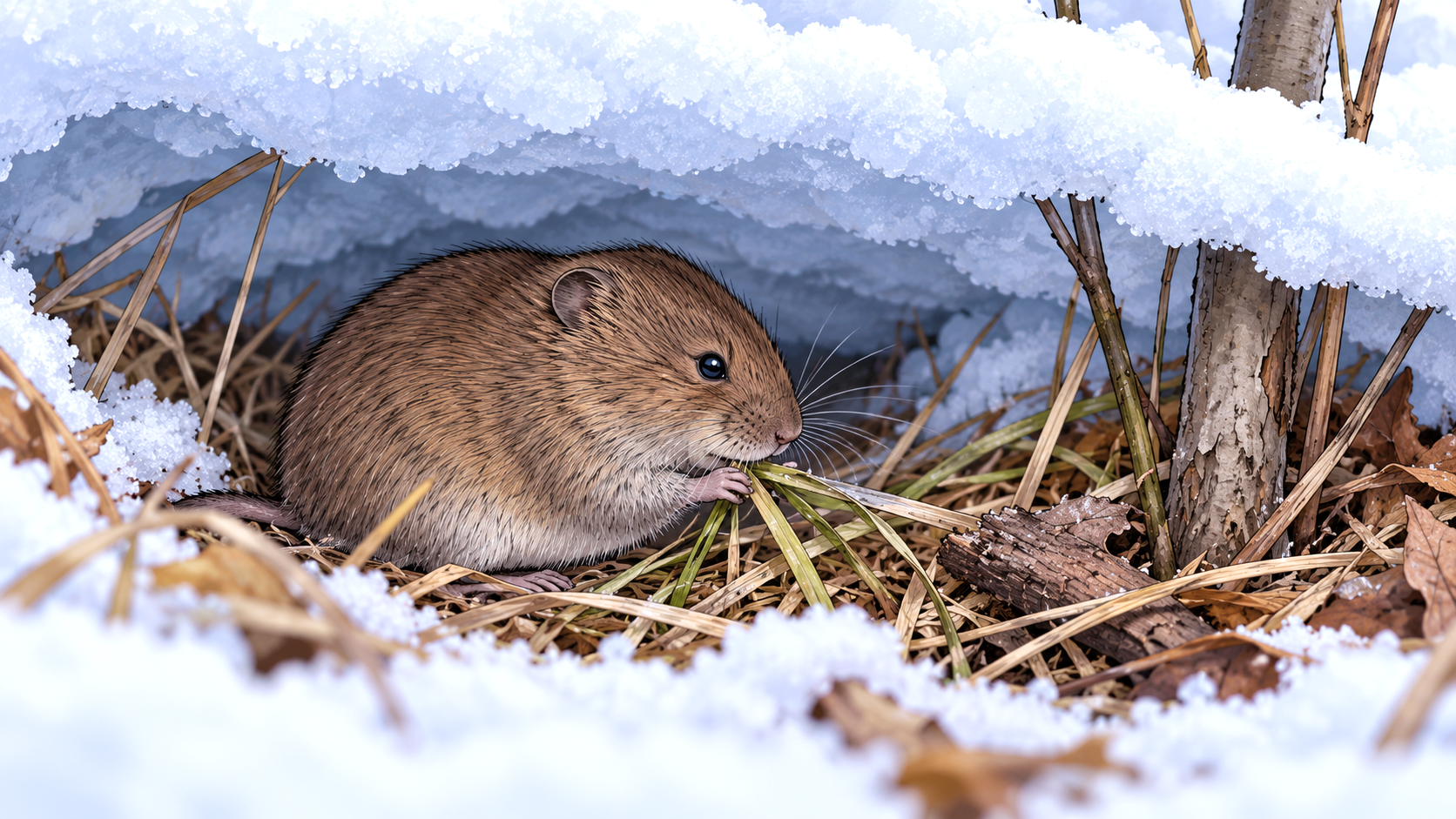
In winter, voles eat the green bases of grasses, roots, seeds, bulbs, and other plant material they can reach beneath snow or soil. When their usual leafy foods become scarce, some species also feed on the bark and inner tissues of trees and shrubs. Meadow voles continue searching for vegetation beneath the snowpack, while woodland voles obtain food underground and red-backed voles exploit seeds, roots, fungi, and other forest resources.
Winter does not force every vole onto the same diet. The food available depends on the species, the vegetation remaining from autumn, and whether snow or frozen ground limits access to particular plants. Even two voles living in different parts of the same property may encounter very different food supplies.
Grass Can Remain an Important Food Beneath Snow
A meadow may appear to contain nothing edible once its grass turns brown and disappears beneath snow. However, the lower portions of many grass plants remain near the soil surface, where voles can reach them without digging through the entire snowpack. The green basal tissues are particularly valuable because they provide living plant material when exposed leaves and stems are no longer readily available.
Meadow voles (Microtus pennsylvanicus) are documented feeding on the green bases of grasses beneath snow. They also consume roots, seeds, and bulbs during winter, drawing on plant structures that remain available after seasonal growth has stopped. Their food supply therefore depends on what survives or remains accessible close to the ground rather than on the appearance of the vegetation above the snow.
The animals move through sheltered spaces beneath the snowpack to reach these foods. Such movement can occur through established surface pathways in grass, although continuous snow cover may also allow them to travel across areas that offer little concealment during warmer months. The grass itself remains both a food source and part of the environment through which the animals forage.
Dried vegetation is another potential resource. Voles can consume senescent grasses, rhizomes, and other plant material that persists into winter, although these foods differ nutritionally from fresh growth. Their ability to survive on seasonally available vegetation reflects adaptations to eating plant tissues that can be relatively fibrous and low in readily digestible energy.
Bark Becomes More Important When Other Foods Are Scarce
Woody plants can provide an alternative food source during periods when fresh vegetation is limited. Voles may gnaw the outer bark and consume accessible living tissues beneath it, including the cambium. Young trees and shrubs with relatively thin bark can be particularly vulnerable.
This feeding shift is well documented in orchards and other landscapes containing woody plants. Winter bark consumption becomes more common when preferred foods are scarce, and the animals may continue feeding in locations that remain sheltered beneath snow. A tree surrounded by dormant vegetation can offer food while little green growth is available nearby.
Meadow voles sometimes consume bark close to the soil surface, while woodland voles (Microtus pinetorum) can feed on buried roots and the lower portions of woody plants. Their different feeding positions reflect how they move through the landscape. Meadow voles frequently use spaces above the ground but beneath vegetation or snow, whereas woodland voles spend considerably more time within shallow underground passages.
Snow accumulation changes which portions of a trunk are accessible. Where snow reaches several inches above the ground, voles can travel against the buried section of a tree and feed at heights they would not ordinarily reach from the exposed soil surface. The resulting winter bark injuries on trees can remain concealed until the snow melts. Bark feeding is not equally important to all vole species, and it should not be interpreted as proof that every vole prefers woody tissues during winter. It is one of several documented responses to changes in seasonal food availability.
Roots, Rhizomes, and Underground Plant Tissues Remain Available
Plants do not necessarily become inaccessible when their aboveground growth dies back. Roots, rhizomes, bulbs, and other underground structures can remain beneath the soil, providing food that is separated from winter air by the ground itself.
Woodland voles are particularly suited to obtaining these resources because much of their activity already takes place underground. They consume small roots and can gnaw larger roots or buried woody tissues. Underground root feeding by woodland voles can continue when aboveground vegetation offers fewer opportunities, particularly where soil conditions still permit movement.
Meadow voles also consume roots and bulbs, although their access depends on the depth and location of the plant material. Shallow underground structures are more accessible than deeply buried tissues in frozen soil. The feeding of voles on bulbs and roots involves plant structures that can remain nutritious even after their leaves disappear.
Agricultural fields provide examples of how this affects winter food supplies. In dormant alfalfa, voles can feed on roots and crowns beneath the surface. The resulting injury may remain inconspicuous until plants begin growing again. California’s agricultural vole guidance documents underground feeding in dormant crops as well as bark consumption in orchards and vineyards.
The presence of frozen soil does not mean every underground plant structure is available. Actual access depends on soil conditions, existing passages, and the position of the food. A vole living in loose, protected soil encounters a different winter environment from one surrounded by deeply frozen, exposed ground.
Some Voles Rely on Food Collected Before Winter
Not all winter feeding begins with finding a new plant. Certain voles collect and store food while vegetation and seeds are abundant, providing resources that can be consumed later.
Meadow voles have been documented storing seeds and tubers in sheltered locations. Some other species gather substantial quantities of vegetation before winter begins. These stores can supplement continued foraging rather than eliminating the need to find food throughout the cold season.
Brandt’s voles (Lasiopodomys brandtii) provide a well-studied example. Research conducted in the grasslands of Inner Mongolia between 2019 and 2021 examined plant material stored within winter burrow systems. The voles favored locally abundant plants, particularly Neopallasia pectinata and Allium polyrhizum, and the amount of stored food was associated with vegetation availability and vole population density.
These findings demonstrate that winter food storage can involve selective gathering rather than collecting plants indiscriminately. However, Brandt’s vole behavior cannot be applied universally to North American species.
Food caching also varies among red-backed voles. Some populations store seeds or other resources, while others continue foraging under snow without depending on substantial winter reserves. The presence of a burrow or sheltered resting area does not establish that it contains a food cache.
Red-Backed Voles Eat Different Winter Foods From Meadow Voles
In forest environments, the winter menu can include seeds, roots, bark, lichens, and fungi rather than being dominated by grasses. Southern red-backed voles (Clethrionomys gapperi) occupy woodland environments where the forest floor offers food sources not commonly found in open meadows.
Their diet changes through the year. Young plant shoots and leaf stalks become prominent in spring, fruits and berries contribute during summer, and nuts and seeds are important during autumn. During winter, these voles may continue foraging for seeds, tree roots, and bark beneath snow.
Forest conditions create opportunities for additional foods. Fallen wood, leaf litter, and decaying organic material support fungi and lichens, which some red-backed voles consume. At Jewel Cave National Monument, southern red-backed voles have been documented using seeds, roots, and inner tree bark as winter foods.
Long-tailed voles (Microtus longicaudus) provide another example of seasonal change. In Mount Rainier National Park, they consume green vegetation, grasses, and berries during summer, while winter feeding includes bark from heathers, willows, and trees. The same national park describes southern red-backed voles foraging beneath snow for vegetation, grasses, lichens, and fungi.
These species-specific records demonstrate why the winter diets of different vole species cannot be reduced to a single list of preferred plants.
How Snow Conditions Affect Access to Food
Snow can protect food resources from the most extreme winter air temperatures while allowing voles to move through sheltered spaces near the soil. A persistent snowpack may give them access to grass bases, seeds, and other vegetation that would otherwise be exposed to wind and freezing conditions.
However, snow cover does not guarantee that sufficient food is available. Ice layers, repeated thawing and freezing, and changes in vegetation can alter access to edible material. The consequences depend on the species and local environment.
A field experiment involving bank voles (Clethrionomys glareolus) in southeastern Norway demonstrated the importance of food availability during difficult winters. Researchers monitored populations under different winter conditions and compared areas receiving supplemental food with areas receiving additional shelter material. During the harsher winter, populations disappeared from almost all untreated plots, while voles receiving supplementary food survived substantially better. Food availability was the decisive factor in the observed winter population declines.
The experiment does not mean every winter vole population experiences food shortages or that providing food is an appropriate household management strategy. It establishes that winter survival can be strongly constrained by access to sufficient nutrition, even when shelter is available.
Snow depth also affects where feeding occurs. Beneath a continuous snowpack, voles may reach vegetation across otherwise exposed ground. When snow is shallow or interrupted, their feeding opportunities become more closely associated with existing shelter. Their winter movement beneath snow and the foods they encounter are consequently linked, although food availability and protective cover serve different functions.
Why Winter Food Supplies Differ From One Yard to Another
Two neighboring properties can offer different winter feeding opportunities even when both support voles during warmer months. A lawn containing mainly short grass presents a different collection of accessible plant tissues from an orchard with tree roots, buried bulbs, and woody stems. Nearby fields may retain grass bases and seeds, while wooded areas contain fungi, roots, and forest-floor vegetation.
The plants present before winter influence what remains after growth stops. Areas with established perennial grasses may retain accessible basal tissues, while deciduous shrubs and trees offer woody material. The range of foods voles consume throughout the year is therefore filtered by seasonal availability rather than replaced by an entirely separate winter diet.
Food sources can also be concealed. A vole may continue consuming underground plant material without leaving obvious evidence on the exposed ground, while bark feeding can occur beneath snow and become visible only during spring thaw. Where changes in plant condition suggest feeding injury, the location of the affected tissue is more informative than assuming all winter damage has the same cause.
Winter feeding ultimately reflects the resources a vole can physically reach. Some animals continue grazing on sheltered grass, others rely more heavily on buried plant structures, and certain woodland species make greater use of seeds, fungi, and woody tissues. Those differences depend on the animal and its immediate environment rather than winter temperatures alone.