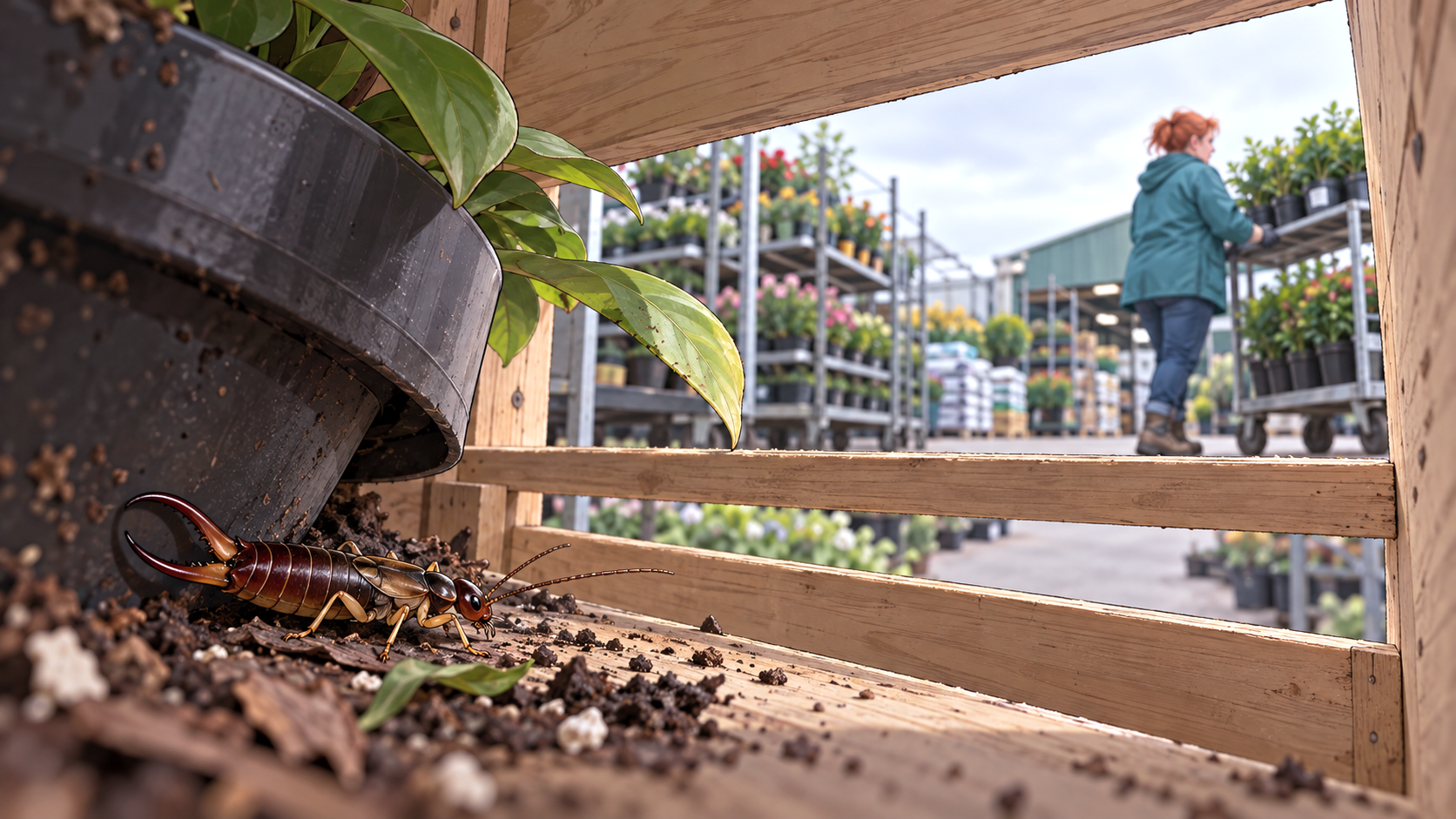
Some earwigs are invasive in the United States, but not all earwigs are nonnative or ecologically invasive. The European earwig (Forficula auricularia) is an introduced species that has established widespread populations and can damage garden plants and agricultural crops. The ringlegged earwig (Euborellia annulipes) is another widespread species often treated as introduced, although published authorities disagree about its native range. The United States also has native earwigs, including the spine-tailed earwig (Doru aculeatum).
Calling an earwig invasive requires more than establishing that it came from another continent. A species must also cause, or be likely to cause, meaningful harm. European earwigs sometimes meet that description, particularly in agricultural and garden settings, but they can also be beneficial predators.
Are Earwigs Invasive or Just Introduced?
The terms introduced, nonnative, established, and invasive describe different aspects of a species’ presence.
An introduced species has arrived outside its natural range through human activity. If it survives and reproduces without continued introduction, it has become established. It is considered invasive when its introduction causes or is likely to cause economic, environmental, or other recognized harm.
The USDA National Invasive Species Information Center’s definition explicitly separates nonnative organisms from invasive ones. Many introduced species do not cause significant damage.
For earwigs, the distinctions look like this:
| Term | What it means for earwigs |
|---|---|
| Native | The species occurs within its natural geographic range |
| Introduced or nonnative | Humans have transported it outside that range |
| Established | The introduced population sustains itself through reproduction |
| Invasive | The introduced species causes, or is likely to cause, significant harm |
A nuisance also differs from ecological invasiveness. An earwig entering a kitchen may be unwelcome, but its presence does not demonstrate environmental damage.
The USDA Animal and Plant Health Inspection Service likewise emphasizes that only a portion of introduced organisms become harmful. Consequently, an established foreign earwig population should not automatically be described as an ecological threat.
Which Earwigs in the United States Are Introduced?
The United States has a mixture of native and introduced earwig species. Published species totals vary with the geographic scope, date, and taxonomy used.
Penn State Extension reports that 12 of 22 earwig species recorded in the United States were introduced, while the Missouri Department of Conservation describes nearly 30 North American species, approximately half originating elsewhere.
Several familiar earwigs illustrate this mixture.
| Earwig | U.S. origin status | Relevant context |
|---|---|---|
| European earwig (Forficula auricularia) | Introduced | Widespread; occasionally damaging to crops and gardens |
| Ringlegged earwig (Euborellia annulipes) | Disputed in some references; commonly considered introduced | Especially common in warmer regions |
| African earwig (Euborellia cincticollis) | Introduced | Recorded particularly in southwestern states |
| Spine-tailed earwig (Doru aculeatum) | Native | Associated with eastern North American vegetation and wetlands |
The University of Florida’s European earwig account identifies European, ringlegged, and African earwigs as nonnative to North America.
By contrast, the Integrated Taxonomic Information System explicitly records Doru aculeatum as native to the continental United States.
These examples demonstrate why the presence of an earwig should not be treated as evidence of an introduced species without identifying which earwig is involved.
The European Earwig Is the Most Prominent Introduced Species
European earwigs are established across much of the United States, with particularly familiar populations in temperate regions. Their introduction is well documented, and they have become sufficiently abundant in some areas to cause recurring agricultural and residential problems.
The University of Colorado’s European earwig assessment describes the species as introduced and established in Colorado since the 1950s. Populations can reach substantial numbers where local conditions favor their survival.
However, abundance is not evenly distributed nationwide.
European earwigs tend to perform well in temperate climates where they can find protected overwintering habitats. They are less consistently abundant in hot, humid parts of the Southeast and in extremely dry environments, although irrigation can create suitable localized conditions.
The University of Florida’s distribution assessment identifies these geographic limitations. It also distinguishes European earwigs from the ringlegged earwigs commonly encountered in Florida.
An introduced species can therefore be widespread without being equally successful in every region. Its environmental effects can also differ substantially among places.
Why Sources Disagree About the Ringlegged Earwig
The ringlegged earwig presents a genuine disagreement in published accounts. The University of Florida considers Euborellia annulipes introduced to North America, probably originating in Europe. Its records place the species in the United States by 1884.
However, the University of California, Riverside’s entomological reference describes it as apparently native to the Americas, while the Missouri Department of Conservation calls it native.
These conflicting assessments make a categorical claim about its original distribution difficult to justify. Its present-day occurrence across the southern United States is well established, but its precise native range is less certain.
The disagreement also illustrates why geographic familiarity cannot determine origin. A species can become widespread through centuries of transportation and still appear naturally established to later observers.
The ringlegged earwig’s Florida distribution and habits provide another important qualification: even where it is considered introduced, the species rarely reaches very high pest populations, and its predatory activity may outweigh its occasional feeding damage.
Its status should therefore not be treated as equivalent to the European earwig’s better-documented history or agricultural significance.
Do Introduced Earwigs Harm American Ecosystems?
The strongest evidence of harm from European earwigs concerns particular crops and garden plants. They sometimes damage seedlings, flowers, tender leaves, fruit, and other susceptible plant tissues.
In California, UC Statewide Integrated Pest Management identifies European earwigs as potentially serious pests of young plants and soft fruit. The same guidance recognizes their beneficial predation on aphids.
This produces an important complication when assessing ecological impact. European earwigs are generalist feeders, meaning their effects depend partly on what food is available.
A population feeding heavily on cultivated fruit can create an economic problem. Another population consuming aphids may help suppress agricultural pests.
Research published in Insects found that European earwigs could improve pest suppression in apple and pear orchards. Earwig releases reduced important pests, including woolly apple aphids and pear psylla, under the conditions studied.
The authors also described earwigs as damaging in certain stone-fruit crops. The same introduced insect can therefore have contrasting economic effects depending on the agricultural setting.
Direct evidence of crop injury should not be confused with proof that European earwigs are displacing native species throughout American ecosystems. Such broader ecological conclusions require studies of native populations, competition, predation, and other environmental changes.
Likewise, finding earwigs feeding on garden plants establishes a localized problem only when the insects are correctly identified as the cause. Their presence alone does not demonstrate invasive damage.
Can an Introduced Earwig Be Beneficial?
Yes. Being introduced does not prevent an insect from providing useful ecological functions.
European earwigs eat various small arthropods and insect eggs. Their predatory behavior can benefit gardens and agricultural crops, although they may consume plant material under other circumstances.
The Utah State University assessment of European earwigs recommends balancing protection from plant damage against the insects’ contribution to biological pest control.
Native earwigs can also serve as predators, and their presence does not automatically indicate that they are harmless to every cultivated plant. Native status and feeding behavior answer separate questions.
The different types of earwigs found around American homes may therefore perform different ecological roles even when they occupy similar habitats.
A sensible assessment considers the species, location, and documented consequences of its activity instead of treating every nonnative insect as undesirable.
Does Invasive Status Vary by State?
A species’ geographic origin does not change when it crosses a state boundary, but its local abundance, management importance, and effects can vary substantially.
European earwigs are established in many northern and western states. Ringlegged earwigs are particularly familiar in southern regions. A species responsible for frequent crop injury in one state may be uncommon or primarily beneficial elsewhere.
Furthermore, the term invasive is not itself proof that an insect is subject to a particular legal restriction. Federal, state, and local authorities may maintain different pest lists, regulatory requirements, and management priorities.
The USDA’s invasive-species framework recognizes that harmful effects must be considered in the relevant ecosystem.
A homeowner does not need to determine a species’ regulatory status before removing an occasional unwanted earwig. However, scientific claims that a species threatens native biodiversity require stronger evidence than its occurrence outside its original range.
Should You Remove Earwigs Because They Are Nonnative?
Nonnative status alone is not a reason to eliminate every earwig encountered on a property. The decision should reflect whether the insects are causing identifiable damage or a substantial nuisance.
An occasional European earwig beneath a garden stone may be consuming aphids or decomposing material. A large population feeding on tender seedlings presents a different situation.
Similarly, earwigs entering an apartment may be unwanted without posing any meaningful ecological threat. Indoor sightings are not a measure of the population’s environmental impact.
The management of earwigs in yards and lawns is generally more useful when based on actual activity and damage than on whether the insects originated in Europe.
For a property owner, the distinction has practical consequences. An introduced earwig population can be tolerated where it causes little harm, while localized control may be justified when crop injury or repeated indoor intrusion becomes significant.
The conditions that attract earwigs around buildings may support both native and introduced species. Modifying those conditions to reduce a nuisance does not require declaring every earwig an ecological invader.
Are All Earwigs in the US Originally From Europe?
No. Although the European earwig is one of the country’s most familiar introduced species, American earwig fauna includes native lineages and species with different geographic histories.
The spine-tailed earwig is a documented native example. The ringlegged earwig’s origin remains disputed among authorities, while the African earwig is generally considered introduced.
The geographic origins and introductions of earwigs also differ depending on whether the subject is the ancient insect order or a particular modern species.
The scientifically defensible assessment is therefore species-specific: European earwigs are established nonnative insects capable of causing significant localized damage, but the entire earwig order cannot be described as invasive to the United States. Native earwigs exist, some introduced species cause relatively little harm, and ecological effects depend on the particular species and environment.