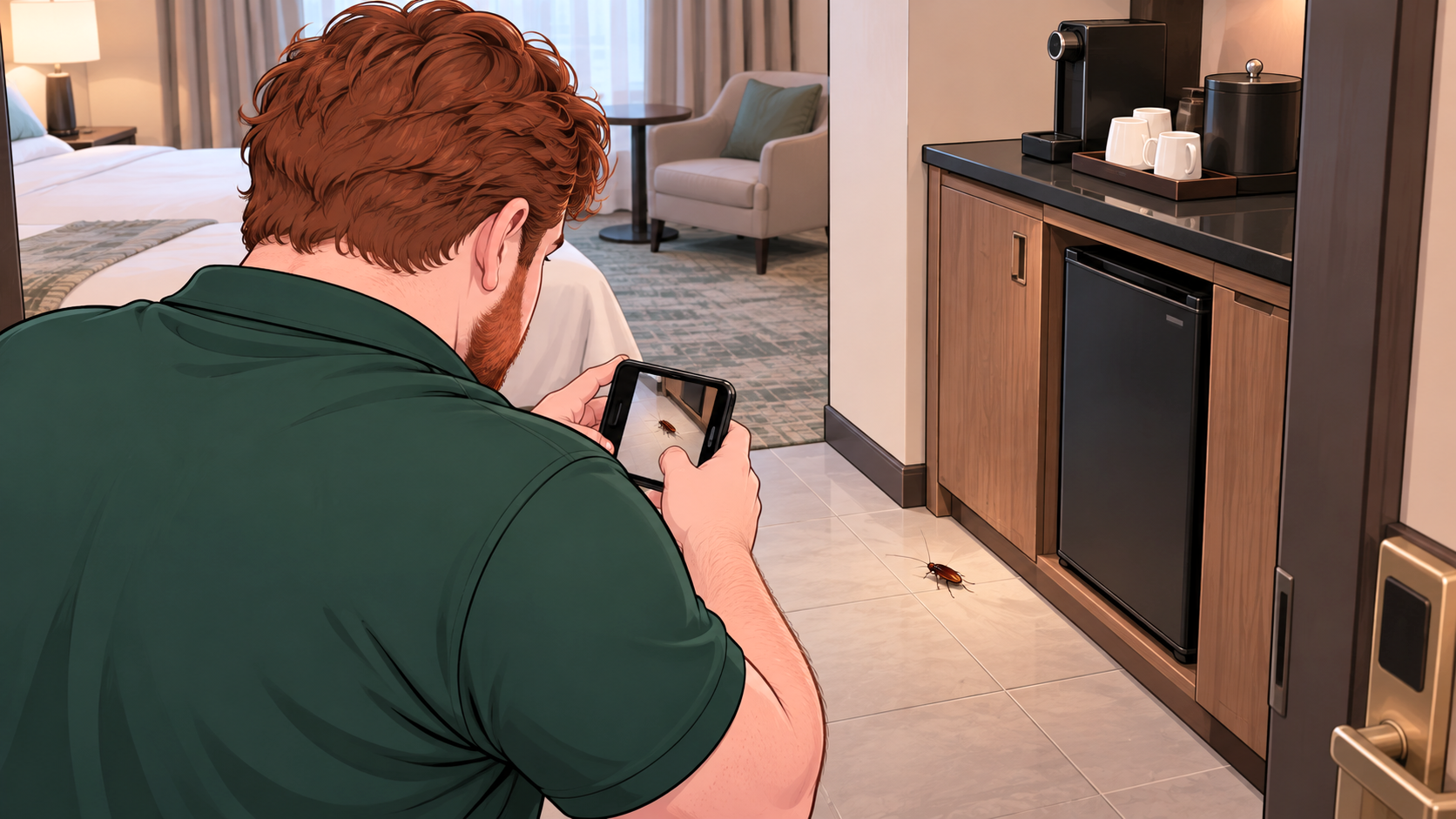
Discovering a cockroach in your hotel room can make you question whether it is safe to stay, especially if you have already unpacked. The first priority is to prevent the insect from reaching your belongings, document what you found, and notify hotel management before the evidence disappears.
If you find a cockroach in your hotel room, photograph it, keep your luggage closed, and request an inspection or a different room. One cockroach does not necessarily establish an infestation, but repeated sightings, small nymphs, or evidence of breeding warrant greater concern. You can also request alternative accommodation if the hotel cannot provide a satisfactory room.
What to Do Immediately After Seeing a Cockroach
Leave the insect undisturbed long enough to photograph or record it, if doing so is practical. A clear image showing its size, shape, and location will be more useful than a verbal description, particularly if the insect disappears before hotel staff arrive.
Keep suitcases zipped and gather loose clothing, shoes, shopping bags, and personal items. Move them away from the area where the cockroach was seen, preferably onto an inspected hard, elevated surface. Avoid placing an open suitcase on the carpet or directly against a wall.
The EPA’s travel precautions for hotel guests recommend keeping luggage off beds and floors when possible. Although those recommendations primarily address bed bugs, separating belongings from potentially occupied surfaces is also a sensible precaution when cockroaches have been observed.
If the insect is near an open meal or drink, stop consuming the exposed items. A cockroach crossing the room is not proof that every food item is contaminated, but direct contact between a cockroach and uncovered food warrants discarding the affected food.
Avoid chasing the insect around the room or dismantling furniture to find it. A photograph and its last observed location provide enough information to begin a discussion with hotel staff.
How to Document the Problem Before Reporting It
Take photographs of the cockroach and its surroundings, including a wider view that establishes where it was found. Record the room number, date, approximate time, and whether the insect was alive or dead.
If several insects are present, document them separately. Photograph any visible egg cases, shed skins, or suspicious deposits without moving contaminated objects unnecessarily.
Evidence becomes more significant when it shows repeated activity. A single large cockroach near a balcony door may be an outdoor visitor, while multiple small cockroaches around the minibar or bathroom vanity are more concerning.
The University of California’s cockroach guidance distinguishes outdoor-associated species from German and brown-banded cockroaches, which commonly establish indoor populations. Identifying the insect can therefore help staff evaluate the situation.
Where possible, obtain a photograph showing the antennae and body markings. Different cockroach species encountered inside buildings can require different interpretations, and a blurry picture of an unidentified brown insect offers limited evidence.
Keep the original photographs and retain written communications with the hotel. Accurate records are particularly useful if the room is cleaned or reassigned before management examines it.
Report the Cockroach to the Front Desk
Contact reception promptly and explain exactly what you observed. Provide the room number and photographs, then ask for the problem to be documented and reviewed by the manager or responsible staff member.
A useful report might be:
I found a live cockroach beside the bathroom vanity in room 412 at approximately 9:30 p.m. I have photographs. I would like the room inspected and would prefer to move to another room while the issue is addressed.
Avoid claiming that the entire hotel is infested unless the available evidence supports that statement. Similarly, staff should not dismiss repeated cockroach sightings merely because a room appears clean.
The National Pest Management Association’s lodging guidance emphasizes routine inspection, pest identification, documentation, and coordinated responses in hospitality properties. Hotel employees may need to refer the matter to housekeeping, maintenance, or a contracted pest-management professional.
Ask whether the hotel can provide an alternative room, preferably after checking that it has no visible cockroach activity. If the proposed response is simply to remove the insect, explain any additional evidence that makes you concerned about remaining in the room.
Should You Ask for Another Room or Leave the Hotel?
A room change is reasonable when a cockroach has been observed, especially if you are uncomfortable remaining in the room or there are signs of continuing activity.
The appropriate response depends partly on what was discovered:
| What you found | Reasonable response |
|---|---|
| One large cockroach near an exterior door | Report it and request inspection or relocation |
| Several live cockroaches in the bathroom or kitchenette | Request another inspected room or alternative accommodation |
| Small cockroaches of different sizes | Treat possible indoor breeding activity as a serious concern |
| Cockroaches in exposed food or food-service equipment | Stop using affected items and notify management immediately |
| Repeated sightings after staff have responded | Escalate to hotel management and consider leaving |
A room farther from the original location may be preferable, particularly when there is evidence of an established indoor population. Cockroaches can move through service penetrations and connected building spaces, so another room immediately beside the affected one may share similar conditions.
However, no particular floor or room number is guaranteed to be cockroach-free. Unlike a universal rule about hotel room placement, a direct inspection of the proposed replacement provides information specific to the actual accommodation.
If staff offer another room, ask to examine it before transferring your belongings. If the hotel cannot provide satisfactory accommodation, you can request cancellation or a refund and discuss alternative lodging. Whether a refund is legally required depends on the booking agreement, applicable consumer protections, and local law; there is no universal entitlement that applies to every cockroach sighting.
What to Check Before Accepting the Replacement Room
Inspect the areas most relevant to cockroaches rather than conducting an exhaustive search of every mattress seam.
Start with the bathroom vanity, gaps around plumbing, edges of the kitchenette or minibar, spaces beside the refrigerator, and accessible cabinet joints. Use your phone’s flashlight to examine corners without pulling apart installed equipment.
The Illinois Department of Public Health’s cockroach guidance identifies protected gaps around plumbing, appliances, and cabinets among locations associated with indoor cockroach activity.
Brown-banded cockroaches can also occupy elevated furniture and dry areas, so check accessible desk joints, shelving, and nearby wall decorations if the insect previously encountered appears to belong to that species.
The daytime shelter preferences of cockroaches mean that insects may be absent from exposed surfaces during a brief inspection. A room without visible cockroaches is preferable to one with confirmed activity, but a visual check cannot guarantee the absence of concealed insects.
If you discover fresh evidence in the replacement room, photograph it and notify management rather than transferring all your belongings into the space.
Protect Your Luggage and Personal Items During the Stay
Until the situation is resolved, keep travel bags closed when they are not being used. Store clothes inside zipped luggage or clean, sealed packing organizers rather than spreading them across drawers and furniture.
Inspect a luggage rack before using it. A hard, elevated surface away from known cockroach activity is generally preferable to storing open bags beneath furniture or beside a bathroom cabinet.
The EPA recommends inspecting personal items and maintaining separation from potentially infested surfaces when traveling. Its advice specifically concerns bed bugs, so it should not be interpreted as evidence that cockroaches behave identically. Nevertheless, limiting the number of exposed hiding places in your belongings is a reasonable precaution against accidental insect transport.
Pay particular attention to bags that were left open near the sighting. Small cockroaches can enter pockets, fabric folds, and seams. The size differences between adult and immature cockroaches make small nymphs especially easy to overlook.
Keep food sealed, remove snack wrappers, and avoid leaving open drinks near luggage. These measures reduce opportunities for insects to investigate your possessions without requiring you to discard clean clothing or replace an otherwise usable suitcase.
Should You Let Hotel Staff Spray the Room While You Are Still Staying There?
Do not remain inside a room during pesticide treatment unless the specific product label and the applicator’s instructions permit occupancy.
Ask what treatment is proposed, whether the room must be vacated, and when it will be suitable for reentry. Spraying a cockroach directly is not equivalent to investigating the conditions supporting activity nearby.
The EPA advises applying pesticides only to authorized locations and following label restrictions. It also discourages broad room spraying when targeted approaches are more appropriate.
If staff propose treatment while your belongings remain inside, ask how food, toiletries, clothing, and other personal items will be protected. Do not allow pesticides to be applied directly to luggage, bedding, or personal possessions unless the product specifically permits that use.
The possible exposure hazards of cockroach sprays vary with the formulation, application method, and contact conditions. A recently sprayed room is not necessarily ready for immediate occupancy simply because the insects are no longer visible.
For a guest who has already requested relocation, moving into an inspected, unaffected room may be more practical than remaining present while the original room is treated.
What if the Hotel Refuses to Help?
If reception dismisses the complaint, request to speak with the duty manager. Present your photographs, describe any repeated sightings, and clearly state the resolution you are requesting.
Keep communication factual. Document when the complaint was reported, who responded, and what accommodation or assistance was offered.
If the hotel cannot provide a satisfactory response, contact the booking platform or travel provider when the reservation was made through one. Explain the conditions you encountered and provide supporting documentation. Depending on the location and circumstances, a local public-health or accommodation regulatory authority may also accept complaints about pest-related sanitation conditions.
The CDC’s integrated pest management framework treats inspection, identification, monitoring, and corrective action as essential components of managing pests in occupied environments. Merely removing a visible insect does not establish whether a broader problem requires attention.
If you choose to leave, arrange new accommodation before transferring your belongings where possible, and inspect exposed bags before packing them. You do not need to prove a building-wide infestation to explain that you are uncomfortable remaining in a room with documented cockroach activity.