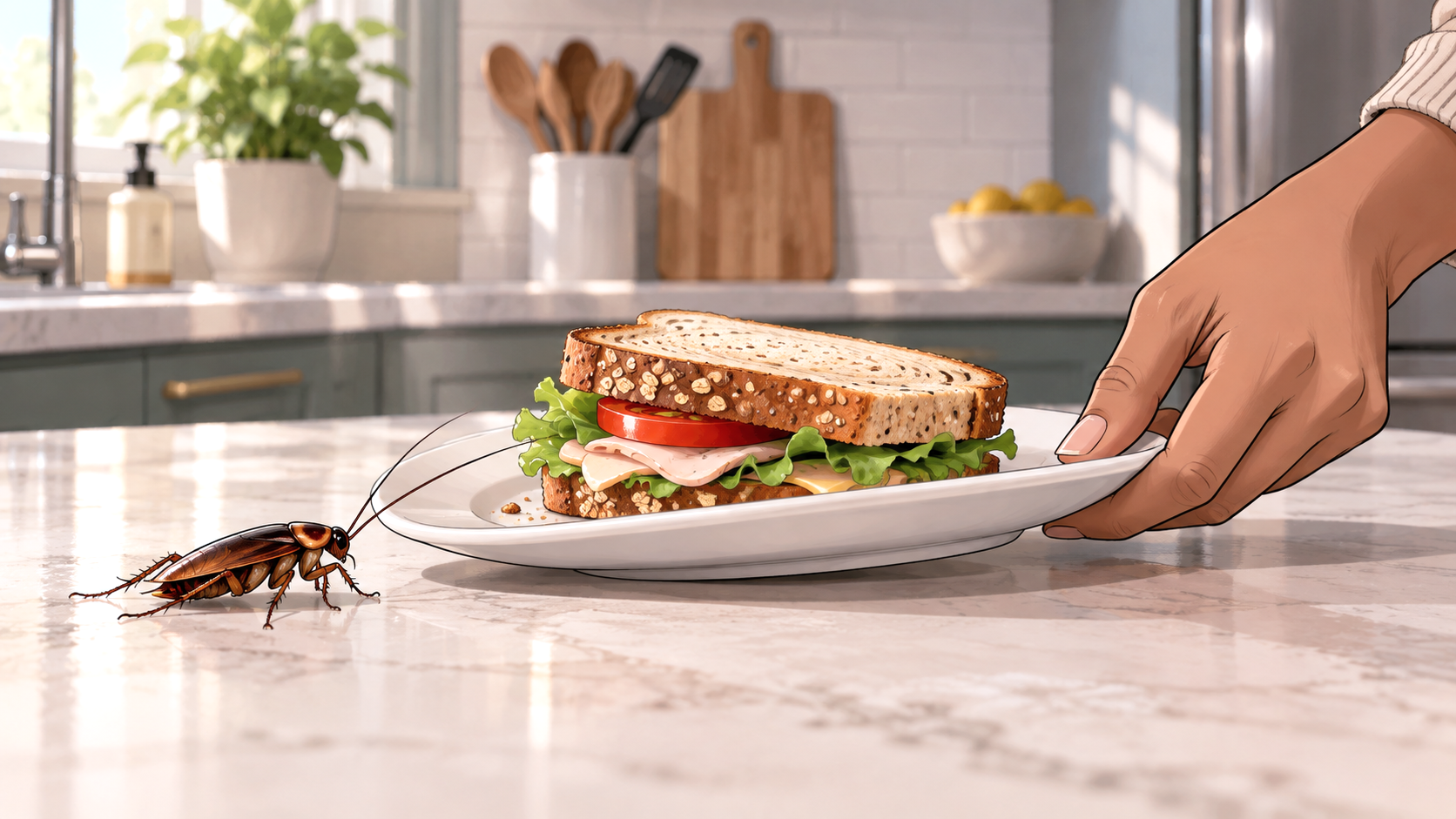
A cockroach crawling across your dinner, fruit, or uncovered leftovers can contaminate the food with microorganisms or particles carried on its body. If a cockroach directly touches exposed, ready-to-eat food, the safest choice is to throw the affected food away. Contact does not guarantee food poisoning, but there is no reliable way to determine whether contamination occurred simply by looking at the food.
The decision changes when a cockroach touches the outside of an intact package rather than the food inside. A washable, properly sealed container can often be cleaned without discarding its contents. Open containers, damaged packaging, and foods that cannot be adequately cleaned require greater caution.
What Should You Throw Away After Cockroach Contact?
The immediate decision depends on whether the insect had access to the food itself or only its packaging.
| What the cockroach touched | Recommended action |
|---|---|
| Cooked rice, meat, pasta, or an uncovered meal | Discard the exposed portion or serving |
| Bread, pastries, or other ready-to-eat foods | Discard the affected food |
| Open cereal, flour, or other dry goods | Discard the exposed contents |
| Cut fruit or prepared vegetables | Discard the exposed food |
| Intact, washable fruit with an edible peel | Thoroughly rinse and rub under running water; discard if contamination cannot be adequately removed |
| Exterior of an intact metal can or sealed glass jar | Clean the container before opening |
| Torn paper packaging or an unsealed food bag | Discard the potentially exposed contents |
These decisions follow the general food-safety principle of preventing contamination rather than waiting until illness occurs. The FDA considers insect-associated filth a potential form of food adulteration, although its regulatory standards do not provide a numerical risk estimate for one cockroach briefly touching a meal.
If a cockroach walks across a plate containing several foods, discard the serving rather than trying to reconstruct its exact route. When an insect has entered an open bag of rice or cereal, removing only the visible grains may leave contamination elsewhere in the package.
The decision is different when an insect merely crosses a clean countertop near a covered meal. Unless it reached the food or contaminated something subsequently brought into contact with it, proximity alone does not establish food contamination.
Why Brief Contact Can Be a Food-Safety Concern
Cockroaches move through environments that may contain waste, decaying materials, and contaminated moisture. Organisms or particles acquired in those locations can remain on the insect’s exterior and potentially transfer to another surface.
Contamination can occur through contact with the legs, body, mouthparts, or material deposited during movement. The amount transferred depends on what the insect was carrying, the condition of the food, and the nature of the contact.
A scientific investigation published in the Journal of Medical Entomology found that cockroaches could transfer Salmonella between contaminated and previously uncontaminated materials under experimental conditions. Such findings demonstrate a plausible contamination pathway, not that every cockroach carries Salmonella or that every brief encounter causes illness.
Even cockroaches that frequently groom themselves are not sterile. Grooming maintains the insect’s sensory structures but does not make subsequent food contact hygienic.
The FDA’s food-contamination program recognizes that insect-associated material can compromise food hygiene. Whether any particular encounter results in illness cannot be predicted without knowing the contamination involved.
Can You Wash or Cook Food After a Cockroach Touches It?
Washing is appropriate for certain intact foods, but not for everything. Whole fruits and vegetables with firm, undamaged surfaces can often be cleaned under running water, rubbing the surface to remove potential contamination. Produce with cracks, damaged flesh, or contamination that cannot be removed should be discarded.
The FDA’s produce-handling guidance recommends washing fruits and vegetables under running water and avoiding soap, detergent, or commercial produce washes. A cockroach observed entering a bowl of cut fruit presents a different situation because the exposed flesh provides no comparable protective surface.
Cooking does not offer a dependable way to rescue food known to have been contaminated by a cockroach. Adequate heating destroys many disease-causing microorganisms, but the outcome depends on the organism, temperature reached throughout the food, and whether other contaminants are present. Some bacterial toxins are also heat-stable.
The USDA’s food-safety guidance provides appropriate cooking temperatures for ordinary food preparation. Those temperatures should not be interpreted as a guarantee that insect-contaminated food becomes safe after reheating.
Simply scraping off the place where a cockroach walked is similarly unreliable for moist, prepared foods. The insect’s exact contact area and any transferred material may not be visible.
What if the Cockroach Only Touched the Packaging?
An intact barrier changes the situation substantially. A cockroach walking across the outside of a sealed can does not automatically contaminate the food within it.
The FDA’s guidance for salvaging food products exposed to filth describes how undamaged all-metal cans and hermetically sealed jars can be cleaned and sanitized while preserving their contents. For ordinary household contact with an intact container, wash the exterior thoroughly before opening and use an appropriate food-safe sanitizer if contamination warrants it.
Pay attention to lids, rims, and pull-tabs. A dirty can lid can transfer contamination inward when opened, even when the product was originally sealed.
Paper and cardboard packaging require greater judgment because they absorb moisture and cannot generally be sanitized like metal or glass. If a cockroach crossed an outer cardboard sleeve while the food remained inside a separate, sealed, undamaged inner package, the outer sleeve can be discarded and the inner package handled with clean hands. If the insect entered the food compartment or the inner seal is damaged, discard the food.
The USDA’s guidance on shelf-stable food packaging emphasizes the importance of package integrity. A package that appears closed but has damaged seams should not be treated as a dependable barrier.
Clean the Surface Before Preparing More Food
Once the exposed food has been removed, clean anything the cockroach touched that will subsequently contact food. This includes cutting boards, countertops, dishes, serving utensils, and the outer surfaces of storage containers.
Wash the affected surface with warm water and detergent to remove visible material, rinse it, and use a sanitizer appropriate for that food-contact surface according to its label. Allow the required contact time before returning the surface to use.
The FDA’s cleaning guidance for food-contact surfaces recommends washing cutting boards, dishes, utensils, and countertops with hot, soapy water and sanitizing as appropriate. Cleaning comes before sanitizing because residue can interfere with the sanitizer’s effectiveness.
If a cockroach was found inside a food-storage drawer, inspect the surrounding utensils and containers for visible contamination. The possible hazards associated with cockroach droppings become relevant if deposits are found around food or food-contact equipment, but one cockroach crossing a shelf does not automatically mean every sealed item must be discarded.
Avoid spraying insecticide onto food, dishes, preparation surfaces, or open packaging. Products intended for pest management are not substitutes for washing or sanitizing surfaces that contact food.
What if You Already Ate the Food?
Accidentally eating food after possible cockroach contact does not mean you will inevitably become ill. The actual risk is unknown and depends on whether contamination occurred and which microorganisms, if any, were transferred.
Do not induce vomiting or take antibiotics simply because a cockroach may have touched something you ate. If you feel well, no specific treatment is generally required solely because of the encounter.
Watch for symptoms such as nausea, vomiting, abdominal cramps, diarrhea, or fever. These can arise from many causes, so symptoms developing after a meal do not establish that the cockroach was responsible.
The CDC’s food-poisoning guidance recommends seeking medical advice when illness is suspected. Bloody diarrhea, dehydration, persistent vomiting, high fever, or severe symptoms require prompt assessment. Young children, older adults, pregnant people, and people with weakened immune systems may need earlier medical attention.
Keep any relevant food packaging or purchase information if a healthcare professional or public-health authority needs to investigate a suspected foodborne illness.
Prevent Cockroaches From Reaching Food-Contact Areas
Food storage is the most direct point at which future exposure can be reduced. Transfer opened cereals, flour, sugar, and similar dry goods into tightly closed, pest-resistant containers. Avoid leaving uncovered meals, dirty dishes, or pet food accessible when they are not in use.
The EPA recommends sealing food packages and promptly removing spills and crumbs, recognizing that cockroaches can enter cardboard packaging and loosely closed bags.
If food contamination happens repeatedly in the same cabinet, note where the insects appear and examine accessible joints, drawer runners, and spaces adjacent to the food-storage area. The typical daytime hiding locations of cockroaches can place them close to food even when exposed surfaces appear clear.
Their movement between rooms and resting areas also means a cockroach discovered on a counter may not originate from that cabinet. Repeated sightings and well-positioned monitoring traps provide more useful evidence than assuming the food itself attracted every insect.
The practical standard is to keep food protected, discard directly contaminated exposed items, and restore cleanliness to food-contact surfaces. A cockroach merely being present in the kitchen does not make every food item unsafe, but direct contact with an uncovered meal is sufficient reason not to eat it.