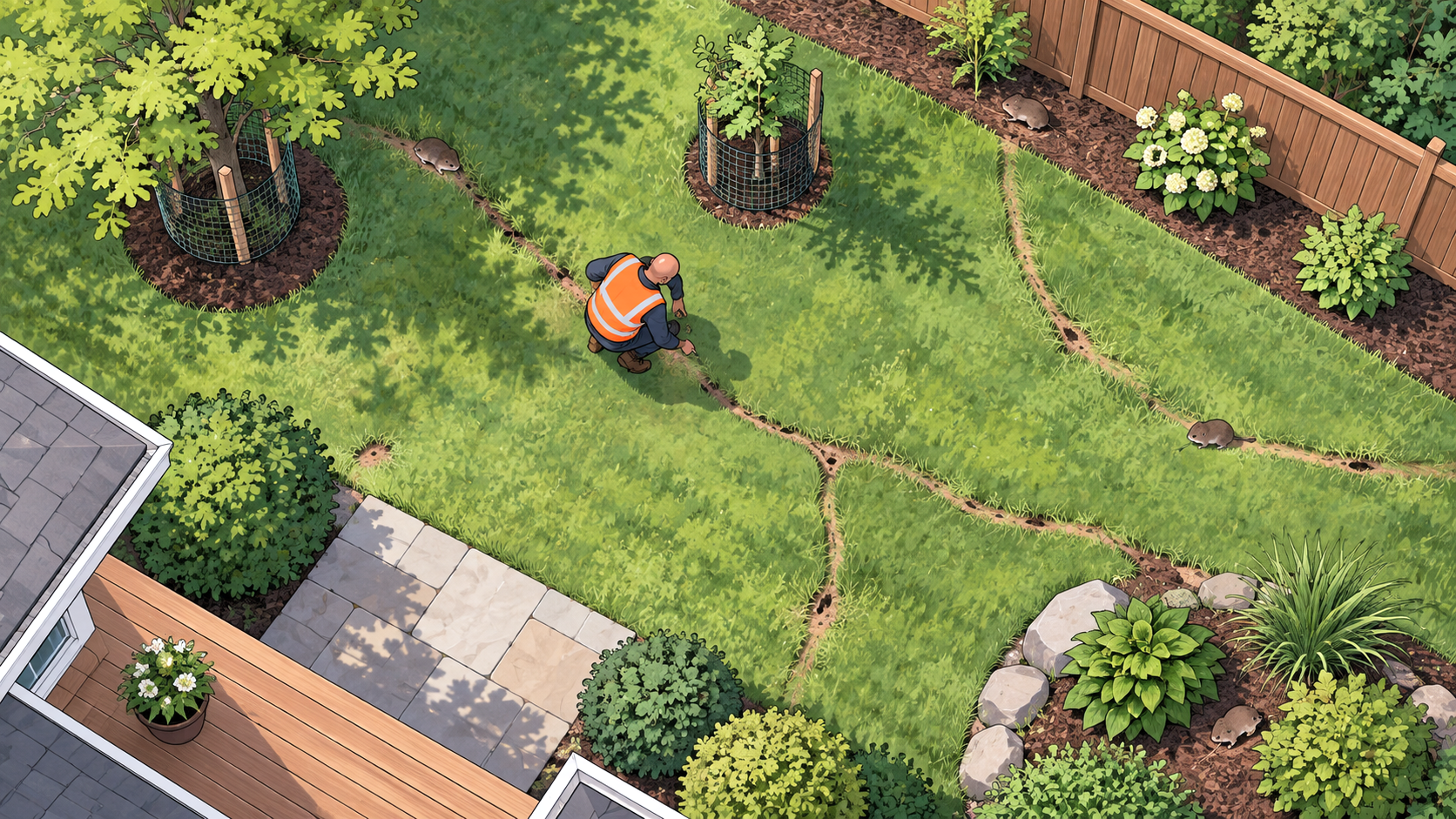
To get rid of voles in your yard, identify their active runways, mow overgrown grass, remove dense ground cover, and protect plants near the areas where they are feeding. Treat connected problem areas together rather than concentrating on a single burrow. If fresh damage continues, additional control may be necessary, but the first improvements should make the yard less suitable for voles.
A lawn bordered by an overgrown ditch, for example, can develop recurring vole activity even after its visible trails have been disturbed. The animals may continue living in the ditch and return through sheltered vegetation. Yard-wide management therefore begins by identifying where activity is concentrated, where voles are entering cultivated areas, and which plants are actually suffering damage.
Map the Active Areas Before Changing the Yard
Walk the lawn and its boundaries, paying particular attention to fence lines, shrub beds, unmowed corners, and adjoining fields. Meadow voles commonly create surface runways measuring 1 to 2 inches wide, connecting burrow entrances and feeding locations. Recently clipped grass and fresh droppings within these paths indicate use. The difference between active and abandoned vole runways helps prevent unnecessary treatment of trails that remain visible after the animals have left.
Mark the areas with fresh evidence on a simple sketch of your property. Separate the lawn itself from adjacent vegetation, tree plantings, and ornamental beds. A property with fresh vole runways through the grass along one boundary needs a different amount of work from a yard with active routes connecting several planting areas.
Do not assume every small opening is a vole burrow. Moles create distinct tunnels and soil disturbance, while woodland voles may occupy underground systems without leaving obvious surface pathways. The combination of animal activity, feeding marks, and characteristic signs of voles in the yard provides a firmer basis for treatment than an isolated hole.
Photograph representative damage before changing anything. Record whether the turf is merely flattened or whether grass has been clipped down to the soil. Where trees or shrubs are present, check for fresh gnawing near their bases. The appearance of vole damage to lawns helps distinguish temporary surface disturbance from vegetation loss that may require additional attention.
Change the Vegetation Across Connected Problem Areas
The most productive yard-wide change is reducing unnecessary shelter. Voles feed on vegetation and use thick ground cover to move while remaining concealed. Dense weeds, unmowed grass, accumulated leaves, and excessive mulch create conditions that favor their activity. Removing those conditions can reduce both feeding opportunities and the protection available to the animals.
Mow the lawn regularly and clear weeds from the edges where active runways enter maintained turf. Around young trees, a vegetation-free circle about 4 feet in diameter can reduce vole damage. Larger properties may benefit from maintained strips alongside tree rows or bordering unmanaged grassland. The purpose is to interrupt sheltered travel routes near susceptible plants without eliminating healthy vegetation throughout the property.
A common mistake is concentrating entirely on the middle of the lawn while leaving its overgrown perimeter untouched. Consider a rectangular yard with short grass across most of its surface but a continuous strip of weeds beside the rear fence. If fresh runways connect that strip to ornamental shrubs, repeatedly disturbing the lawn paths leaves the shelter supporting the activity unchanged.
Bird feeders deserve attention when spilled seed accumulates beneath them. Remove uneaten seed from the ground and consider changing the feeder arrangement. Reducing ground cover and accessible food around landscaped areas complements regular mowing.
Shrubs and established ornamental beds need not be destroyed. Keep desirable plants while thinning excessive ground-level cover where voles are actively traveling. A long-term approach to preventing vole activity depends on maintaining these improvements rather than making one unusually aggressive cleanup.
Coordinate Plant Protection With Yard Management
Changes to the lawn will not immediately protect a tree that already has fresh bark damage. Where voles are feeding on valued plants, combine vegetation management with physical exclusion.
Suitable hardware-cloth guards can protect young trunks, while fencing may be practical around compact ornamental plantings. Quarter-inch mesh with its lower edge buried can prevent voles from passing through or digging beneath properly constructed barriers. Trunk guards also need adequate clearance as the tree grows and should not constrict the bark.
Protect the most vulnerable plants first. Girdling can threaten the survival of a young tree, so preventing further vole damage to its trunk deserves more urgency than an old trail crossing an otherwise healthy patch of turf.
The following assessment helps allocate work across a yard without treating every square foot equally.
| Yard area | What to assess | Appropriate initial response |
|---|---|---|
| Maintained lawn | Fresh runways and clipped grass | Maintain short turf and monitor active areas |
| Overgrown fence or field boundary | Connected runs leading into the yard | Reduce dense vegetation along the affected edge |
| Shrub and ornamental beds | Feeding injury and excessive ground cover | Thin unnecessary cover and protect susceptible plants |
| Young trees | Fresh bark gnawing near the base | Install suitable protection promptly |
| Unaffected sections | Absence of new feeding or active routes | Leave undisturbed and inspect periodically |
This approach also limits unnecessary intervention. Established turf with old tracks may need no animal control, whereas a small area surrounding several damaged trees can warrant immediate protection.
What to Do When Voles Continue Damaging the Yard
Fresh runways and feeding injury may persist after habitat changes, particularly where surrounding fields or unmanaged vegetation continue supporting voles. At that point, determine whether the remaining problem is confined to a few locations or distributed across a much larger area.
Trapping can be useful for localized populations, but it becomes labor-intensive over extensive properties. Small-area trapping and broader vole management have different practical limits. Concentrating on confirmed active areas is generally more efficient than deploying equipment across unaffected lawn.
Before using lethal traps, live traps, or relocating captured voles, establish which species are present and which wildlife regulations apply. Some voles receive legal protection, and trapping, killing, possession, or relocation may be restricted by jurisdiction. The legality of killing or relocating voles cannot be inferred from their classification as lawn pests. Where legal requirements remain uncertain, continue nonlethal exclusion and habitat management while consulting the responsible wildlife authority.
Any permitted trapping also requires protection against accidental contact by children, pets, and non-target wildlife. Live capture carries welfare concerns, including confinement stress and risks associated with release into unfamiliar habitat.
Rodenticides introduce additional restrictions and hazards. A product labeled for rats or house mice is not automatically authorized for voles. Some vole-control products are restricted to certified applicators or specific nonresidential sites, and rodenticide labels govern lawful use. Product availability alone does not establish that an application is appropriate for a residential yard.
Large or persistent infestations affecting valuable plantings may warrant a qualified wildlife-control professional who can identify the animals, evaluate connected habitats, and determine which control options are permitted locally.
Measure Whether the Yard Is Improving
Compare fresh activity in the same marked areas after management begins. Check the lawn edges, sheltered routes, and damaged plantings rather than relying on how frequently animals are seen. A decline in new feeding and active runways is stronger evidence of improvement than an absence of sightings.
Photographs of the original locations make comparisons easier. Old trails can remain visible after activity decreases, so they should not automatically trigger additional treatment. Where damage continues along the same boundary, reassess the adjoining vegetation and any overlooked sheltered connections. The use of runway and feeding observations to monitor vole activity provides a practical basis for deciding whether further measures are warranted.
Once new damage has stopped, maintain ordinary lawn care and the protective measures around vulnerable plants. Areas disturbed by earlier feeding can be assessed separately for lawn restoration after vole damage, without confusing turf recovery with the continuing presence of animals.
2 thoughts on “How to Get Rid of Voles in Your Yard”