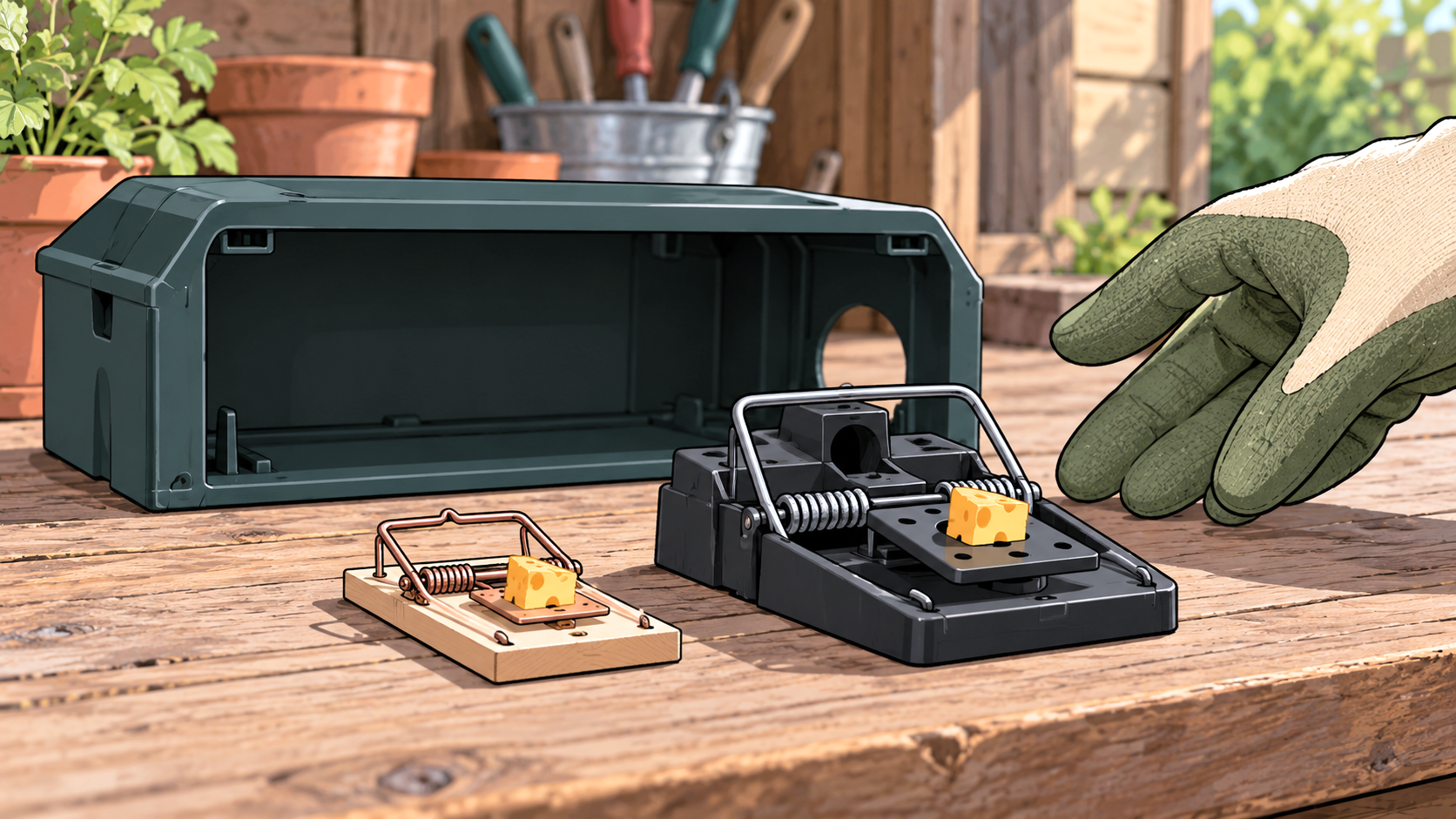
Ordinary mouse-sized snap traps can catch and kill voles, and they are an established option for controlling small, localized vole populations. Their effectiveness depends on the trigger design, the animal’s contact with the mechanism, and whether the trap intercepts an active travel route. However, electronic mouse traps, enclosed catch-and-release models, and oversized rat traps should not be assumed equally suitable.
The word mouse on the packaging does not necessarily make a trap unsuitable for voles. Both animals are small rodents, but their movement patterns differ. A mouse trap designed for indoor travel along walls may function effectively outdoors when its mechanism is accessible to a vole moving through grass.
Which Mouse-Trap Designs Work for Voles?
Conventional spring-loaded snap traps have the strongest practical support. Mouse-sized snap traps can control small vole populations, particularly where damage is confined to a garden border, ornamental planting, or other limited area.
The trigger is an important design feature. Some snap traps have a narrow metal bait pedal, while others have an enlarged plastic platform. Both designs can operate when a vole applies enough pressure, but a broad trigger provides a larger contact area for an animal crossing the mechanism.
For example, the Victor Wide Pedal Mouse Trap uses an expanded trigger and offers firm and sensitive settings. These features affect how readily the mechanism activates. They do not establish that the product has been independently tested against voles.
A useful comparison separates demonstrated vole suitability from features designed primarily for catching house mice.
| Mouse-trap design | Suitability for voles | Main limitation |
|---|---|---|
| Standard wooden snap trap | Established option for small populations | Requires contact with the trigger |
| Wide-pedal snap trap | Suitable snap-trap design | Trigger sensitivity and reliable contact still matter |
| Enclosed electronic mouse trap | Vole effectiveness not established by ordinary mouse ratings | Entrance dimensions and triggering requirements may differ |
| Tunnel-style live mouse trap | Not a dependable substitute for a vole-specific live trap | Voles may avoid entering the enclosure |
| Oversized rat snap trap | Not the preferred size | Larger mechanism is unnecessary for a small vole |
A manufacturer’s mouse-trap specifications should be read for what they establish. A product described as suitable for mice has not necessarily been evaluated for voles, even when its dimensions appear appropriate.
Does the Trigger Matter More Than the Bait?
A mouse snap trap can catch a vole without bait when the animal crosses its trigger during ordinary movement. Voles often follow narrow surface runways, allowing a trap to function as an interception device rather than depending entirely on food attraction.
This is one reason mouse traps can catch voles along established runways. Their effectiveness depends on the animal encountering the triggering mechanism. A trap positioned outside the route may remain untouched even when voles continue feeding nearby.
Bait can attract voles, but it does not compensate for an unsuitable mechanism or an inaccessible trap. An enlarged trigger may provide an advantage where reliable physical contact is difficult to achieve. The precise placement of vole traps affects that contact more directly than choosing between two otherwise functional mouse-sized snap traps.
A trap’s advertised sensitivity also needs careful interpretation. A sensitive trigger activates with less pressure, but it may be more susceptible to unintended activation. The best choice is a mechanism that operates reliably under the manufacturer’s intended conditions without unnecessary exposure to other animals.
Will Live Mouse Traps Catch Voles?
Some live traps designed for mice can catch voles, but enclosed tunnel-style models are not consistently effective. Voles may refuse to enter certain narrow plastic enclosures even when their bodies are small enough to fit.
Cage-style traps provide a different arrangement. The suitability of mouse live traps for voles varies with the design, and some models intended for indoor mice are unsuitable for this purpose.
Size alone cannot determine whether a live trap will work. Entrance shape, internal space, door operation, and the animal’s willingness to enter all affect the outcome. A small enclosure may physically accommodate a vole without being attractive enough for the animal to enter.
Live trapping also raises welfare and legal concerns. Captured voles can suffer from confinement, exposure, and stress. Their subsequent release may be restricted, and survival after relocation is not guaranteed. Someone choosing a live trap must establish how the captured animal can lawfully and humanely be managed before attempting capture.
Are Mouse Traps Effective for Large Vole Infestations?
The limitations become apparent when voles occupy extensive connected habitat. A few snap traps may remove individual animals without substantially reducing activity across a field, large lawn, or heavily vegetated property.
Trapping is most practical for small vole populations. Large populations require more equipment, maintenance, and monitoring, which can make trapping inefficient compared with protecting vulnerable plants and reducing favorable habitat.
Trapping success also depends on continued access from surrounding areas. If voles remain established in neighboring vegetation, removing animals from a small section of lawn does not prevent others from entering later. The broader management of voles in a yard therefore involves more than selecting an effective trap.
When avoiding animal capture is preferable, nonchemical exclusion and habitat management can protect susceptible plants without relying on a reduction in the local vole population.
What Should You Check Before Using a Mouse Trap?
Mouse traps are lethal devices when used as snap traps, and their legality cannot be determined from the product name. Some vole species and subspecies are protected, while wildlife trapping restrictions differ among jurisdictions. A trap sold legally for house mice may still be unlawful to use against a protected vole.
Before trapping, identify the animal and check whether killing or capturing voles is permitted where the property is located. Where species identity or authorization remains uncertain, use nonlethal barriers and habitat management instead.
Snap traps can injure children, pets, and non-target wildlife. Simple coverings reduce exposure but do not guarantee protection against a dog that overturns them or a cat that reaches underneath. Any lawful trapping arrangement must prevent unintended contact. The risks of vole traps around pets deserve consideration before equipment is left outdoors.
For an already owned mouse trap, the most useful assessment is whether it is a conventional mouse-sized snap trap with a functioning trigger, rather than whether its packaging specifically mentions voles. Where trapping is lawful and justified by confirmed damage, that design can work. An electronic or enclosed live-catch model requires separate evidence of vole suitability before it can be treated as an equivalent alternative.