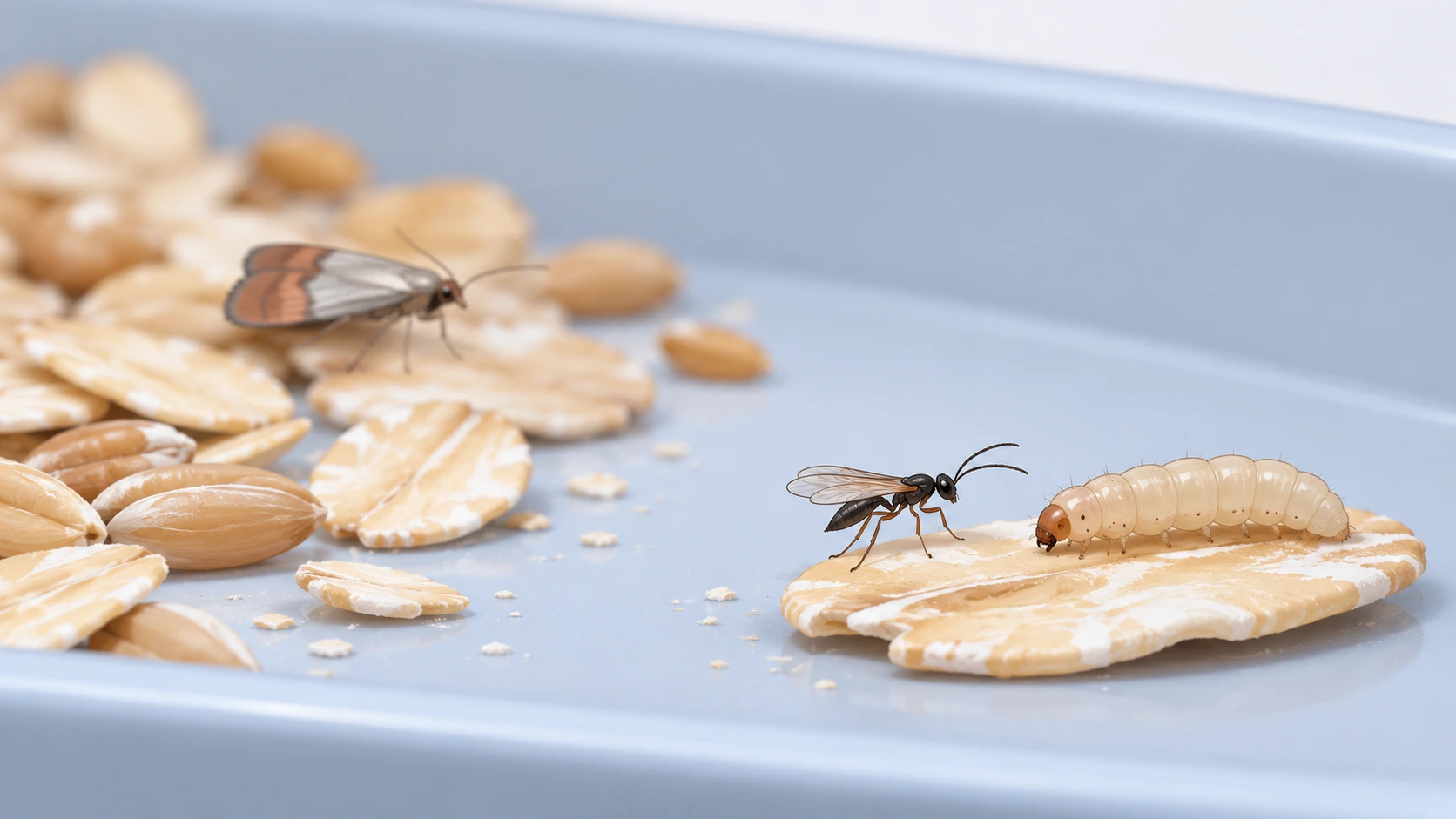
Certain parasitoid wasps can control Indian meal moths by attacking their eggs or larvae. Research has demonstrated substantial reductions in Indian meal moth populations when suitable wasp species are introduced under controlled conditions. However, effectiveness depends on the parasitoid species, the moth’s developmental stage, the accessibility of the insects, and the conditions in the storage environment.
These beneficial insects are much smaller than the familiar yellowjackets and paper wasps seen outdoors. Some species are barely visible without close inspection, and they specialize in finding particular insect hosts rather than hunting people or defending large nests.
For Indian meal moths (Plodia interpunctella), two important groups are egg parasitoids in the genus Trichogramma and larval parasitoids such as Habrobracon hebetor. They attack different parts of the moth’s life cycle, making their effects complementary.
The strongest evidence for their use comes from research on stored commodities, warehouses, and food-handling facilities. Biological control can reduce future moth production, but it does not remove insects, silk, droppings, or other contamination already present in stored food.
That limitation is especially important when deciding whether a parasitoid release would be useful in a particular setting.
How Do Parasitoid Wasps Control Indian Meal Moths?
Parasitoid wasps reproduce by using another insect as a host for their developing offspring. For Indian meal moths, the targeted host is usually an egg or a caterpillar, depending on the wasp species.
An egg parasitoid deposits its own egg inside a moth egg. The developing wasp consumes the contents and prevents the moth embryo from producing a normal larva.
A larval parasitoid attacks a caterpillar that has already hatched. The wasp may immobilize the caterpillar and deposit eggs on or near it. Developing wasp larvae then feed on the host, eventually killing it.
This is different from ordinary predation. A spider may catch and consume an adult moth immediately, while a parasitoid uses a host insect to complete its own development.
The distinction also explains why parasitoid wasps are often described as biological control agents. Their reproductive activity directly reduces the number of pest insects that survive.
For the Indian meal moth, the target stages matter because the caterpillars cause the stored-food damage. The Indian meal moth life cycle provides the background for understanding why attacking eggs and larvae can reduce the number of adults produced later.
Are These the Same Wasps That Build Nests Around Houses?
The parasitoids used in stored-product research are not the large social wasps that commonly build nests beneath rooflines or around sheds.
Habrobracon hebetor, for example, is approximately 2 to 3 millimeters long. It searches for suitable caterpillars rather than building a large defensive colony.
The much smaller Trichogramma species are commonly around half a millimeter long, although their exact size varies.
These parasitoids are generally not considered a stinging hazard to people in the way yellowjackets can be. Habrobracon uses its ovipositor to attack small caterpillar hosts, not as a defensive weapon against humans.
However, the absence of a typical wasp-nest hazard does not mean that releasing insects inside a home or food facility is automatically appropriate. Product contamination, host suitability, insect escape, and regulatory requirements still need consideration.
Which Wasps Attack Indian Meal Moths?
Several parasitoid wasps have been investigated for their ability to attack Indian meal moths. The strongest evidence concerns Habrobracon hebetor and particular Trichogramma species.
Their differences are more useful than treating every parasitic wasp as interchangeable.
| Parasitoid wasp | Target stage | How it attacks | Evidence and main limitation |
|---|---|---|---|
| Habrobracon hebetor (also called Bracon hebetor) | Primarily later-stage larvae | Paralyzes caterpillars and lays eggs on or near them | Strong experimental evidence; requires accessible suitable larvae |
| Trichogramma deion | Eggs | Deposits eggs within moth eggs | Effective under some experimental arrangements, especially when eggs are accessible |
| Trichogramma pretiosum | Eggs | Parasitizes eggs before caterpillars emerge | Laboratory population suppression demonstrated |
| Trichogramma evanescens | Eggs | Searches for and parasitizes moth eggs | Laboratory studies show potential in stored grain, with performance influenced by commodity |
| Venturia canescens | Larvae | Internal larval parasitoid | Recognized natural enemy of stored-product moths; performance depends on host and conditions |
This table identifies relevant species rather than ranking them by universal effectiveness. A wasp that performs well against eggs in a laboratory dish may behave differently when those eggs are scattered among grain kernels or protected inside packaging.
Likewise, a larval parasitoid cannot directly destroy an egg simply because it has been released into the same room.
Habrobracon hebetor: The Larval Parasitoid
Habrobracon hebetor is among the best-studied biological control agents for Indian meal moths.
An adult female searches for suitable caterpillars, particularly those approaching the later stages of larval development. When she locates a host, she uses venom to paralyze it and then lays eggs on or near its body.
The wasp’s offspring develop externally, feeding on the immobilized caterpillar. Multiple wasps can develop from a single host.
This behavior gives H. hebetor two routes to pest suppression. The initial attack disables the caterpillar, while the developing parasitoids consume its tissues and prevent it from completing normal moth development.
Research summarized by the U.S. Department of Agriculture describes how Habrobracon hebetor attacks Indian meal moth larvae, including its ability to locate hosts associated with stored commodities.
Because the wasp attacks larvae rather than eggs, some feeding damage may already have occurred before the caterpillar is parasitized.
That timing matters in a food-storage environment. Preventing an individual larva from becoming an adult does not undo the silk or food contamination it produced while feeding.
Can Habrobracon Wasps Find Larvae Inside Packages?
Habrobracon hebetor can locate Indian meal moth larvae associated with packaged stored products, but its effectiveness depends on whether the host is accessible.
In an experiment involving coarse-ground cornmeal, the wasp substantially suppressed moth populations in both bagged and unbagged treatments.
That result is encouraging because it shows that packaging does not always prevent biological control.
However, it does not establish that these wasps can penetrate every intact, tightly sealed package.
The type of packaging, gaps or seams, the location of larvae, and the structure of the stored material all influence access.
A caterpillar near an accessible opening presents a different opportunity from one protected inside a well-sealed container. The wasp must reach or effectively attack the host before parasitism can occur.
Trichogramma Wasps: Controlling Moths Before Larvae Hatch
Trichogramma wasps attack Indian meal moth eggs rather than caterpillars.
They search for suitable host eggs and deposit their own offspring inside them. Successful parasitism prevents those eggs from producing feeding Indian meal moth larvae.
That early intervention can be valuable because it prevents the caterpillar stage from beginning in the first place.
Several Trichogramma species have shown activity against Indian meal moth eggs, but they do not all perform identically.
For example, laboratory testing found that Trichogramma evanescens accepted and parasitized a greater proportion of Indian meal moth eggs than T. cacoeciae under the tested conditions.
The same investigation found that T. evanescens could forage within stored grain. Researchers observed access to eggs located as deep as approximately 8 centimeters in the tested bulk grain, although the number of parasitoids reaching those depths differed between commodities.
This finding is relevant because Indian meal moth eggs are not necessarily confined to the top of a stored product.
Still, the result should not be interpreted as unlimited penetration into sacks, bins, or every type of grain. The study measured particular wasps and materials under controlled conditions.
Why Does the Trichogramma Species Matter?
Different Trichogramma species can vary in host acceptance, searching behavior, and effectiveness.
A product containing one species should not be assumed interchangeable with a product containing another.
Laboratory experiments with T. deion, for example, found that the species did not significantly suppress Indian meal moth populations in one unbagged-cornmeal treatment. It performed differently when eggs were deposited on bags of cornmeal.
That contrast demonstrates a general limitation of biological control: successful parasitism depends on how the host is presented to the wasp.
It is therefore important to identify the actual parasitoid species rather than purchasing any product advertised broadly as containing beneficial wasps.
How Effective Are Parasitoid Wasps Against Indian Meal Moths?
The most useful evidence comes from experiments that measured surviving moths or offspring rather than merely counting wasps released.
A 2006 study examined the egg parasitoid Trichogramma deion and the larval parasitoid Habrobracon hebetor in treatments involving coarse-ground cornmeal.
The researchers compared the parasitoids individually and together, including arrangements where Indian meal moth eggs were placed on the surface of plastic bags containing cornmeal.
The results showed substantial suppression, particularly when the two parasitoids were combined.
| Experimental treatment | Reported result | What the figure actually describes |
|---|---|---|
| H. hebetor with bagged or unbagged cornmeal | Approximately 71% suppression | Reduction in live Indian meal moths under the tested conditions |
| T. deion with bagged cornmeal | 87% suppression versus 15% for bagging alone | Effect of egg parasitism within that experimental arrangement |
| H. hebetor added to bagged cornmeal | 70.6% reduction | Reduction in live moths compared with the relevant control |
| Both T. deion and H. hebetor with bagged cornmeal | 96.7% reduction | Combined effect against live Indian meal moths in that treatment |
These are not universal success rates. They come from particular experimental arrangements, with defined host exposures, packaging conditions, and parasitoid treatments.
The original egg-and-larval parasitoid experiment provides an especially useful comparison because it shows that the combination of stages attacked can change the result.
The 96.7% figure does not mean that releasing both wasps into any building will eliminate 96.7% of its moths.
It also does not mean that every egg or larva was destroyed. Even in the reported experiment, the result was suppression rather than a guaranteed complete elimination.
What About Other Studies?
Other laboratory experiments have found substantial population suppression using different parasitoid combinations.
Research summarized in a detailed Indian meal moth species account reports approximately 37.3% suppression with Trichogramma pretiosum alone, 66.1% with Bracon hebetor alone, and 84.3% when the two were combined.
These percentages differ from the cornmeal experiment because the parasitoids and experimental conditions were not identical.
A separate study examining parasitoid-to-host ratios found that B. hebetor significantly suppressed Indian meal moths only above a particular ratio in the tested system. At lower ratios, its effect was negligible. The researchers also concluded that sustained suppression required repeated introductions.
That finding is important because it shows why simply releasing a small number of wasps may accomplish very little when the number of moth hosts is large.
Why Combining Egg and Larval Parasitoids Can Improve Control
Egg and larval parasitoids attack different developmental stages, so using them together can close gaps that either species leaves.
A Trichogramma wasp can prevent a suitable egg from producing a caterpillar. But it cannot parasitize a fully grown Indian meal moth larva.
Habrobracon hebetor can attack larger caterpillars that escaped earlier egg parasitism. Yet it cannot undo damage already caused by feeding or reach every egg before hatching.
The two types can therefore complement one another.
Imagine a storage area containing newly deposited eggs and older feeding larvae. An egg parasitoid can potentially reduce the number of caterpillars that hatch. A larval parasitoid can potentially attack some of the caterpillars already developing.
The combined approach covers more of the moth’s life cycle than either one alone.
This explanation is consistent with experimental findings, but it does not establish that combining the wasps will always produce a larger benefit. The outcome still depends on host availability, parasitoid activity, and their ability to reach the relevant stages.
What Can Prevent Parasitoid Wasps From Working?
Parasitoids can be effective only when they encounter suitable hosts under conditions that allow successful attack and reproduction.
Several practical constraints can reduce their performance.
Host stage is the first limitation. An egg parasitoid needs eggs, while a larval parasitoid needs caterpillars of suitable developmental stages. If the wrong stage is present, a release may have little immediate effect.
Access is another limitation. Larvae or eggs hidden inside inaccessible packaging may escape parasitism. Some wasps can search among grain or around package seams, but access differs with the commodity and storage arrangement.
The ratio of parasitoids to hosts matters. A large Indian meal moth population may overwhelm a small release. Experimental research shows that parasitoid numbers can affect suppression, although exact release rates cannot be generalized from one experiment to every facility.
Environmental conditions also matter. Temperature, humidity, available hosts, and the physical layout of the storage space can influence searching and survival.
Finally, parasitoids are living organisms. Their quality when delivered, their age, and how they are handled before release can affect whether they remain active long enough to find hosts.
Do Parasitoid Wasps Need Repeated Releases?
Repeated releases may be necessary to sustain population suppression.
An initial release introduces beneficial insects into a space, but their numbers do not necessarily remain high indefinitely. Adult wasps can die, disperse, or fail to reproduce if suitable hosts are scarce.
Research examining Habrobracon hebetor population effects found that periodic introductions were needed for continuous suppression under the tested conditions.
That does not establish a universal weekly or monthly release schedule. Appropriate timing depends on the parasitoid, the host population, the facility, and the biological-control product.
Commercial programs sometimes use delivery systems designed to release parasitoids over an extended period. Such systems may improve the continuity of beneficial-insect activity, but the performance of one delivery method should not be generalized to all products.
Does Packaging Make Biological Control Ineffective?
Packaging can either limit parasitoid access or create locations where exposed moth eggs remain vulnerable.
In the cornmeal experiments, the egg parasitoid T. deion had a measurable effect when moth eggs were placed on the outside of bags. That is different from parasitizing eggs deep inside a fully sealed container.
Likewise, H. hebetor suppressed moths associated with bagged cornmeal in the tested conditions, but those results do not mean the wasp can reliably enter every sealed package.
The original study demonstrates why the position of the insect matters as much as the presence of packaging.
A bag may protect most of its contents while exposed seams, openings, or surrounding debris continue to support moth activity.
Can Insecticides Interfere With Parasitoid Wasps?
Some insecticides can harm beneficial parasitoids as well as their target pests.
A treatment that kills adult Indian meal moths may also kill wasps released to attack eggs or larvae. Residual pesticide exposure can reduce parasitoid survival or activity.
Compatibility therefore matters when biological control is being considered in a space where pesticide applications have occurred.
The relevant question is not whether a treatment is described as natural or chemical. It is whether the actual conditions allow the parasitoid to survive, search, and reproduce successfully.
Do not assume that a commercially supplied parasitoid can safely be released immediately after any insecticide treatment. Product-specific instructions and professional advice are necessary where the two methods might overlap.
Can Wasps Control Indian Meal Moths in Warehouses and Food Facilities?
Stored-product facilities are among the more suitable settings for parasitoid-based Indian meal moth control.
These environments can contain recurring populations in grain, packaged commodities, or materials that are difficult to inspect individually. A biological control agent capable of searching for concealed hosts may provide a useful additional form of suppression.
However, a large building introduces practical complications.
Parasitoids must reach appropriate host locations. They may need to forage through storage racks, around packages, or within bulk material. The facility also needs to manage incoming products, changing host availability, and the possibility that parasitoids disperse away from the intended area.
Food-safety and quality requirements can impose another restriction. Even beneficial insects may be undesirable in exposed finished food, packaging operations, or locations with strict contamination standards.
The fact that a parasitoid reduces Indian meal moth populations does not automatically mean its release is acceptable in every food-handling environment.
A facility considering biological control needs to verify that the specific species, supplier, release method, and use site are permitted and compatible with its food-safety requirements.
Are Parasitoid Wasps Suitable for Grocery Stores or Pet-Food Retailers?
Retail environments may benefit from biological control under appropriate conditions, particularly when Indian meal moth activity recurs around vulnerable stored products.
The cornmeal research explicitly examined the potential usefulness of egg and larval parasitoids for retail and warehouse environments.
Pet-food retailers face a practical challenge because susceptible products may arrive regularly and be stored in multiple areas. Parasitoid wasps can potentially suppress insects within accessible locations, but they cannot guarantee that incoming goods are free of eggs or larvae.
There is also a customer-facing issue. Released insects, even tiny beneficial parasitoids, may be unacceptable in certain display areas or where food-contact rules prohibit their presence.
A successful research experiment therefore does not automatically become a suitable retail treatment.
Biological control should be evaluated in relation to the actual site, product handling, applicable rules, and the level of moth activity rather than adopted simply because a published suppression percentage appears impressive.
Should You Release Parasitic Wasps Inside Your House?
Releasing parasitoid wasps is generally not a practical first choice for an ordinary household Indian meal moth infestation.
The strongest published evidence comes from specialized experimental and commercial settings rather than routine residential pantry treatments.
A home usually contains relatively small quantities of stored food, and the source may be a single infested package. In that situation, removing the affected material directly is often more useful than introducing another insect species.
A release also requires correct identification. Not every wasp advertised for biological control attacks Indian meal moths, and not every Trichogramma species performs equally well against their eggs.
Even when an appropriate parasitoid species is available, the outcome can be limited by host stage, storage conditions, and the location of the infestation.
There is also no guarantee that a released wasp population will remain confined to one cupboard or disappear exactly when the moth problem ends.
For a household with visible larvae or webbing inside stored food, the evidence used to identify Indian meal moth infestations provides a more direct starting point than buying beneficial insects.
Are Parasitoid Wasps Safe Around People and Pets?
The tiny parasitoids studied for Indian meal moth control are not generally considered aggressive stinging insects that attack people or pets.
That is reassuring in comparison with large social wasps, but it is not the only safety consideration.
Biological-control agents must be correctly identified, sourced appropriately, and used in suitable locations. Environmental restrictions, non-target hosts, and food-contamination requirements can affect whether a release is acceptable.
A wasp species sold for release in one country may not have the same legal status in another. Commercial availability does not establish permission for every use site.
Homeowners should not collect unidentified wasps outdoors and release them into a pantry. Nor should a biological-control product intended for agricultural storage automatically be used around open household food.
Will Parasitoid Wasps Leave After Indian Meal Moths Are Gone?
Parasitoids depend on suitable hosts for successful reproduction, but that does not establish exactly when all released adults will disappear.
Some adults may survive for a period without locating another host. They may also disperse into surrounding areas.
Certain parasitoid species can use more than one moth species as a host, so the disappearance of Indian meal moths does not necessarily mean every parasitoid lacks an alternative host.
The release location and building structure can also influence movement.
A supplier or specialist may be able to provide species-specific information about expected persistence. However, there is no sound basis for promising that every released wasp will die or leave immediately after Indian meal moth activity ends.
This uncertainty matters more in homes, retail displays, and other spaces where additional insects may be unwelcome.
How Can You Tell Whether Biological Control Is Working?
A reduction in Indian meal moth adults can be encouraging, but it does not by itself establish successful parasitoid activity.
Adult numbers can change for several reasons, including the availability of host food, environmental conditions, and movement into or out of the monitored area.
The more relevant evidence is whether fewer Indian meal moths successfully develop.
In research, scientists can measure parasitized eggs, surviving larvae, adult emergence, or the number of live insects remaining after treatment.
For an actual facility, monitoring may need to consider larval evidence and affected products rather than relying only on flying adults.
There is another distinction: seeing parasitoid wasps in an area does not prove they are finding and successfully parasitizing Indian meal moth hosts.
A wasp may be present without having reached suitable eggs or larvae. The host stage could be inaccessible, or the parasitoid may be unsuccessful under the current conditions.
The best measure of biological control is therefore reduced development of the target pest, supported by observations appropriate to the setting.
What Does a 96.7% Reduction Really Mean?
The 96.7% figure from the combined-parasitoid cornmeal experiment deserves careful interpretation because it is one of the most striking results in the literature.
Suppose an untreated experimental group produced 1,000 live Indian meal moths. A 96.7% reduction relative to that control would correspond to approximately 33 live moths remaining.
That is an illustrative calculation, not the study’s actual count.
It demonstrates why a large reduction can still leave surviving insects. In a location containing many hosts, even a small surviving percentage may allow continued activity.
More importantly, the published percentage applies to the experimental treatment arrangement. It cannot predict the exact outcome of releasing parasitoids into a particular pantry, warehouse, or retail store.
A reported suppression rate also does not establish that contaminated food has become safe to use.
For this reason, biological-control results should be evaluated alongside the amount of surviving pest activity and the condition of the stored material.
Frequently Asked Questions
Do Trichogramma Wasps Kill Indian Meal Moth Larvae?
Trichogramma wasps primarily parasitize eggs, preventing successful development into larvae. They are not the larval parasitoids used to attack already growing Indian meal moth caterpillars. Habrobracon hebetor is a better-studied option for that stage.
Can One Parasitoid Wasp Kill Several Indian Meal Moths?
A female parasitoid may attack multiple suitable hosts during her reproductive life, but the number varies with species, conditions, and host availability. Some Habrobracon females can paralyze and parasitize multiple caterpillars, while Trichogramma females may parasitize multiple eggs. There is no universal number that applies to every release.
Do Parasitoid Wasps Attack Adult Indian Meal Moths?
The main parasitoids discussed here target eggs or larvae rather than flying adults. An adult Indian meal moth may remain alive even when nearby eggs or caterpillars are being parasitized.
Can Wasps Reach Indian Meal Moth Eggs Inside Grain?
Some egg parasitoids can forage within stored grain under suitable conditions. Laboratory work with Trichogramma evanescens demonstrated parasitism at several centimeters of depth, but performance differed among tested commodities. These findings do not establish unlimited penetration through bulk grain or sealed packaging.
Do Parasitoid Wasps Remove Indian Meal Moth Webbing?
No. Parasitoids attack living insect hosts and do not clean up larval silk, droppings, or contaminated food. Even successful biological control leaves existing debris behind.
Are Beneficial Wasps Better Than Pheromone Traps?
The methods have different functions. Parasitoids attack eggs or larvae and can reduce successful development. Pheromone monitoring traps primarily attract and capture responsive adult males. A decline in trap catches does not measure the same outcome as a decline in surviving larvae. The practical suitability of either method depends on the purpose and setting.
The Bottom Line
Tiny parasitoid wasps can suppress Indian meal moth populations, and controlled research has demonstrated substantial effects. Trichogramma species attack eggs, while Habrobracon hebetor targets caterpillars, particularly later larval stages.
Experiments involving packaged cornmeal found approximately 71% suppression with H. hebetor and up to 96.7% reduction in live Indian meal moths when egg and larval parasitoids were combined under the tested conditions.
Those figures demonstrate biological-control potential, not guaranteed eradication.
Successful releases depend on suitable hosts, access to eggs or larvae, adequate parasitoid activity, and conditions that allow the beneficial insects to function. Existing food contamination remains even after the target insects die.
For specialized stored-product environments, parasitoids can provide a useful way to reduce Indian meal moth development. For a typical household pantry, introducing wasps is usually unnecessary and less practical than directly addressing the infested material.
The scientific evidence is promising, but the setting determines whether releasing beneficial wasps is a sensible response.