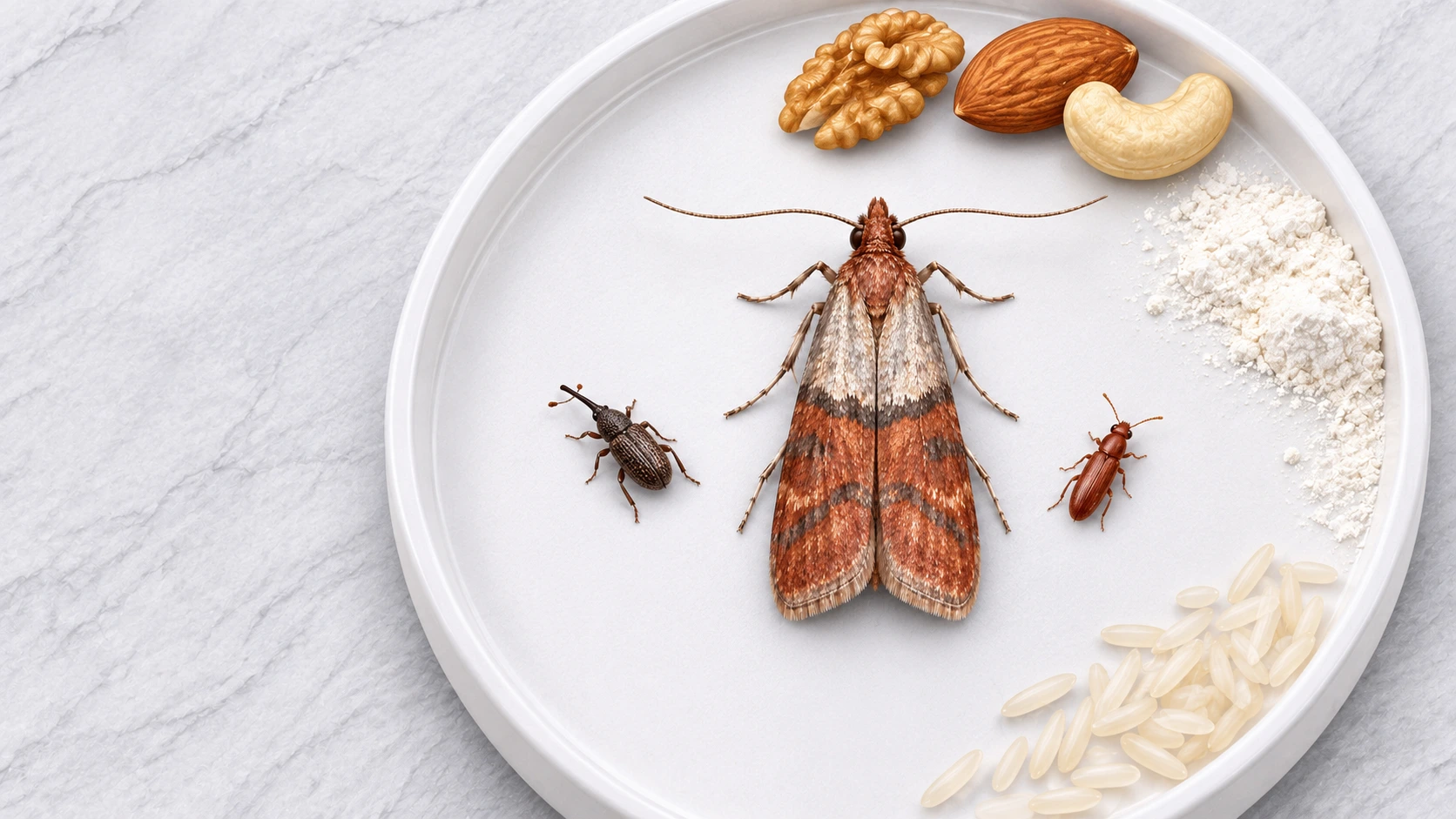
Finding small insects in flour, rice, cereal, or another dry food does not automatically mean you have Indian meal moths. Several moths and beetles infest stored products, and their larvae can look remarkably similar when you discover them among food particles. The most useful clues are often the adult insect’s shape, the presence or absence of silk webbing, and the kind of damage visible in the product.
Indian meal moths are most readily recognized by their two-toned adult wings and the silk webbing produced by their caterpillar-like larvae. Rice weevils have distinctive snouts, flour beetles are small reddish-brown beetles, and other stored-food moths may have more uniformly colored or patterned wings. No single clue identifies every specimen, so examine the insect and the food evidence together.
Indian meal moths (Plodia interpunctella) are among the most common moths found in household stored foods. However, the broader category of pantry pests includes other moth species and numerous beetles. Some develop inside intact grain kernels, while others feed on processed foods, broken grain, or dry materials in exposed packages.
This guide organizes the main possibilities so you can choose the appropriate detailed comparison instead of treating every insect found near groceries as the same pest.
Indian Meal Moth vs. Other Pantry Pests: Quick Identification Chart
The following table highlights practical distinctions between Indian meal moths and other insects commonly associated with stored food.
| Pantry pest | Adult appearance | Useful evidence in food |
|---|---|---|
| Indian meal moth (Plodia interpunctella) | Small moth with pale inner forewings and often coppery-brown outer forewings | Silk webbing, caterpillars, clumped food, wandering larvae |
| Rice or grain weevils (Sitophilus species) | Small, dark beetles with a noticeable elongated snout | Adult beetles among grains, small emergence holes in kernels |
| Rice moth (Corcyra cephalonica) | Relatively plain grayish-brown stored-product moth | Silken feeding material in susceptible grain products |
| Mediterranean flour moth (Ephestia kuehniella) | Grayish moth with darker wavy or zigzag wing markings | Larval webbing and clumping, often in flour or milled products |
| Angoumois grain moth (Sitotroga cerealella) | Small yellowish-brown moth with narrow, fringed wings | Development inside individual grain kernels and adult emergence holes |
| Almond moth (Cadra cautella) | Grayish-brown moth with darker markings or crossbands | Silk and larval activity in nuts, dried fruit, grains, and other stored products |
| Flour beetles (Tribolium species) | Very small reddish-brown, elongated beetles | Beetles and larvae in flour or other processed foods, usually without moth-like webbing |
| Sawtoothed grain beetle (Oryzaephilus surinamensis) | Tiny, flattened brown beetle with tooth-like projections behind the head | Crawling beetles in cereal products and other dry foods |
| Drugstore or cigarette beetles | Small, oval, reddish-brown beetles with a somewhat rounded or hump-backed outline | Small holes, fine debris, and insects in various dry materials |
| Warehouse or related dermestid beetles | Small oval beetles, sometimes patterned or mottled | Hairy larvae, shed skins, and damage in susceptible dry foods |
This is an identification starting point, not a definitive taxonomic key. Some specimens are too small, damaged, or immature to identify reliably from these features alone.
A detailed pantry pest identification guide distinguishes moths from beetles using adult features and larval anatomy, while also explaining why insects found indoors are not necessarily associated with food.
First, Decide Whether You Have a Moth or a Beetle
The quickest division is usually between adult moths and adult beetles.
Adult Indian meal moths have scaly wings that fold along the body when the insect rests. Their wings often show a noticeable contrast between a pale inner section and a darker, coppery outer section.
Adult pantry beetles have hardened forewings, called elytra, that form a protective covering over the back. Many are much smaller and more compact than an Indian meal moth, although exact size varies by species.
A moth may appear as a small triangular or narrow-winged shape resting on a wall. A beetle more often looks like a hard-bodied insect crawling across a shelf or through the food.
Movement can help you notice differences, but it should not be the deciding factor. Some stored-food beetles can fly, and some adult moths spend considerable time resting or walking.
What if You Have Only Found Larvae?
Larvae are harder to identify than adults because many stored-food insects have pale immature stages.
Indian meal moth larvae are caterpillars. They have a distinct head capsule, three pairs of true legs near the front of the body, and additional fleshy prolegs farther along the abdomen.
Beetle larvae can be grub-like, elongated, or hairy depending on the species. They do not have the same arrangement of abdominal prolegs as moth caterpillars.
A hand lens can help when the insect is small. However, inexperienced homeowners should not feel obligated to count tiny legs on a moving specimen. A clear photograph, the food in which it was found, and the presence of webbing often provide a more practical starting point.
The differences in moth and beetle larvae found in stored food are particularly relevant when no adult insects have yet appeared.
Indian Meal Moth vs. Weevil
Weevils are beetles, not moths. The most recognizable difference is the elongated snout on the adult weevil.
Rice weevils and granary weevils belong to the genus Sitophilus. Their bodies are small, hard, and generally dark, making them quite unlike a winged Indian meal moth when viewed closely.
The food evidence can differ as well. Certain grain weevils develop within individual kernels, and small holes may become visible when adults emerge. Indian meal moth larvae, by contrast, leave silk webbing around suitable food material as they feed.
Finding an insect in rice does not settle the identification. Both types of pest may be associated with stored grain products.
For the detailed adult, larval, and grain-evidence comparison, see Indian meal moth vs. weevil.
Indian Meal Moth vs. Other Stored-Food Moths
Not every pantry moth is an Indian meal moth. Several different moth species can infest stored products and leave some overlapping evidence.
Silk webbing is particularly useful for recognizing moth-larval activity, but it does not distinguish Indian meal moths from every other stored-product moth. Other species also produce silk.
When you have confirmed that the insect is a moth, the adult wing markings, resting shape, and food evidence help narrow the possibilities.
Indian Meal Moth vs. Rice Moth
The rice moth, Corcyra cephalonica, is a separate stored-product moth species.
Its name can be misleading in a household investigation. Finding a moth inside a bag of rice does not establish that it is a rice moth. Indian meal moths also infest rice and other grain products.
Adult rice moths tend to have a more subdued grayish-brown appearance than the characteristic two-toned Indian meal moth. However, worn moths and differences in lighting can make that distinction less obvious.
Both species can be associated with silk-producing larvae, so webbing alone is not enough to separate them.
See Indian meal moth vs. rice moth for the species-specific comparison and its identification limitations.
Indian Meal Moth vs. Mediterranean Flour Moth
The Mediterranean flour moth, Ephestia kuehniella, is another stored-product moth whose larvae can produce webbing.
Its adults generally look grayer than typical Indian meal moths and have darker, wavy or zigzag markings across their forewings.
Flour and milled grain products are especially relevant to this comparison, but discovering a moth in flour does not automatically mean it is a Mediterranean flour moth. Indian meal moth larvae can develop in flour as well.
The differences in adult wing patterns are often more useful than the product name.
For a closer comparison, see Indian meal moth vs. flour moth.
Indian Meal Moth vs. Angoumois Grain Moth
The Angoumois grain moth, Sitotroga cerealella, is commonly associated with stored grain kernels.
Adults are relatively small, often yellowish-brown, and have narrow wings with fringed margins. They lack the prominent coppery outer-wing pattern typical of a fresh Indian meal moth.
A useful difference also involves where larvae develop. Angoumois grain moth larvae develop within individual grain kernels, which may show evidence of adult emergence. Indian meal moth larvae commonly produce visible silk around the surfaces of suitable stored products.
These distinctions are reflected in stored-food moth identification guidance.
For the specific comparison, see Indian meal moth vs. grain moth.
Indian Meal Moth vs. Almond Moth
The almond moth, Cadra cautella, is another moth associated with stored foods such as nuts, grains, and dried products.
Its adults generally appear grayish-brown with darker wing markings, rather than having the strongly contrasted inner and outer forewing sections often seen on Indian meal moths.
The larvae of both species may produce silk and damage similar products. Consequently, a small pale caterpillar in a container of nuts is not enough to identify either species confidently.
The adult moth provides more useful evidence, although worn scales and overlapping appearances can complicate identification.
See Indian meal moth vs. almond moth for the more detailed comparison.
Indian Meal Moth vs. Flour Beetles
Red flour beetles (Tribolium castaneum) and confused flour beetles (Tribolium confusum) are common examples of beetles associated with processed grain products.
Their adults are small, elongated, and reddish-brown. Unlike Indian meal moth adults, they have hard wing covers and a distinctly beetle-shaped body.
Their larvae may be found in flour or other stored products, but they do not produce the characteristic silk webbing of moth caterpillars.
The distinction is useful when examining a bag of flour containing tiny brown insects. If you can see numerous hard-bodied beetles crawling through the product, an Indian meal moth identification becomes less likely.
Food association alone is insufficient because the two pest groups can occur in overlapping products.
An illustrated collection of common stored-product insect specimens provides useful reference photographs of both Indian meal moths and flour beetles.
Indian Meal Moth vs. Sawtoothed Grain Beetle
The sawtoothed grain beetle (Oryzaephilus surinamensis) is a small, narrow, flattened brown beetle.
Its distinctive feature is a row of six tooth-like projections along each side of the thorax, the body section just behind the head. These projections are small enough that a hand lens or close photograph may be needed.
The adult looks nothing like a fresh, two-toned Indian meal moth when the insects are examined side by side.
Sawtoothed grain beetles can be found in cereal products and various other dry foods. Their presence may be accompanied by tiny crawling insects and food debris rather than obvious moth webbing.
The physical features of sawtoothed grain beetles are a helpful example of why adult identification is often clearer than simply considering which grocery item was infested.
Indian Meal Moth vs. Drugstore and Cigarette Beetles
Drugstore beetles (Stegobium paniceum) and cigarette beetles (Lasioderma serricorne) are small, rounded, reddish-brown insects that may occur in numerous dry materials.
Both have a somewhat hump-backed appearance because the head can be partially concealed beneath the front of the body.
They are beetles, not moths. Their hard wing covers and compact outline distinguish them from Indian meal moth adults.
Infested products may contain tiny holes, fine food debris, and developing beetle larvae. However, these signs are not unique to either beetle species, and the two beetles themselves can require a close examination to separate.
The important household decision is to recognize that small brown beetles inside dry goods should not automatically be labeled pantry moths.
What About Hairy Larvae in Stored Food?
Some pantry beetles produce larvae that look very different from Indian meal moth caterpillars.
Warehouse beetles and related dermestids may have visibly hairy larvae, while Indian meal moth larvae are comparatively smooth-looking caterpillars with a distinct head and abdominal prolegs.
A hairy, brownish larva or a bristly shed skin in dry food should therefore prompt a closer look at beetle possibilities rather than an automatic Indian meal moth diagnosis.
This is especially useful when adult insects are absent. The larval body covering can provide a stronger clue than the mere fact that the insect was discovered inside a food package.
Avoid handling unknown hairy larvae unnecessarily. Keep the suspect product contained while obtaining an identification.
The range of stored-product beetles, including dermestids, is described in the University of California pantry pest guide.
Are Mealworm Moths and Indian Meal Moths Different?
This is largely a naming problem rather than a comparison between two well-defined moth species.
Mealworm moth has been used as an alternative common name for the Indian meal moth. It should not be confused with the yellow mealworm, which is the larval stage of a beetle, Tenebrio molitor.
The word mealworm is often used informally for worm-like insects found in stored products, so it can create confusion if the actual insect has not been identified.
The important questions are whether the adult has moth wings or beetle wing covers and what the larva looks like.
Our separate article, are Indian meal moths and mealworm moths the same?, addresses that terminology without inventing a second moth species.
Which Clue Should You Trust Most?
The most reliable identification comes from combining several observations rather than depending on one.
Start with the adult insect if one is available. Determine whether it is a moth or a beetle and examine its wing pattern, body shape, or distinctive structures.
Then examine the associated food. Silk webbing strongly suggests that moth larvae have been present, while a snouted beetle emerging from a grain kernel points toward a different group.
The following decision table helps direct the next investigation.
| What you find | First possibility to investigate | Important caution |
|---|---|---|
| Small moth with coppery outer wings and pale inner wings | Indian meal moth | Wing scales may be worn |
| Pale caterpillars with fine silk connecting food particles | Indian meal moth or another stored-product moth | Webbing is not species-specific |
| Tiny dark beetles with long snouts | Rice or granary weevils | Confirm the adult features |
| Reddish-brown elongated beetles in flour | Flour beetles | Several species look similar |
| Small flattened beetles with toothed thorax | Sawtoothed or related grain beetles | Teeth may require magnification |
| Small oval brown beetles in spices or dry foods | Drugstore or cigarette beetles | Close inspection may be required |
| Hairy larvae or bristly shed skins | Dermestid beetles | Not typical Indian meal moth larvae |
| Small plain gray or brown moths with webbing | Another stored-food moth may be involved | Adult photographs or expert identification may be necessary |
An insect’s discovery location is supporting evidence, not proof. Rice, flour, and cereal are not exclusive to pests with those foods in their common names.
Can Two Different Pantry Pests Infest the Same Food?
Yes. One susceptible product can potentially support more than one type of stored-food pest.
For example, moth larvae and small grain beetles may be associated with overlapping dry-food materials. Finding a moth does not exclude the possibility that beetles are also present.
This is another reason to inspect actual specimens and food evidence rather than assuming that everything found in a cupboard belongs to one species.
The insects do not all develop in the same way. Some lay eggs within or on grain kernels, while others feed among food particles or along package surfaces.
You do not need a detailed scientific classification to recognize that a mixed collection of different-looking insects may represent more than one pest.
If an identification matters for a persistent problem, preserve clear photographs or a securely contained specimen for a qualified extension service or pest professional.
What to Do When You Cannot Identify the Pantry Pest
If you can see an insect but cannot determine whether it is an Indian meal moth, photograph the adult or larva against a plain background with a size reference.
Try to capture the wings, head, legs, and body shape without crushing the specimen. Photograph any webbing, grain holes, or unusual material in the associated food as well.
A clear photograph often provides more useful identification evidence than a description such as “tiny brown bug.”
Do not identify an insect solely from a pheromone trap catch unless the specimen’s physical features also support the conclusion. Lures can be specific, but trap presence is not a complete identification key.
If the product is clearly contaminated, set it aside securely while determining what insect is present. Avoid spraying it with pesticide, which can make the food unsuitable for use and may obscure the original evidence.
Once an Indian meal moth infestation has been confirmed, the full response is covered in how to get rid of Indian meal moths step by step. This comparison guide is intended to help you identify the pest before selecting the appropriate response.
Frequently Asked Questions
Are All Pantry Moths Indian Meal Moths?
No. Indian meal moths are common household stored-food moths, but rice moths, Mediterranean flour moths, almond moths, and Angoumois grain moths are separate species. The term pantry moth is a general common name rather than a scientific species identification.
What Is the Difference Between a Pantry Moth and a Weevil?
A pantry moth has scaly wings as an adult and caterpillar-like larvae. Weevils are beetles, and common stored-grain weevils have a distinctive snout. Their larvae also develop differently from moth caterpillars.
Does Webbing Always Mean Indian Meal Moths?
No. Silk webbing supports a stored-product moth identification, but several moth species can produce it. Adult appearance and other evidence are needed to determine the species.
Can Indian Meal Moths Be Found in Rice?
Yes. Indian meal moth larvae can develop in rice. Finding a moth inside rice does not identify it as the separate species commonly called the rice moth.
What Are the Tiny Brown Beetles in Flour?
They may be flour beetles or another stored-product beetle. Examine the adult body shape and other features before identifying the insect. Indian meal moth adults are winged moths rather than small hard-bodied beetles.
Are All Small Worms in Pantry Food Moth Larvae?
No. Beetle larvae, fly larvae, and other immature insects may look superficially similar. Head structure, leg arrangement, body covering, and evidence in the food help narrow the possibilities.
Should You Identify the Exact Species Before Discarding Infested Food?
You do not need a species-level identification to recognize that food containing active insects, webbing, or obvious contamination should not be used normally. However, identifying the pest correctly is valuable when deciding which other products to inspect and whether continued sightings indicate the same problem.
Identify the Insect Before Choosing the Solution
Indian meal moths are recognizable when a fresh adult shows pale inner wings and coppery-brown outer wings, especially when the associated food contains silk webbing. However, other stored-food moths may produce similar feeding evidence, and numerous pantry beetles can infest the same kinds of groceries.
A reliable identification begins with the adult’s body shape, continues with larval evidence, and uses the food location as supporting context rather than a final answer.
If the insect has a snout, think weevil. If it has hard wing covers, consider pantry beetles. If it is a two-toned moth associated with silk-webbed dry food, Indian meal moth is a strong possibility.
Use the individual species comparisons for the finer distinctions, especially when adult markings overlap or the only evidence is an immature insect. Correct identification helps prevent unnecessary treatments and ensures that the response matches the actual pest.