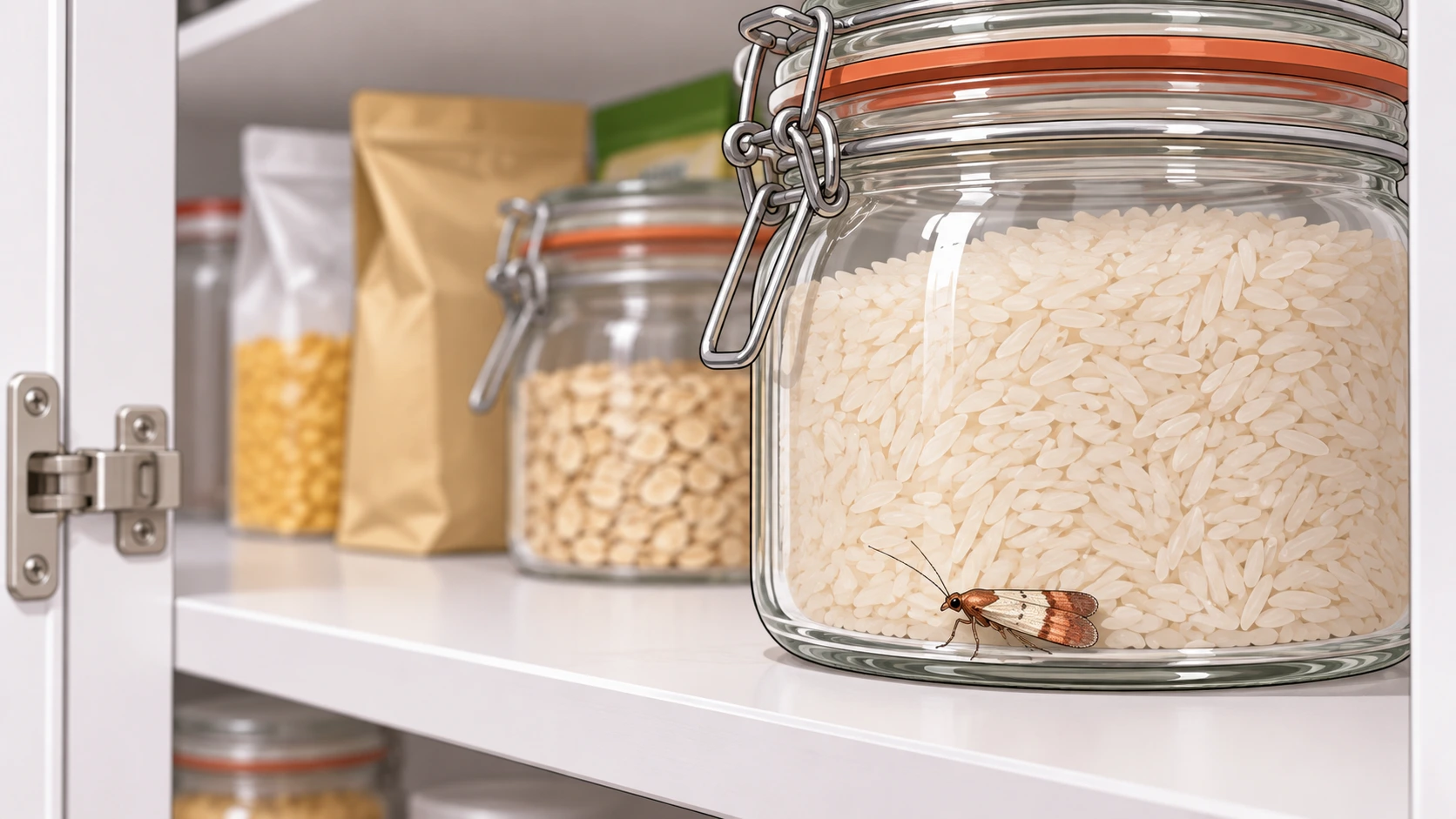
Pantry moths and Indian meal moths can mean the same insect, but the terms are not always interchangeable. Indian meal moth is the common name of one specific species, Plodia interpunctella. Pantry moth is a less precise name that people use both for that species and for other moths whose larvae infest stored food.
If someone tells you they found pantry moths in their kitchen, Indian meal moths are a strong possibility. They are among the most frequently encountered moths in household food storage. Still, a moth’s presence near cereal, flour or birdseed does not establish its exact identity.
The difference becomes important when identifying an infestation, buying a pheromone trap or following species-specific pest-control instructions. A product or identification description that applies to Indian meal moths may not apply to every insect someone calls a pantry moth.
What Does the Name Pantry Moth Actually Mean?
The name pantry moth describes an insect by its association with stored food rather than identifying it through a unique scientific name.
People generally use it for small moths that are found in kitchens, cupboards, food-storage rooms and similar places. Their caterpillars may develop in grain products, nuts, seeds, dried fruit or other suitable stored materials.
However, there is no single moth species that exclusively owns the common name.
The term is used in two ways. Sometimes pantry moth is simply another name for the Indian meal moth. In other cases, it describes a broader group of stored-food moths that includes species other than Indian meal moths.
Both uses appear in reputable pest-identification references, which explains why apparently conflicting definitions can both be reasonable.
For example, the University of Maine’s Indian meal moth fact sheet explicitly includes “pantry moth” among the common names for Plodia interpunctella. That is a direct use of pantry moth as a synonym.
By contrast, Cornell’s pantry moth identification resource discusses both Indian meal moths and Angoumois grain moths under the same broader heading.
Neither approach changes the identity of Plodia interpunctella. They simply use the informal name at different levels of specificity.
Are All Pantry Moths Indian Meal Moths?
No. Every Indian meal moth can reasonably be described as a pantry moth, but not every moth described as a pantry moth is necessarily an Indian meal moth.
That one-way relationship is the easiest way to understand the terminology.
| Term | What it identifies | How precise it is |
|---|---|---|
| Indian meal moth | The species Plodia interpunctella | Specific species name |
| Pantry moth, used as a nickname | An Indian meal moth | Specific when the intended species is clear |
| Pantry moth, used broadly | A moth associated with stored-food infestation | Informal group description |
| Pantry pest | A moth, beetle or another insect associated with stored products | Broader than pantry moth |
The last row also matters. A pantry pest is not necessarily a moth. Stored-food beetles and other insects fall into that category, although they are not pantry moths.
In everyday conversation, the context usually makes the intended meaning obvious. In identification and treatment instructions, we prefer the specific species name whenever it can be established.
Why Do People Usually Mean Indian Meal Moths?
Indian meal moths are common in residential food-storage areas. Their larvae can develop in a wide range of dry foods, and the adults often become noticeable when they fly around kitchens or rest on walls and cabinets.
The University of California’s pantry pest guidance identifies the Indian meal moth as the most common moth found on food products in homes.
That prevalence helps explain why pantry moth has become a familiar nickname for it. Homeowners are more likely to recognize the kitchen setting than to know the moth’s scientific name.
The association is also reinforced by online shopping. A person looking for a way to catch Indian meal moths may search for “pantry moth traps,” while a product description may use both names to reach the same audience.
But common usage does not establish that every moth caught or observed is the same species.
We would treat the phrase “I have pantry moths” as a useful starting description rather than a completed identification.
How Can You Tell Whether Your Pantry Moths Are Indian Meal Moths?
The adult’s wing pattern offers a useful first clue.
Indian meal moths typically have two-toned forewings. The portion nearest the head is pale grayish or tan, while the outer portion is darker reddish brown, sometimes with a coppery sheen.
When the insect rests with its wings folded over its body, that contrast can be noticeable from above. Worn scales, poor lighting and an awkward viewing angle can make the colors less obvious.
A University of Minnesota Extension identification reference describes the wing pattern and notes that rubbing away the scales can make the markings less clear.
The adult Indian meal moth appearance guide explains the features needed for a closer examination.
Finding small caterpillars and silk webbing in stored food also supports the possibility of an Indian meal moth infestation. Its larvae produce silk as they feed, sometimes binding food particles together.
However, that evidence is not exclusive to Indian meal moths. Other stored-product moth larvae can also produce webbing. A webbed package tells you there may be a moth infestation, but it does not automatically identify the moth responsible.
Similarly, a caterpillar crawling across a ceiling may have left its food source to pupate. Its location does not mean that the ceiling itself contains the breeding material.
A clear adult specimen, together with evidence from the infested product, is more informative than the pantry location alone.
What Other Moths Can Be Called Pantry Moths?
Several moth species can infest stored foods and may be included when people use pantry moth as a broad term.
The Mediterranean flour moth, Ephestia kuehniella, is one example. The almond moth, Cadra cautella, is another. The Angoumois grain moth, Sitotroga cerealella, can also be encountered in stored-grain situations.
These are separate species, not alternative scientific names for the Indian meal moth.
Their precise identification depends on features and evidence that cannot be reduced to the fact that they were found in a cupboard. Some have overlapping food associations, and immature stages can be difficult to distinguish.
The broader Indian meal moth versus other pantry pests guide covers the identification options without assuming every stored-food insect belongs to one group.
For this article, the point is narrower. The existence of other stored-food moth species is why pantry moth cannot always be treated as a species-level identification.
A useful comparison is the name garden moth. It suggests where an insect might be seen, but the location alone does not determine the species. Pantry moth often works in a similar way, except that it is also established as a common name for the Indian meal moth.
Why the Name Matters When You Buy Pantry Moth Traps
The terminology can affect which monitoring product you choose.
Many pantry moth traps use pheromone lures designed to attract particular moth species. A product advertised using the broad phrase “pantry moth” does not automatically attract every moth that develops in stored foods.
The National Pesticide Information Center’s pantry moth guidance emphasizes identifying the pest correctly so that control efforts can be targeted.
If you have positively identified Indian meal moths, check whether a trap’s stated target includes Plodia interpunctella. If a package merely says “pantry moths,” inspect its detailed pest list or manufacturer’s instructions rather than assuming universal coverage.
The same caution applies to interpreting catches. A pheromone trap intended for Indian meal moths is not a general survey device for every possible stored-product moth. Attraction also does not demonstrate that the infested food has been located.
The Indian meal moth trap guide addresses trap types, their uses and their limitations.
This is one situation where an imprecise common name can lead to an avoidable purchase mistake. The species named on the lure matters more than a broad marketing label.
Does the Difference Change How You Handle an Infestation?
Some basic responses are similar across many stored-product moth infestations. You need to examine susceptible stored materials, locate contamination and prevent continuing access to suitable food.
Yet it would be a mistake to conclude that all pantry moth species behave identically or respond equally to every species-specific monitoring tool.
An Indian meal moth infestation typically requires attention to products such as cereals, flour, nuts, dried fruit, pet food and birdseed. Larvae may leave their feeding site before pupating, which can make the adult moths seem disconnected from the original food source.
If a moth has not been identified, begin by examining the insects and the material where activity is occurring. This is more useful than applying an Indian meal moth label to every small moth in the kitchen.
The signs of an Indian meal moth infestation can help you judge whether the evidence is consistent with that species.
Once the identity is established, the Indian meal moth removal guide provides the appropriate household response.
We would not use a general “pantry moth” identification as justification for spraying food-storage cabinets. Physical inspection and removal of contaminated material remain central, and pesticides used around food create avoidable safety concerns when applied without proper authorization or purpose.
How Should You Interpret the Term in Articles and Product Labels?
The surrounding wording usually tells you whether pantry moth is being used narrowly or broadly.
If an article says “Indian meal moth, also called pantry moth” and identifies Plodia interpunctella, it is describing one species under two common names.
If a guide says “types of pantry moths” and discusses multiple scientific names, it is using pantry moth as a group label.
If a trap says it catches pantry moths but provides no species information, you cannot determine its full target range from that label alone.
And if someone reports pantry moths after finding an unidentified insect near food, the description should remain provisional until the specimen or other evidence supports identification.
We recommend keeping three things separate: the common name a person uses, the species the evidence supports and the pest targeted by any monitoring or treatment product.
That simple habit prevents the most common confusion without requiring homeowners to memorize a long list of moth names.
Can You Use Indian Meal Moth and Pantry Moth Interchangeably?
Yes, when you are already talking specifically about Plodia interpunctella.
For example, a homeowner with an identified Indian meal moth infestation can reasonably say they have pantry moths. A fact sheet may also use both names for the same insect without creating any biological ambiguity.
The reverse is less reliable. If someone reports pantry moths, you should not automatically conclude they have identified an Indian meal moth.
This matters most in three situations. First, when the specimen’s identity is unknown. Second, when instructions contain species-specific information. Third, when purchasing traps or another product that claims to target particular insects.
The term pantry moth is convenient in everyday conversation. Indian meal moth is the better choice when accuracy depends on knowing exactly which moth is present.
The Bottom Line
Indian meal moth is a specific species, while pantry moth can be either its common nickname or a broader label for moths that infest stored foods.
Both usages are found in authoritative pest references. Their coexistence does not mean one reference is necessarily wrong. It means the everyday name is flexible.
If you are dealing with moths around stored food, start with the insect and its evidence, not just the setting. A confirmed Indian meal moth can safely be called a pantry moth, but an unidentified pantry moth should not automatically be called an Indian meal moth.