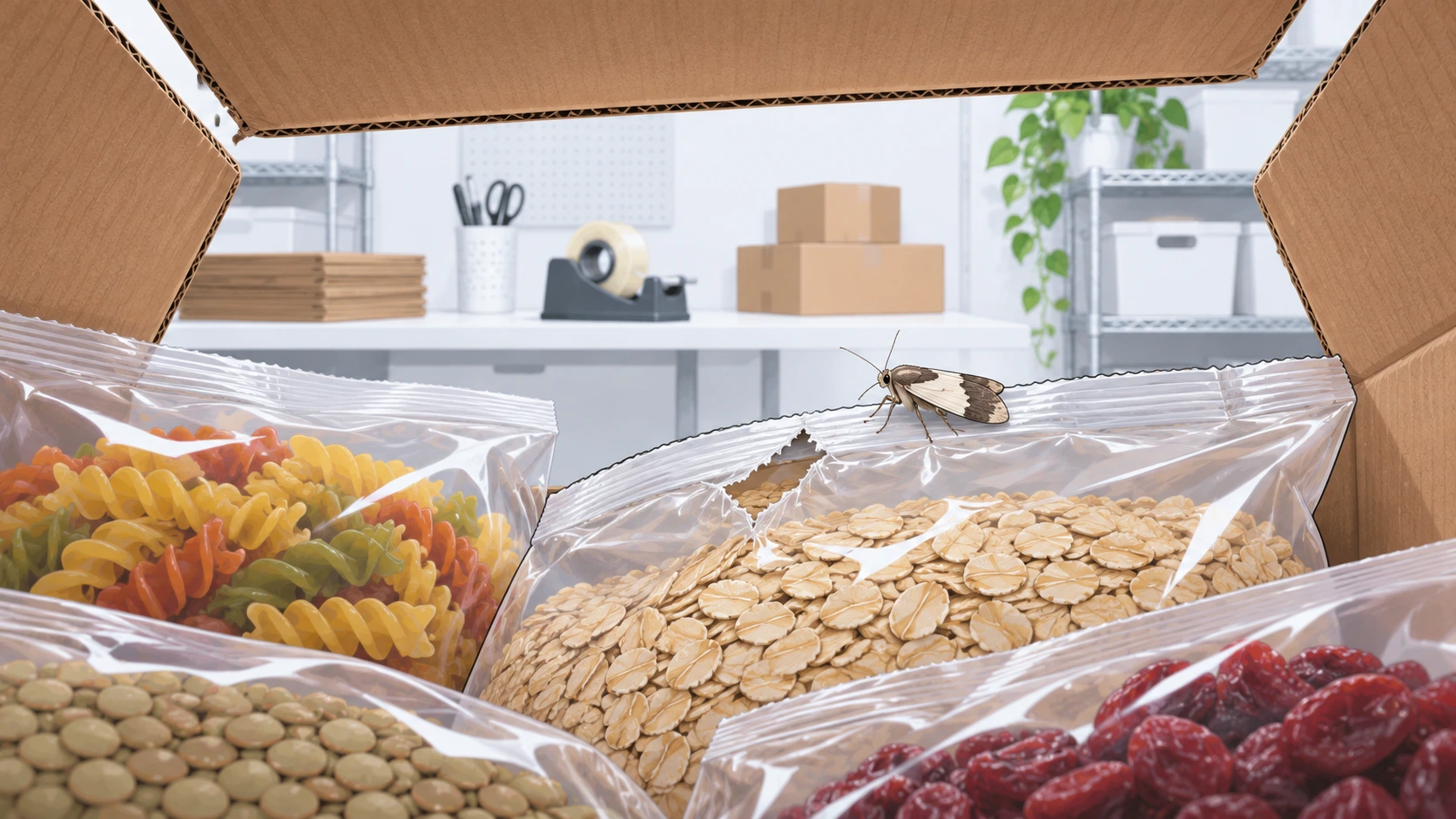
Indian meal moths are widespread, economically important stored-product pests, but they should not automatically be described as an invasive species everywhere they occur. The term invasive has a more specific meaning than simply being common, troublesome or capable of contaminating food.
The Indian meal moth, Plodia interpunctella, occurs around the world and has spread through the movement of stored agricultural products. Its larvae infest grain products, nuts, dried fruit, seeds, pet food and other susceptible materials. That damage makes the species a recognized pest, regardless of whether a particular government or scientific database classifies it as invasive.
Invasive status depends on geographic context. A species must be assessed in relation to the area where it occurs, whether it arrived through human introduction, and what harm it causes or is likely to cause there.
For Indian meal moths, those questions require some care because the species’ precise ancestral range is not firmly settled across historical references, even though its present worldwide distribution is well documented.
Is the Indian Meal Moth Considered Invasive?
The most accurate general description of the Indian meal moth is a cosmopolitan stored-product pest. Cosmopolitan means that the species has a very broad geographic distribution, while stored-product pest describes the kind of damage it causes.
Neither term automatically establishes invasive status.
Under the U.S. federal definition of invasive species, an organism must be non-native to the ecosystem being considered, and its introduction must cause or be likely to cause economic, environmental or relevant health-related harm.
Indian meal moths unquestionably cause harm to stored food products. Their larvae feed on susceptible commodities and contaminate them with silk, droppings and other insect material. Their presence can also affect the handling and quality of stored products.
The geographic requirement is less straightforward. An insect cannot be classified as non-native to a particular ecosystem solely because it occurs on several continents. Its historical relationship to that region must be considered.
For that reason, we would not label the Indian meal moth a universally invasive species without identifying the country, region or ecosystem and the authority or evidence supporting that designation.
A publication describing it as a serious pantry pest is making a supported statement about its economic significance. A publication calling it invasive throughout the world is making a much broader claim that needs additional support.
Introduced, Invasive and Pest: What Is the Difference?
These words describe related but separate characteristics. Confusing them can make an ordinary stored-food infestation sound like a newly discovered ecological emergency.
| Term | Meaning | How it applies to Indian meal moths |
|---|---|---|
| Native | Occurs naturally in a particular geographic area without human introduction | Its precise ancestral range remains subject to conflicting historical attributions |
| Introduced or non-native | Occurs outside its natural range because of human activity | Human-assisted movement through stored commodities is well documented, but regional origin matters |
| Established | Maintains reproducing populations in a location | The moth has established populations in many regions and storage environments |
| Invasive | A non-native organism that causes or is likely to cause specified harm in the ecosystem being assessed | Requires geographically qualified evidence rather than a blanket worldwide label |
| Stored-product pest | Damages or contaminates stored food or other susceptible products | A firmly established description of Indian meal moths |
| Cosmopolitan | Found across a very broad geographic area | An appropriate description of its worldwide distribution |
An introduced species is not necessarily invasive. The United States Register of Introduced and Invasive Species explains that established, non-native species can have harmful, neutral or beneficial effects.
That distinction applies even when the species is extremely common. Widespread occurrence tells us where an organism has been recorded. It does not, by itself, identify the consequences of its presence or determine its legal classification.
The reverse is also important. A species does not need to appear on an invasive-species list before it can damage stored food.
Why Native Range Matters to Invasive Classification
The first part of an invasive-species assessment concerns whether the organism belongs naturally in the ecosystem being considered.
Indian meal moths are often described in modern references as originating in South America. Some older entomological publications have instead attributed an Old World origin. That historical disagreement limits how confidently a single continent can be identified as the species’ original home.
The moth’s native-range evidence and worldwide distribution require more detailed treatment than a simple invasive-or-not label can provide.
The uncertainty does not mean the moth has always been native everywhere. Its spread in internationally traded commodities is documented, and human transport has carried it into distant storage systems.
It does mean that a regional invasive designation needs a reliable basis for describing the moth as non-native to that particular area.
For example, a moth intercepted in a shipment from another country is not automatically invasive in the country receiving the shipment. The interception establishes that the insect was transported. It does not necessarily show that a population has become established, or that its establishment is causing harm in the surrounding ecosystem.
Likewise, a long-established population in a food warehouse tells us that the insect can persist in that storage environment. It does not by itself settle the moth’s original native range.
Are Indian Meal Moths Invasive in the United States?
Indian meal moths are well-established pests of stored foods throughout the United States. Their economic significance is not in doubt.
They are regularly discussed in agricultural and university entomology guidance as pests of packaged foods, grains and other stored products. They also appear in interceptions involving imported commodities.
The USDA’s work identifying moths that damage packaged food identifies Indian meal moths as insects encountered in stored grains and imported materials.
That evidence supports their importance in food storage and commodity movement. It does not establish that every U.S. authority assigns the species a formal nationwide invasive designation.
The federal invasive-species definition is also not a universal list of prohibited organisms. The applicable regulatory consequences depend on the relevant law, agency, species and activity.
A homeowner should therefore avoid assuming that an Indian meal moth infestation creates an invasive-species reporting obligation merely because the insect is widespread and troublesome.
If a particular regulatory requirement matters, such as for an agricultural shipment or an inspected facility, check the current requirements of the responsible authority. Pest identity, commodity and destination can all affect how a regulatory rule applies.
For an ordinary household pantry, the more immediate concern is whether moth larvae are contaminating stored food.
Are Indian Meal Moths Invasive in Canada?
Indian meal moths occur throughout Canada and are recognized as pests of stored products.
The Canadian Grain Commission identifies the insect as a secondary grain pest found worldwide and coast to coast in Canada.
That classification is significant. It describes the insect’s pest status in stored commodities, where larvae contaminate food and produce silk webbing. It does not, by itself, label the moth a regulated invasive species across Canada.
Canadian use of the term invasive can depend on the relevant authority and the environmental or agricultural context. A provincial, federal or industry-specific classification should not be assumed to apply nationally without verification.
A Canadian homeowner who finds Indian meal moths in a pantry is dealing with a stored-food pest problem. The insects’ presence alone is not evidence of a new biological invasion or a mandatory invasive-species incident.
Commercial importers and other regulated operators may face separate rules concerning contaminated commodities. Those requirements should be evaluated for the actual shipment and jurisdiction rather than inferred from the common name of the insect.
What About Europe, Australia and Other Regions?
Indian meal moths are found in many countries across Europe, Asia, Africa and Oceania, as well as the Americas.
Their recorded presence in those places establishes a broad distribution. It does not establish one identical invasive-status determination for every country.
Authorities may use different categories when describing the same organism. One reference may call it a stored-product pest, another may discuss it as introduced, and a third may apply an invasive-species definition within a particular jurisdiction.
Those descriptions are not always contradictory. They can answer different questions.
A national agricultural reference might be primarily concerned with grain contamination. An ecological assessment might ask whether a non-native population threatens local species or habitats. A biosecurity authority may assess whether an insect is regulated on a particular import pathway.
The same moth may be relevant to more than one type of assessment, but the terms cannot be treated as interchangeable.
When encountering a country-specific claim that Indian meal moths are invasive, look for the exact geographic scope and the basis of the designation. A regional assessment deserves to be reported as regional, not converted into a worldwide rule.
Why Indian Meal Moths Are Major Stored-Product Pests
The moth’s established economic impact is easier to document than a universal invasive label.
Indian meal moth larvae feed in stored food and contaminate the material with silk, frass, shed skins and other insect remains. Feeding and webbing can make products unsuitable for their intended use, while infestations can create additional inspection, disposal and handling costs.
A scientific review describes Plodia interpunctella as a worldwide insect pest of stored products and processed food commodities. Its importance comes from the range of susceptible materials and its repeated occurrence in storage and distribution environments.
These are economic and commodity-quality concerns. They should not automatically be represented as evidence that the moth is displacing native wildlife, transforming natural habitats or causing a documented ecological invasion in every location.
The difference matters because invasive species are sometimes discussed chiefly in terms of biodiversity loss. Indian meal moths are more often evaluated through their effects on stored products.
A homeowner can see those effects directly. The damage caused by Indian meal moth larvae includes feeding and contamination inside susceptible food packages.
An infestation can be serious enough to warrant corrective action without requiring an ecological invasive-species classification.
Can a Stored-Product Pest Also Be an Invasive Species?
Yes. The categories are not mutually exclusive.
A non-native insect that becomes established in a region and causes economic harm may satisfy an applicable invasive-species definition. Economic damage is expressly included in the U.S. federal formulation, so ecological damage is not always required.
But the reasoning must be completed rather than assumed. The species’ presence outside its natural range and the relevant harm both need to be considered.
For Indian meal moths, stored-product damage supplies evidence about harm. The harder question can be assigning and substantiating non-native status in a particular region.
There may also be differences between a biological description and a formal regulatory listing. An insect could satisfy a broad scientific or policy definition without appearing on every government’s regulated-pest list. Conversely, a pest may be regulated under commodity or plant-health rules without being designated invasive in a separate biodiversity program.
This distinction is especially useful when reading search results that mix government factsheets, pest-control advertisements, scientific papers and invasive-species databases.
The word pest is not a substitute for the word invasive, and a regulated-pest classification is not automatically an invasive-species designation.
Does Being Common Mean a Species Is Invasive?
A very abundant or widely distributed organism is not necessarily invasive.
Indian meal moths are often found in homes, stores and places where dry commodities are handled. Their distribution can be described as cosmopolitan because they have been recorded across much of the world.
Abundance and distribution are useful biological facts, but invasive status requires additional context.
A species might be widespread because it naturally occupies a large region. Another species might be common because people have transported it into numerous new environments. Only after considering non-native status and relevant harm can the invasive label be properly assessed.
In the Indian meal moth’s case, transport through commodities has contributed to its worldwide occurrence. That history is relevant to the introduction question, but it does not establish identical legal or ecological status wherever the moth has been found.
The ordinary household observation that moths appear in several rooms is even less informative about invasive status. It is evidence of insect activity, not a geographic classification.
How to Interpret an “Invasive Indian Meal Moth” Claim
A credible invasive-species claim should provide enough context for a reader to understand exactly what is being asserted.
The following questions help separate a meaningful regional designation from a loose use of the term.
| Question to ask | Why it matters |
|---|---|
| What country, state, province or ecosystem is being discussed? | Invasive status is geographically specific |
| Is the insect explicitly identified as Plodia interpunctella? | Similar common names can refer to other moths |
| Does the source establish that the species is non-native there? | Widespread presence alone does not meet this condition |
| What economic, ecological or health-related harm is documented or anticipated? | The applicable definition generally requires harm or likely harm |
| Is this a scientific assessment, policy definition or formal regulatory listing? | These have different purposes and legal consequences |
| Is the claim current? | Lists and regulatory requirements can change |
This is an editorial test for interpreting statements about this species, not an official government classification procedure.
A source that calls Indian meal moths economically damaging stored-product pests is making a supported and useful claim. A source that declares them invasive in every country without defining the region or providing a basis for non-native status leaves a significant part of the conclusion unexplained.
We would retain the specific pest classification unless a narrower, documented invasive designation is needed.
What Does This Mean for a Homeowner With Indian Meal Moths?
You do not need to establish the moth’s invasive status before dealing with contaminated food.
An Indian meal moth infestation is a household pest problem because larvae can develop in stored products. The appropriate response depends on finding the affected materials and preventing continued infestation, not on whether the species appears on an invasive-species list.
The signs of Indian meal moth infestation help distinguish actual feeding evidence from an isolated adult sighting. Fresh webbing, larvae and contaminated products are more meaningful for household decisions than a geographic label.
If the infestation is confirmed, source-focused Indian meal moth removal addresses the material supporting the larvae. Long-term food-storage and prevention measures can reduce the chance of another problem.
A routine pantry infestation does not become more dangerous simply because someone calls the species invasive. The insect’s documented effects on food remain the same.
When the breeding source cannot be found or activity continues despite credible corrective efforts, professional pest-control assessment may be useful. The need for that assessment depends on the infestation itself.
Special circumstances, such as a regulated agricultural consignment or a suspected introduction at a border, may involve official reporting or inspection requirements. Those obligations are determined by the relevant authority and circumstances, not by a blanket claim that every Indian meal moth is legally invasive.
The Bottom Line
Indian meal moths are established, widespread pests that can cause substantial economic losses through feeding and contamination of stored products. Their worldwide occurrence and movement through trade are well documented.
Calling them invasive everywhere is not justified without geographically specific evidence. Under the U.S. federal definition, invasive status involves both non-native occurrence and actual or likely harm. The precise ancestral range of the Indian meal moth is also less certain than its current distribution.
For most homeowners, stored-product pest is the clearest and most useful description. It accurately communicates why the moth matters and why an infestation should be addressed without implying an unsupported worldwide invasive designation.
Where a government or scientific authority assigns the species an invasive classification, that status should be described within the exact region and context to which it applies.