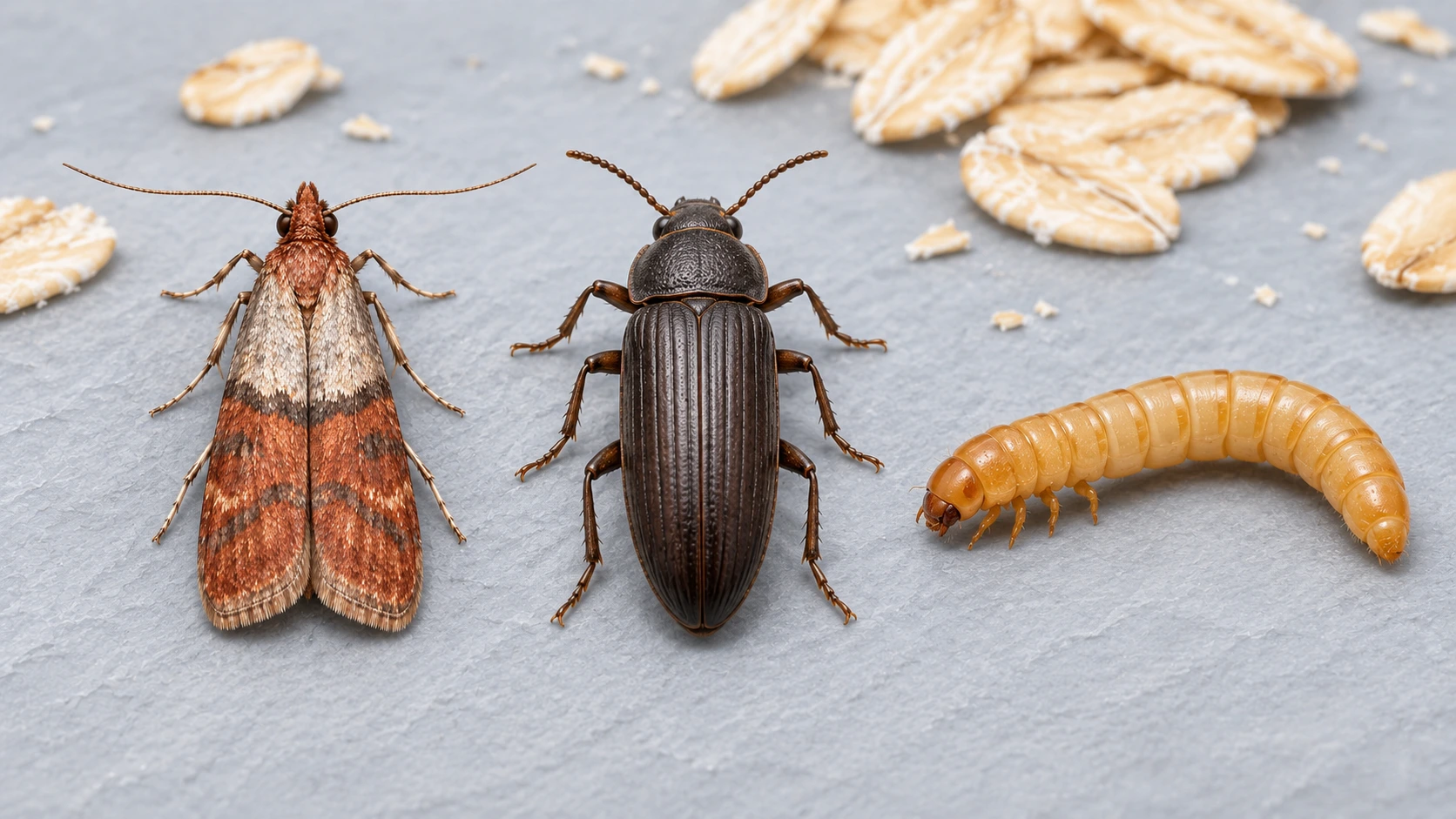
Indian meal moth and mealworm moth are two common names for the same insect, Plodia interpunctella. If you see both names in pest-identification references, they are not describing two different moth species.
The confusion starts with the word mealworm. Mealworms are also real insects, but they are the larvae of certain darkling beetles. An Indian meal moth does not grow into a mealworm beetle, and a beetle mealworm never becomes a moth. For a homeowner trying to identify an insect in the pantry, the names are easy to mix up. Fortunately, the insects themselves are quite different.
Why Is the Indian Meal Moth Also Called a Mealworm Moth?
Insect species sometimes have more than one common name. Those names can come from regional usage, historical descriptions or the foods and habitats associated with an insect. Different names do not necessarily mean different species.
The EPPO Global Database identifies “Indian meal moth” and “mealworm moth” as English common names for Plodia interpunctella. That provides a direct answer to the naming question. Both labels refer to the same species, even though Indian meal moth is the name homeowners are much more likely to encounter in pest-control instructions.
The word meal is also part of the confusion. In this context, meal refers to ground grain or a similar food product. Indian meal moth larvae feed in stored foods, including grain products. The historical origin of the name “Indian meal moth” is a separate question from whether mealworm moth is an accepted alternative name.
We would use Indian meal moth when identifying this pest or looking for reliable control information. It is clearer, more recognizable and less likely to be confused with the beetle larvae sold or described as mealworms.
A Mealworm Moth Is Not the Same Thing as a Mealworm
A mealworm is usually the larval stage of a darkling beetle. One familiar example is the yellow mealworm, Tenebrio molitor, which develops into an adult beetle.
The term can also refer more broadly to the larvae of other darkling beetles. These larvae typically have elongated, relatively firm bodies and recognizable jointed legs near the front. They are commonly found in grain products and other suitable materials. The biology of darkling beetles and mealworms makes clear that mealworms belong to beetles, not moths.
Indian meal moth larvae are caterpillars. They have a different body structure and develop into flying adult moths. Their feeding can produce silk threads that bind food particles together, often leaving webbing in contaminated packages.
This difference matters when you discover something wormlike in flour, cereal or birdseed. The everyday word worm tells you very little about the insect’s identity. You need to examine its body and the evidence around it.
The appearance of Indian meal moth caterpillars is particularly useful when the adult insect has not yet appeared.
Indian Meal Moth, Mealworm Moth and Mealworm: The Difference
| Name | What it refers to | What it becomes |
|---|---|---|
| Indian meal moth | Plodia interpunctella, a stored-food moth | The adult stage is a moth |
| Mealworm moth | An alternative common name for the Indian meal moth | The same moth, Plodia interpunctella |
| Mealworm | A larva of a darkling beetle, such as Tenebrio molitor | An adult beetle |
| Meal moth | Usually Pyralis farinalis when used as a specific species name | A different moth species |
The fourth entry deserves attention. A meal moth, without the word worm, can mean a separate stored-product moth called Pyralis farinalis. It is not automatically another name for the Indian meal moth.
Stored-food pest references distinguish the meal moth from the Indian meal moth, even though both may infest grain-based products. The names sound similar, but the scientific names identify separate species.
We would not treat “meal moth” and “mealworm moth” as interchangeable terms. One missing word changes what an identification reference may be describing.
How Can You Recognize an Indian Meal Moth?
The adult Indian meal moth is a small moth with a characteristic two-toned forewing pattern. The part of each forewing nearest the body is relatively pale, usually grayish or tan. The outer portion is darker, often reddish brown with a coppery appearance.
The adult Indian meal moth identification guide covers its size, resting position and other features in greater detail.
The contrasting wing colors are a useful clue, although worn wing scales and poor lighting can make the pattern harder to see. The appearance and feeding signs of Indian meal moths also help connect an adult sighting to the insects developing in food.
If you find small, pale caterpillars in stored food, look for fine silk webbing, clumped particles and material stuck around package folds. Indian meal moth larvae produce silk as they feed. Mature larvae may also leave the food and crawl along walls or ceilings before pupating.
Those signs are consistent with Indian meal moth activity, but they are not always enough to identify the species by themselves. Other stored-product moths can produce webbing too. A recognizable adult specimen, or a specialist identification when necessary, provides stronger evidence.
For a broader assessment, the signs of an Indian meal moth infestation can help you decide whether a flying moth is connected to an active food source.
What If You Find Mealworms and Moths in the Same Pantry?
Do not assume that one must be the immature form of the other.
Stored foods can attract more than one type of insect. Discovering a beetle larva in one package and a moth flying near the cupboard does not establish that they belong to the same species or even the same infestation.
Start with the actual specimens and their locations. A small, smooth-looking caterpillar surrounded by silk suggests a different feeding pattern from a firmer-bodied beetle larva moving through grain or bedding material. If you can safely photograph both insects, take separate close-up pictures rather than treating them as two stages of one life cycle.
Check susceptible products for activity, including cereals, flour, dry pet food, birdseed, nuts and dried fruit. These are among the foods that may support Indian meal moth larvae. A package containing visible insects, webbing or obvious insect contamination should be set aside rather than returned to storage.
Finding the food source is more useful than debating which common name to use. Once you have confirmed an Indian meal moth infestation, the next task is to locate the infested package or material. Adult moths may be seen some distance from the food in which their larvae developed.
If beetle larvae are also present, identify them separately. One pest’s presence does not rule out another.
Does the Name Change How You Get Rid of Them?
No. If the insect is Plodia interpunctella, the name mealworm moth does not call for a separate treatment method.
The same Indian meal moth identification and control information applies under either name. The first priority is to find and remove the material supporting the developing larvae. Inspect nearby susceptible products, clean up spilled food and store unaffected foods in containers that exclude pantry pests.
Adult moth traps can help reveal activity, but trapping adults does not remove larvae feeding inside an overlooked package. Using traps without checking the stored food may leave the infestation source untouched.
The full Indian meal moth removal guide covers the treatment sequence. For this naming question, the point is simpler: two common names for the same species do not require two different control strategies.
The situation changes if the specimens are actually beetle mealworms. Then you are dealing with a different insect group, and you should not rely on a moth identification or moth-specific trapping method to identify what is present.
Why the Scientific Name Settles the Question
Common names are convenient, but their wording is not always consistent. A reliable species identification is more precise.
Both Indian meal moth and mealworm moth refer to Plodia interpunctella. The scientific name acts as the common reference point when one document uses a familiar name and another uses a less common alternative.
That does not mean every insect called a mealworm, meal moth or pantry moth belongs to Plodia interpunctella. Each term has its own possible meaning, and some are used loosely.
For this particular question, there is no need to invent differences in wing shape, body size, diet or behavior between an Indian meal moth and a mealworm moth. They are the same insect.
The Bottom Line
Indian meal moths and mealworm moths are the same species, Plodia interpunctella. The alternative name is legitimate, but Indian meal moth is the clearer term for most household pest-identification purposes.
Do not confuse either name with mealworms, which are beetle larvae, or with the separately named meal moth, Pyralis farinalis.
If you have found an insect in stored food, its body features, life stage and surrounding evidence matter more than a similar-sounding name. Identify the insect first, then choose the appropriate response.