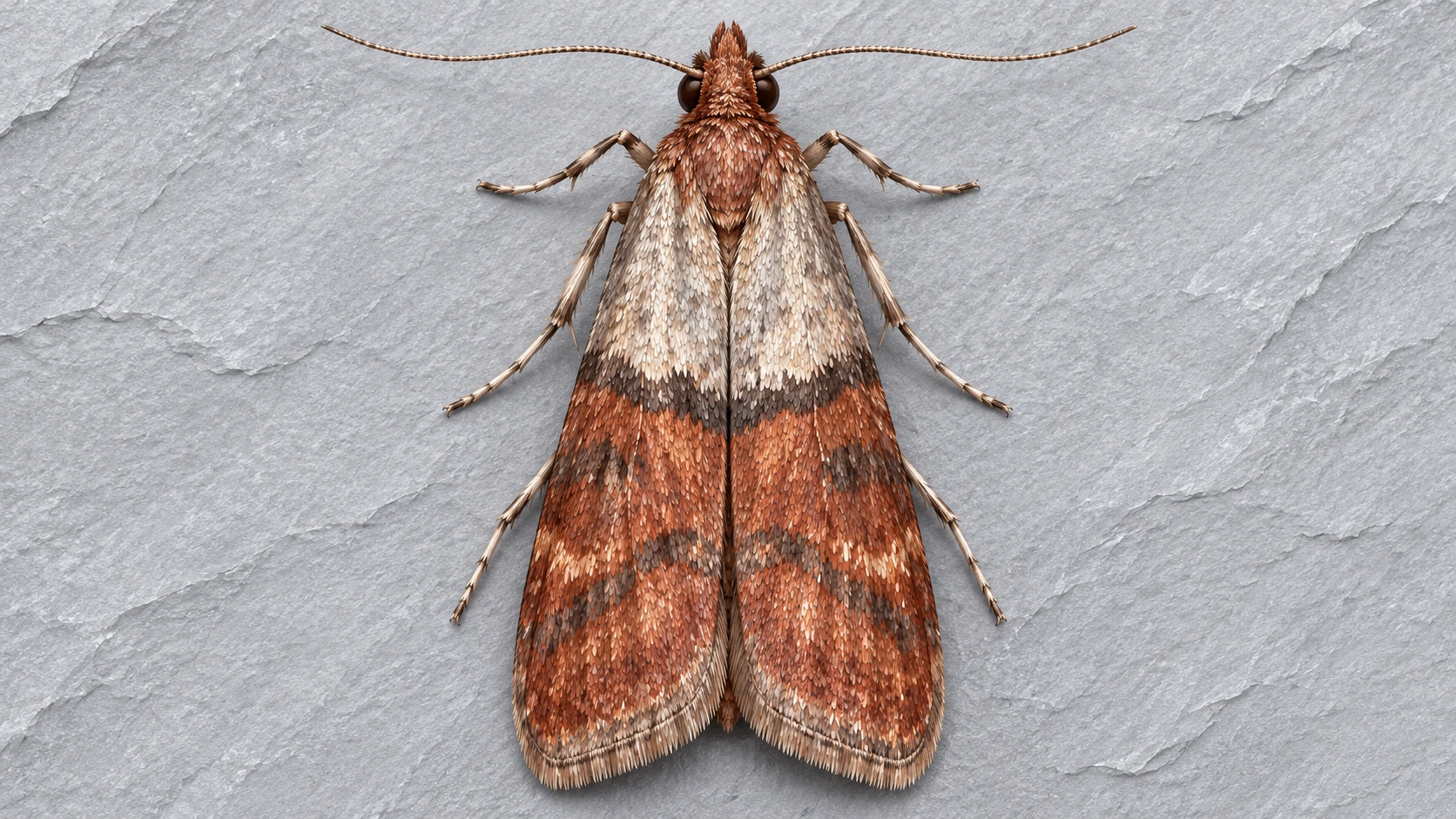
Indian meal moths are usually grayish-tan and coppery brown, with two contrasting color sections on their forewings. The portion closest to the body is pale cream, gray or yellowish tan, while the outer portion is reddish brown, bronze or copper-colored. Some individuals look considerably darker, and certain lighting conditions can make an adult appear almost black.
The contrast between the two wing sections is more dependable than any single shade. One Indian meal moth may look rusty red, another bronze-brown, and another dark gray in a photograph. Those differences do not necessarily mean they belong to different species.
The condition of the wings also matters. Moth wings are covered with tiny scales that contribute to their color and pattern. When those scales are rubbed away, the familiar markings can become faint or difficult to recognize.
For homeowners, the most useful approach is to examine where the light and dark areas occur, rather than expecting every Indian meal moth to match the colors of one identification photograph.
What Colors Are an Indian Meal Moth’s Wings?
The adult Indian meal moth, Plodia interpunctella, has a distinctive forewing pattern made up of two main color zones.
The inner section, nearest the head and thorax, is generally pale. It may appear whitish gray, cream, light tan or yellowish buff. Some freshly emerged specimens can show a subtle greenish cast in this area.
The outer section is darker and usually occupies approximately the outer two-thirds of the forewing. Its color varies from reddish brown and rusty bronze to darker copper-brown or gray-brown.
The Canadian Grain Commission’s species description records the pale wing bases as cream to yellow and the outer portions as coppery red to dark gray. These are normal variations within the appearance of the species.
When an adult rests with its forewings folded along its body, the pale inner sections and darker outer sections create a noticeable division. The result is often described as a two-toned or bicolored moth.
That arrangement matters more than whether you would personally describe the outer section as brown, red or copper.
A moth with pale wing bases and darker coppery outer wings is consistent with an Indian meal moth. A uniformly brown moth without visible contrast requires closer examination before making the same identification.
The Two-Toned Pattern Is More Useful Than an Exact Color
Color names can be subjective. One person may call a moth reddish brown, while another sees bronze or dark copper. The same specimen can look different against a white wall, a wooden cupboard or a dark countertop.
The position of the markings is less subjective.
| Part of the adult moth | Common appearance | What to look for |
|---|---|---|
| Inner forewing, closest to the body | Cream, pale gray, tan or yellowish buff | A relatively light section near the base of the wing |
| Outer forewing | Reddish brown, rusty bronze, copper or dark gray-brown | A darker section extending toward the wing tip |
| Faint markings within the dark section | Dark bands or subtle gray, metallic-looking lines | Additional detail that may be visible in a sharp photograph |
| Hindwings | Pale grayish or whitish, often less conspicuous | Usually hidden beneath the forewings when the moth rests |
| Head and thorax | Often grayish or brownish | Supporting details, not the most dependable color feature |
The inner and outer sections do not always form perfectly clean blocks of color. The boundary may look irregular, and faint lines within the darker section can affect the overall appearance.
A North American moth identification record describes the pale forewing base as tan to gray, sometimes greenish when fresh, and the outer section as dull reddish brown with subtle lead-colored lines.
These smaller details can be useful when a photograph is exceptionally clear. For an ordinary household sighting, the broad contrast between the pale base and darker outer wing is the stronger clue.
We would not rule out an Indian meal moth merely because the copper color looks muted or because the boundary between the two regions is less sharp than it appears in a reference image.
Are Indian Meal Moths Red, Brown or Copper-Colored?
All three descriptions can be appropriate.
The darker part of an Indian meal moth’s forewing can have a reddish-brown ground color with a metallic-looking copper sheen. Under favorable lighting, that sheen may be the feature that stands out first.
In softer light, the same region can look like ordinary brown. Under warm indoor bulbs, it may appear redder or more orange than it does in daylight.
The terms bronze and copper describe the visual impression of the wing scales. They do not mean the insect has a metallic shell. A moth’s surface is covered with scales, and the appearance of those scales changes with illumination and viewing angle.
The adult color description published by the University of Florida identifies the reddish-brown outer forewings and their copper sheen as characteristic features.
A useful photograph may therefore show a combination of colors rather than a single dominant brown. The inner section might look almost silver-gray, while the outer section appears reddish bronze.
That combination is typical. Indian meal moths are not expected to have identical shades across their entire wings.
Can Indian Meal Moths Be Black or Very Dark Brown?
Yes. Some Indian meal moths appear very dark, and certain live specimens can look almost black under particular lighting conditions.
The Natural History Museum’s Indian meal moth identification guide specifically notes that some adults are dark enough to appear black in certain lighting.
This is one reason the phrase small black moth does not automatically rule out an Indian meal moth.
When a dark moth is resting in a shadowed cupboard, the pale section near the wing base may be difficult to distinguish. The copper-colored outer section can also lose its reddish appearance and blend into an almost uniform dark silhouette.
Try examining a sharp photograph taken under neutral, diffuse lighting. A subtle change in shade between the inner and outer wings may become visible.
Nevertheless, a genuinely uniform black appearance is not enough to identify an Indian meal moth. Other moth species can also look dark, and the contrast might remain invisible because of scale loss or poor image quality.
The correct conclusion is that a very dark appearance is possible, but it offers weaker evidence than a clearly preserved two-tone pattern.
Can Indian Meal Moths Look Gray or Silver?
They can, especially when the pale wing bases dominate what you see.
The inner forewing region is often described as silvery gray or whitish gray. If the moth is partly concealed, the darker wing tips may not be obvious. A photograph taken from the front can also emphasize the lighter section and make the adult appear paler overall.
The hindwings add another source of gray coloration. They are much less conspicuously marked than the forewings and may look pale grayish or whitish when visible during flight or in a specimen with its wings spread.
A predominantly gray impression is therefore possible without indicating a different species.
However, a clearly visible adult whose entire forewings are uniformly gray does not show the classic Indian meal moth pattern. You would need additional evidence before identifying it confidently.
The full adult Indian meal moth appearance guide covers body shape, resting position and other identification features that become useful when wing coloration is ambiguous.
Why Do Some Indian Meal Moths Look Different From Others?
Natural variation is part of the explanation. Indian meal moths do not all have exactly the same shade of gray, tan, red or brown.
The outer forewings can range from brighter coppery red to duller brown or dark gray. The pale bases can also differ in tone. The contrast between these areas may be pronounced in one moth and comparatively subdued in another.
Differences in specimen condition add to that variation.
A freshly emerged moth may have intact scales and a relatively clear pattern. An older or handled moth may have lost some scales, weakening the appearance of its original colors. The reference photographs you find online may show individuals in different conditions.
Photography adds another layer. Camera exposure, flash, background and white-balance settings can all change the apparent shade.
It helps to separate three explanations when two Indian meal moths look unlike each other: real variation in wing coloration, physical wear to the wing scales, and differences introduced by how the moths were viewed or photographed.
Those explanations can occur together. An unusually dark moth photographed under a warm bulb may look quite different from a pale, intact specimen photographed in daylight.
How Wing Scale Wear Changes an Indian Meal Moth’s Appearance
The colors on a moth’s wings are associated with its covering of tiny scales.
Those scales can be lost through contact with surfaces, physical handling and other abrasion. When the scales disappear, the visible pattern may become patchy or faded.
An adult Indian meal moth that has brushed against packaging, walls or the inside of a trap may therefore look different from an intact specimen.
The pale basal area might lose its clean appearance. The darker outer section may also look less coppery or show irregular patches that make the original color boundary difficult to see.
The University of Minnesota’s identification guidance specifically warns that Indian meal moth wing markings may become unclear when scales have rubbed off.
This is an important identification limit. A worn moth should not be expected to match a pristine reference photograph.
It also explains why an adult found dead on a windowsill may be harder to recognize than a recently emerged moth resting undisturbed.
Scale loss does not create a new color form or turn an Indian meal moth into a different species. It changes how much of the original pattern remains visible.
What Does a Worn Indian Meal Moth Look Like?
A worn specimen may have duller wings, unevenly colored patches or a partially obscured boundary between the pale and dark sections.
In some cases, the adult can appear unusually plain. If the remaining scales are sparse or damaged, the identifying pattern may be too incomplete for a confident visual judgment.
Do not scrape or brush the wings to reveal markings. That would remove more scales and further reduce the quality of the evidence.
If you need to preserve a moth for identification, handle it as little as possible and keep it in a secure container. A clear photograph taken before handling can be more informative than a damaged specimen examined afterward.
How Lighting Changes the Color You See
Lighting can dramatically alter the apparent color of an Indian meal moth without changing the insect itself.
Under daylight, the pale forewing base may look gray or creamy white, and the outer section may appear a fairly distinct reddish bronze.
Warm indoor lighting can push the tan and brown areas toward yellow, orange or red. Cool lighting may make the same specimen appear more grayish or muted.
Dim lighting reduces the visibility of subtle differences. A moth that looks almost black against a dark cabinet may reveal its pale wing base when photographed against a light background.
Direct flash can create a different problem. It may produce bright reflections from the wing scales or wash out the pale section. Strong shadows can hide portions of the darker section at the same time.
The surface behind the moth also affects perception. Brown wings can blend into wood grain, while the same wings may appear much darker against a white wall.
For color assessment, we prefer even, neutral lighting that reveals both wing sections without intense glare or deep shadow.
Why Phone Pictures Can Make Indian Meal Moths Look the Wrong Color
Phone cameras do not record insect colors under perfectly controlled conditions.
Automatic white balance attempts to compensate for the light source, but it can make gray areas look warm or cool and can shift coppery brown toward orange, purple or nearly black.
Exposure presents another issue. A small dark moth against a bright wall may be underexposed, causing the darker wing section to lose detail. Against a dark background, the camera may brighten the whole image and make the moth appear paler than it is.
Digital sharpening and image processing can also exaggerate fine wing markings or turn subtle color boundaries into harsh edges.
A close photograph with a bright flash might show a pale-looking moth that appeared dark brown to the eye. A picture taken under a yellow bulb might make a fairly muted bronze moth look strongly reddish.
These changes are photographic effects, not proof that the species has unusual coloration.
The most useful pictures preserve the relative relationship between the inner and outer wing sections, even when the exact shades are imperfect.
How to Photograph Indian Meal Moth Wing Markings Accurately
You do not need specialized photography equipment to obtain a useful image, but the way the picture is taken matters.
Try photographing the moth while it is resting with its wings visible from above. Move slowly and avoid touching it. The goal is to preserve its scales and capture the pattern before the insect moves.
Use steady, diffuse light. A nearby window or a room with even illumination is usually preferable to a harsh direct flash. Keep the phone parallel to the upper surface of the moth when possible.
Tap the insect on the screen to focus, then take more than one photograph. One image can show the overall pattern, while another may capture the subtle color markings more clearly.
If your phone offers an extreme digital zoom setting, avoid relying on it for fine details. Moving closer within the camera’s focusing distance often produces a more useful image than enlarging a blurred photograph.
Keep the original image if possible. Strong filters, dramatic contrast adjustments and automatic color effects can make the picture less suitable for judging true wing coloration.
A good photograph should help answer a practical question: Is the forewing clearly paler near the body and darker toward the tips?
If the photograph cannot show that relationship, the image may still be useful for documenting a moth sighting, but it should not be treated as definitive color evidence.
Can You Identify an Indian Meal Moth by Wing Color Alone?
Sometimes the characteristic wing pattern is strong enough to support a confident identification, particularly when the adult is intact and the photograph is clear.
The pale inner forewing and coppery outer region are distinctive features of Plodia interpunctella. They are among the reasons this moth is often recognizable in household settings.
But color is less useful when the specimen is worn, unusually dark, poorly photographed or partly obscured.
Another limitation is that color descriptions are not exclusive labels. Other moths can be brown, gray, reddish or bronze. A general color match does not establish species identity.
If the wing pattern is unclear, examine other adult features and the circumstances in which the moth was found. The signs of Indian meal moth activity provide context when the insect is associated with stored food.
Actual feeding evidence is more useful than the color of a moth discovered near the kitchen. Larvae, silk webbing and contaminated dry products can support an identification, although these signs may also occur with other stored-product moths.
If several species remain plausible, keep the identification provisional rather than forcing a conclusion from an imperfect photograph.
For a focused examination of similarly colored insects, the Indian meal moth and almond moth comparison addresses a different identification question, while the brown house moth comparison covers another commonly confused adult.
Does a Different Wing Color Mean a Different Sex or Life Stage?
Not necessarily. Darker wings are not a reliable shortcut for identifying male or female Indian meal moths.
Both sexes have the characteristic two-zone wing pattern, and ordinary color differences cannot be used as a dependable sex-identification method.
The male-versus-female Indian meal moth guide addresses the anatomical evidence and the limitations of size-based guesses.
The colors described in this article belong specifically to adult moth wings. Eggs, caterpillars and pupae have different body structures and should not be judged against adult wing coloration.
An immature Indian meal moth cannot be identified by looking for coppery forewings because it has not yet developed the adult wing pattern.
The Indian meal moth life cycle explains when adult features appear. That prevents a normal developmental difference from being mistaken for a strange color variant.
What to Do When Your Moth Does Not Match Reference Photos
A mismatch in shade does not automatically eliminate Indian meal moth as a possibility.
First, compare the layout of the wing markings. Look for a pale basal section and darker outer area, even if the colors are muted.
Next, consider whether the specimen has lost scales. Faded or patchy wings can explain why the usual contrast is absent.
Then look at the photograph itself. Strong yellow lighting, direct flash, a dark background or aggressive image processing can alter how the colors appear.
If the characteristic pattern remains uncertain, use additional identification evidence instead of making increasingly speculative color judgments. Where the moth was found, whether larvae were present and whether stored materials show feeding damage can all help direct the investigation.
When the specimen is too worn or unclear to identify, a qualified insect-identification service may be the most reliable option.
We would rather leave an uncertain moth unidentified than assign it to Plodia interpunctella solely because it appears brown in a pantry.
The Bottom Line
Indian meal moths typically have pale gray, cream or yellowish-tan wing bases and darker reddish-brown, bronze or coppery outer forewings. Some have a faint greenish cast near the wing base, subtle darker bands or a much darker overall appearance.
Lighting can make the same moth appear redder, grayer or nearly black. Camera processing can distort the shades further, while rubbed-off wing scales can obscure the original markings.
The most dependable color clue is the two-toned arrangement of the forewings, not an exact shade of brown or copper. When that pattern is missing or unclear, use other physical and infestation evidence before making a species identification.