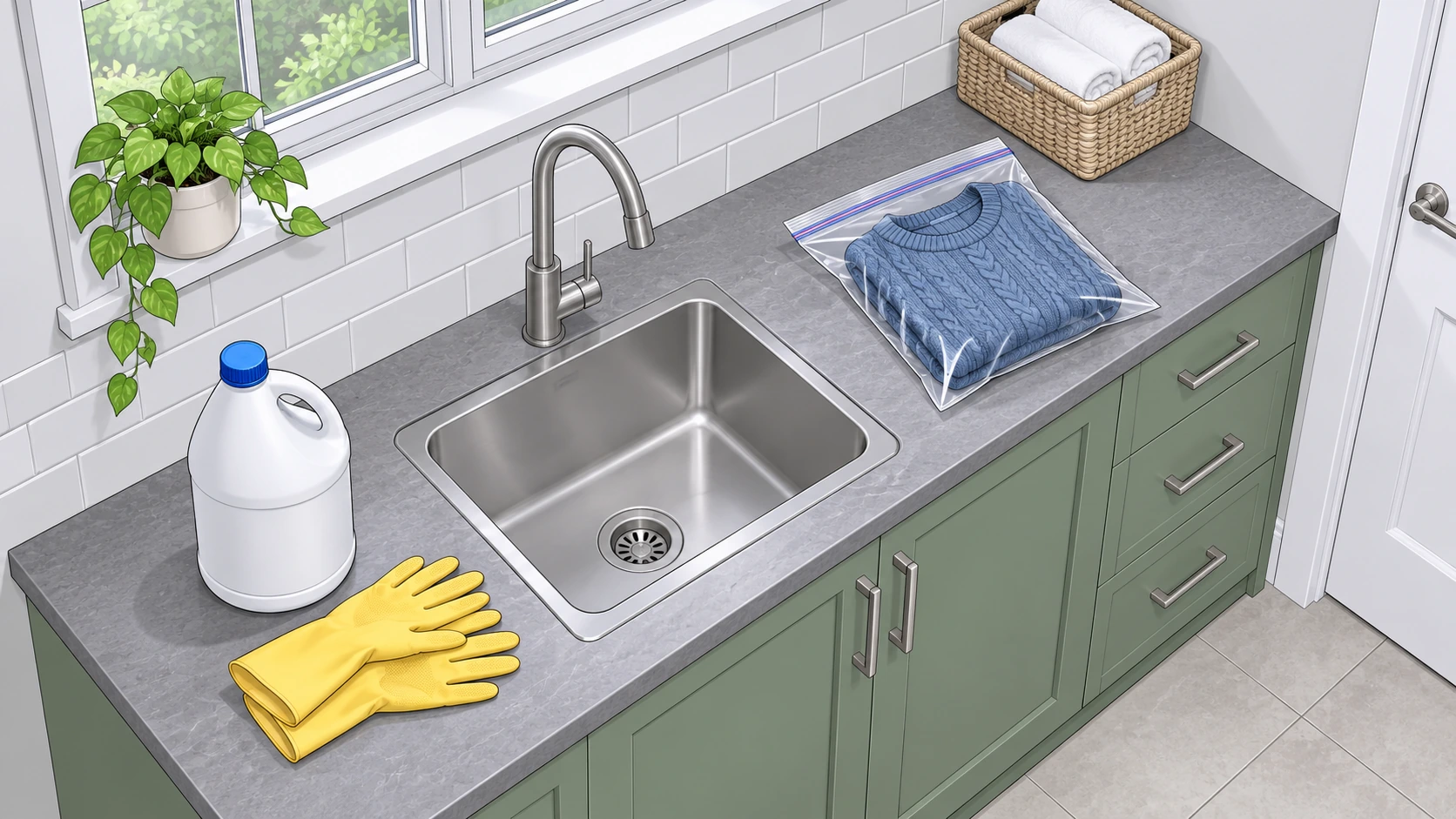
Bleach may injure or kill carpet beetles that come into direct contact with it, but ordinary household bleach is not an established or reliable carpet beetle treatment. There is insufficient carpet beetle-specific evidence to recommend a bleach concentration, contact time, or application method that will consistently kill adults, larvae, pupae, and eggs.
Some household pest-control advice recommends spraying diluted bleach on infested surfaces. The difficulty is that a disinfectant’s ability to destroy microorganisms does not establish its effectiveness against insects. Even if bleach kills an exposed larva, that result says little about larvae concealed inside furniture, carpet backing, or stored fabrics.
Bleach can also discolor textiles, damage materials, and irritate the skin, eyes, and respiratory system. For most carpet beetle problems, its potential drawbacks outweigh the uncertain pest-control benefit.
What Bleach Could Do to a Carpet Beetle on Contact
Ordinary chlorine bleach contains sodium hypochlorite, a reactive chemical used in many cleaning and disinfecting products. It can damage biological material through oxidation, which is why appropriately formulated bleach products are effective against many microorganisms.
An insect exposed directly to a sufficiently aggressive chemical may suffer injury or die. However, carpet beetles are multicellular animals with protective external structures, and their response cannot be predicted from tests involving bacteria or viruses.
There is no well-established household bleach treatment that specifies how much sodium hypochlorite must contact a carpet beetle, for how long, to reliably kill a particular developmental stage. The distinction matters because a claim of possible contact mortality is much narrower than a claim of proven insect control.
Bleach products also differ in concentration and formulation. A laundry bleach, a disinfecting bleach, and a thickened bathroom cleaner should not be treated as interchangeable chemicals simply because all contain sodium hypochlorite.
The difference between antimicrobial disinfectants and insect-control products is particularly relevant here. Bleach can be sold as a cleaner, a disinfectant, or both, but its actual intended uses depend on the product and label.
A household bleach bottle with directions for disinfecting hard surfaces should not be assumed to have tested directions for killing carpet beetles.
Why a Bleach Spray Cannot Reliably Eliminate Carpet Beetles
Carpet beetle infestations usually involve larvae developing around suitable food materials. Depending on the species, these may include wool, animal hair, feathers, insect remains, and debris accumulated in protected spaces.
A spray applied to an exposed surface may never reach the insects responsible for the damage. Larvae can remain beneath carpet edges, inside upholstery, between stored textiles, or in material concealed behind furniture.
Bleach has another limitation: ordinary household bleach is not designed to leave a persistent insecticidal deposit that controls carpet beetles moving through an area later. Once a treated surface has been cleaned and dried, you should not assume it will kill larvae that subsequently crawl across it.
The established approach to managing carpet beetles in homes focuses on removing infested materials, clearing accumulated food sources, and using an insecticide specifically labeled for the pest only when appropriate.
This creates a practical problem with bleach spraying. You could repeatedly wet a carpet edge or closet shelf while leaving the actual larval food source untouched. The insects might remain active, and the treated materials could suffer unnecessary chemical damage.
A more useful investigation follows where carpet beetles are actually developing before deciding whether any chemical treatment is warranted.
Does Bleach Kill Carpet Beetle Eggs?
Bleach has not been established as a dependable household treatment for carpet beetle eggs. Claims that a particular dilution will kill every egg on contact need carpet beetle-specific testing and defined exposure conditions.
Eggs may be deposited in protected locations near suitable larval food. Some may be concealed within folds, cracks, or layers of material that a surface-applied liquid does not reach.
Even where bleach makes direct contact with an egg, the result depends on factors that have not been adequately established for a general household recommendation. These include formulation, concentration, exposure duration, and the egg’s actual condition.
It would therefore be misleading to claim that a bleach spray automatically kills carpet beetle eggs simply because bleach is effective against certain microorganisms.
The broader issue of killing carpet beetle eggs in concealed locations requires methods that account for placement and developmental-stage coverage. Bleach does not offer a verified shortcut around those problems.
Does Bleach Kill Carpet Beetle Larvae?
Direct exposure to bleach could harm a carpet beetle larva, but there is no validated household bleach application that reliably eliminates larvae under typical infestation conditions.
Larvae are the main stage responsible for fabric damage. They can feed in protected materials for extended periods, often leaving cast skins as they develop. A larva visible on a hard floor may be easier to contact than one sheltered deep within a textile.
That difference explains why observing an insect become inactive after chemical contact cannot establish that the rest of the infestation is controlled.
Physical removal is usually a more dependable response to visible larvae. An accessible insect can be captured or removed without exposing surrounding materials to an unnecessarily harsh chemical.
When several larvae appear in the same area, the evidence should prompt inspection of nearby food materials. Repeatedly spraying exposed individuals does not address the conditions supporting their development.
What About Adult Beetles and Pupae?
An adult carpet beetle found on a windowsill may have developed elsewhere. Spraying it with bleach would expose the windowsill and nearby surfaces to a chemical without providing meaningful information about the infestation’s origin.
Adults of common household carpet beetle species can fly. Some gather around light, so the place where they are seen may be far from the material in which they developed.
Pupae present another uncertainty. They are often concealed, and a treatment that contacts exposed larvae may fail to reach them. No reliable general bleach treatment has been established for carpet beetle pupae.
Successful carpet beetle control must account for the insects and their breeding materials, not only the adults that happen to be visible.
Can You Use Bleach on Carpets and Rugs?
Bleach is usually an unsuitable choice for treating carpet beetles in carpets and rugs because of its potential to damage fibers, dyes, backing, and other components.
Chlorine bleach can remove or alter color. It can also damage certain fibers, including wool and silk, which are among the materials carpet beetle larvae may attack.
This creates an unfortunate combination. A natural-fiber rug might be particularly vulnerable to carpet beetle feeding, yet the chemical proposed to kill the larvae could damage the rug itself.
Carpet construction further complicates the issue. The surface pile, backing, adhesives, and underlay may have different chemical tolerances. A product that does not visibly damage one component may still affect another.
Do not pour bleach into carpet edges, soak rug backing, or attempt to saturate padding to reach larvae. The treatment is not validated for carpet beetles and may leave damage or chemical residues in material that cannot be readily rinsed.
Even insecticides specifically intended for carpet beetle control require attention to permitted application sites and potential staining. The label requirements for carpet beetle sprays cannot be replaced with an improvised bleach treatment.
For valuable rugs or delicate natural fibers, appropriate professional cleaning or pest assessment may be preferable to risking irreversible damage.
Can Bleach Be Used on Bedding, Mattresses, or Upholstery?
Bleach should not be applied to bedding, mattresses, or upholstered furniture as a carpet beetle insecticide.
Mattresses and upholstered items contain layers that can absorb liquid. Their internal padding may be difficult to rinse or dry thoroughly, and bleach can affect colors, fibers, and finishes.
Applying bleach to a mattress surface also does not establish that larvae in seams, fabric folds, or deeper components have received a lethal exposure.
Pillows, blankets, and other bedding may have separate care instructions. Some fabrics permit particular bleaching products as part of ordinary laundering, while others prohibit bleach entirely. A care-label allowance for bleaching does not establish that the product is effective against carpet beetles.
When insects are found around a sleeping area, the more relevant issue is identifying which materials actually contain larvae. Carpet beetles in a bed or mattress require material-appropriate inspection and control rather than applying household disinfectant to sleeping surfaces.
Similar restrictions apply to sofas, padded chairs, and stuffed objects. Chemical compatibility and the difficulty of treating concealed areas make bleach a poor general option for these belongings.
Is Bleach Useful for Cleaning Hard Surfaces After Finding Carpet Beetles?
Bleach may have a legitimate role in disinfecting a compatible hard surface for an unrelated hygiene reason, but routine carpet beetle removal does not require disinfecting the surface with bleach.
Carpet beetle larvae feed on available organic material. Removing debris, shed hair, lint, and infested items addresses their food supply. Disinfecting a bare surface does not remove an infested wool item hidden nearby.
Ordinary cleaning with a suitable detergent and water can be appropriate for compatible hard surfaces. The difference between cleaning and disinfecting is important: cleaning removes dirt and debris, while disinfecting is directed at microorganisms.
If a surface needs disinfection for a separate reason, use a product labeled for that purpose and follow its instructions. The decision should be based on the surface and hygiene concern, not an assumption that bleach residue will prevent carpet beetles from returning.
For carpet beetle management, the benefits of physical debris removal are addressed in more detail by vacuuming and its limitations against carpet beetles.
Bleach Contact Claims Versus Actual Infestation Control
The claims surrounding bleach often combine several different outcomes. A substance may injure an exposed insect without being suitable for treating the places where the insect develops.
| Claim | What can reasonably be concluded |
|---|---|
| Bleach may kill a directly exposed beetle | Possible, but a reliable carpet beetle-specific household procedure has not been established |
| Diluted bleach kills all carpet beetle eggs | Unsupported as a general guarantee |
| Spraying carpet with bleach eliminates larvae | Unreliable and potentially damaging |
| Bleach disinfects certain hard surfaces | Supported when an appropriate product is used according to its label |
| Cleaning away hair and lint reduces larval food | Supported by established carpet beetle management guidance |
| Bleach prevents carpet beetles from returning | No reliable evidence supports ordinary bleach use as lasting population control |
The difference between the first and last claims is especially large. Killing one accessible insect, even if observed directly, is not equivalent to eliminating a breeding population.
That is why we would not choose household bleach as a carpet beetle treatment. Its practical effectiveness is uncertain, and its hazards are avoidable when established management options are available.
The Chemical Risks Are More Certain Than the Pest-Control Benefit
Bleach is a reactive household chemical. Depending on the product and exposure, it can irritate or injure skin and eyes and can affect the respiratory system.
Good ventilation, appropriate protective equipment, and correct product handling matter whenever bleach is used for a legitimate labeled purpose. The household chemical safety guidance for bleach also warns against applying bleach directly to people or using it casually around children.
Never mix bleach with vinegar, ammonia, acidic cleaners, or other cleaning products. Such combinations can generate toxic gases, including chlorine or chloramine vapors. The chemical reactions caused by mixing household cleaners can produce serious respiratory injuries.
There is no carpet beetle-control benefit that justifies experimenting with chemical mixtures.
Keep bleach in its original labeled container, away from children and pets. Do not transfer it into an unmarked spray bottle or food container. Follow the manufacturer’s directions for storage, protective equipment, suitable surfaces, and disposal.
If bleach or a mixture of cleaning chemicals produces strong fumes, breathing difficulty, or eye irritation, leave the exposure area and seek immediate guidance from emergency services or a poison center as appropriate. Do not attempt to neutralize the mixture by adding another chemical.
Does a Stronger Bleach Solution Work Better?
Using more concentrated bleach is not an evidence-based way to improve carpet beetle control.
Higher chemical concentration can increase the risk of material damage and harmful exposure. Without validated insect-specific instructions, there is no defensible way to choose a stronger solution or predict that it will reach hidden larvae.
Household bleach concentrations also vary. A ratio suggested for one product cannot automatically be transferred to another, and disinfecting instructions should not be repurposed as insect-killing instructions.
Claims that a particular bleach-to-water ratio kills carpet beetles or their eggs on contact should therefore be treated cautiously. Without identified species, developmental stages, exposure conditions, and supporting test results, a recipe offers false precision.
We would not recommend any bleach dilution as a carpet beetle treatment.
What If You Already Sprayed Bleach Where Carpet Beetles Were Found?
Stop applying additional bleach to the affected area. Do not add vinegar, ammonia, detergent, insecticide, or another cleaner in an attempt to make the treatment more effective or remove the bleach chemically.
Check the product label for instructions relevant to the surface and any accidental application. Ventilate the area if it is safe to do so, and keep children and pets away from the affected material until the situation has been assessed.
If the bleach reached carpet, upholstery, or another absorbent item, the risk depends on the product, amount, and material. Some damage may not be reversible. A qualified cleaning professional or the material manufacturer may be able to advise on appropriate handling.
For a significant spill, chemical reaction, or suspected exposure, seek poison-center or emergency guidance rather than trying an improvised cleanup.
Once the chemical issue has been dealt with, examine the original carpet beetle evidence. The larvae may still be present, and the source may remain untouched.
Further activity should be evaluated through fresh sightings and signs of development rather than assuming the bleach killed everything it contacted.
How to Judge Whether Bleach Actually Worked
A dead beetle after exposure demonstrates only that the individual insect died. It does not establish the cause with certainty, the effectiveness of a particular dilution, or the survival of insects elsewhere.
A larva that stops moving is also not a dependable measurement of whole-infestation control. Other larvae, pupae, or eggs may remain in protected materials, while adults could appear later from a separate source.
More meaningful evidence involves whether new larvae continue to appear and whether active feeding material has been identified and dealt with.
The signs that carpet beetles are gone require distinguishing new insect activity from old shed skins, dead adults, and existing fabric damage.
If sightings continue, investigate the material supporting the insects rather than applying more bleach. Repeated contact treatments can damage belongings while leaving a concealed infestation unaffected.
The Bottom Line
Bleach could kill a carpet beetle through direct chemical contact, but household bleach has not been established as a reliable treatment for carpet beetle infestations. There is no supported universal dilution or contact time that guarantees control of adults, larvae, pupae, and eggs.
The greatest practical limitations are poor access to concealed insects, lack of demonstrated population control, and potential damage to fabrics and furnishings. The risks of irritating fumes and unsafe chemical reactions add little reason to use it for this purpose.
For carpet beetles, identifying and removing the infested material is more dependable than spraying disinfectant. Bleach should not be used as a substitute for an appropriate, evidence-based pest-control method.