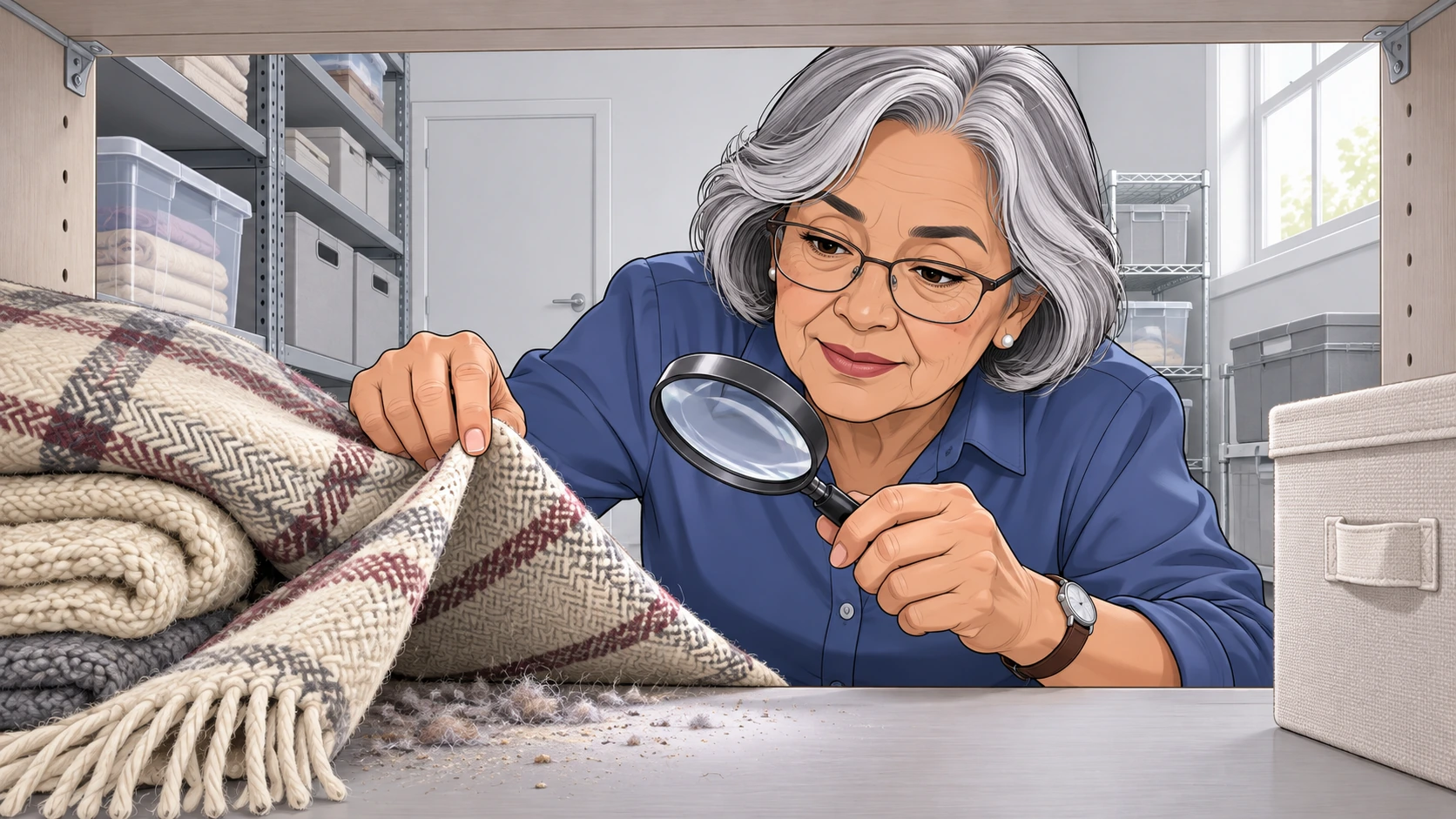
Finding where carpet beetles are actually coming from means tracing them back to the material where their larvae are feeding and developing. The place where you see a beetle is often not its source. Start by identifying the life stage you found, comparing evidence across nearby locations, and examining suspected materials for live larvae, shed skins, and feeding damage.
A carpet beetle on a windowsill might have developed somewhere else in the house. A larva crawling across a bedroom floor might have left its feeding site behind. Even a damaged wool sweater does not automatically prove that the sweater is the main source of an infestation.
The goal is to find the active feeding site, not simply the room with the most noticeable insects. That requires following evidence, ruling out weak suspects, and knowing when activity points toward something hidden.
First, Understand What Counts as a Carpet Beetle Source
A source is a material or accumulation of debris that supports carpet beetle larvae as they develop. It might be a wool rug, a collection of pet hair beneath furniture, an infested stored textile, or an accumulation of dead insects in an inaccessible space.
Carpet beetles do not build organized colonies or constructed nests. Their larvae develop around suitable food, sometimes in loose groups, and leave evidence as they feed and grow. That is why identifying what a carpet beetle nest actually looks like is less useful than establishing which material is supporting larval development.
Finding an adult beetle is different from finding its source. Adults of several common carpet beetle species fly and may gather around windows, while larvae typically develop in darker, protected places. Larvae can also wander away from food, particularly as they mature.
The difference between adult sightings and larval feeding sites matters because adults may travel considerable distances from where they developed.
For practical source tracing, a suspicious location becomes more convincing when it contains several connected clues. A live larva inside a wool item, several shed skins caught within its folds, and damage concentrated in the same area provide stronger evidence than an adult beetle found on the floor nearby.
Rank the Evidence Before You Start Moving Furniture
Not every carpet beetle sign carries the same weight. Some observations strongly suggest local development. Others merely show that an insect passed through the area.
| Evidence found | What it tells you | How useful it is for finding the source |
|---|---|---|
| Live larvae inside or directly feeding on susceptible material | The material is being used by larvae | Strong evidence |
| Multiple shed skins embedded in one material, alongside damage or larvae | Larval development has occurred there | Strong evidence, especially with recent activity |
| Fresh-looking damage and feeding debris concentrated in one location | Possible localized feeding | Useful, but needs insect confirmation |
| One larva crossing an exposed floor | A larva is present, but may have wandered | Moderate to weak evidence |
| Adult beetles clustered at a window | Adults are gathering there | Weak evidence of the actual breeding location |
| One old shed skin in a closet | A larva was there at some point | Historical evidence, not proof of ongoing activity |
| Unexplained holes in fabric | Damage has occurred | Insufficient by itself to identify the pest |
Shed skins deserve particular care. Carpet beetle larvae molt repeatedly, leaving bristly, empty skins that can resemble living larvae. Finding several does not necessarily mean several larvae are currently present. For a closer identification, carpet beetle shed skins need to be distinguished from living insects and other debris.
Clustering matters more than a single sign. Several kinds of evidence concentrated in one material make a stronger case than scattered discoveries across unrelated surfaces.
Trace the Activity Backward From Where You Found It
Begin with the exact spot where you first noticed the insect, but do not assume that spot is the source. Record whether it was an adult or larva, what surface it occupied, and whether similar specimens have appeared there before.
For a quick investigation, work through three questions in order.
1. Are You Finding Adults, Larvae, or Both?
Mostly adult beetles near windows suggest a different search pattern from repeated larvae emerging around a stored rug.
Adults may be more visible because they are drawn toward light. The behavior and identification of carpet beetle life stages explain why the most obvious sightings can occur away from the materials being damaged.
Repeated larvae deserve closer attention to nearby concealed materials. That does not guarantee that the food source is immediately beside them, but it gives you a more useful starting point than isolated adults.
2. Where Is the Evidence Concentrated?
Compare the locations where insects or skins have appeared. If one corner repeatedly produces larvae while neighboring areas remain quiet, examine materials connected to that corner before expanding the investigation.
For example, larvae appearing at the edge of a bedroom rug might be associated with the rug backing, debris beneath its edge, or another nearby concealed material. Their presence alone cannot distinguish among those possibilities.
The point is to develop a short list of plausible sources, then inspect those sources directly. A whole-property carpet beetle inspection checklist can help when you do not yet have a starting location, but source tracing should become more targeted once a pattern emerges.
3. Is There Material There That Larvae Can Use?
A location becomes more suspicious when it contains food that matches the beetle’s larval habits. Wool, animal hair, feathers, fur, insect remains, and certain stored products can support different carpet beetle species.
Do not treat every fabric as equally susceptible. A clean synthetic blanket and an old wool blanket present different feeding possibilities. Knowing what carpet beetle larvae actually eat helps separate likely sources from objects that merely happen to be nearby.
The insect’s identity still matters. Other fabric pests and related dermestid beetles can require a different investigation, particularly when the suspected source is a stored food product or animal-derived material.
Test Suspected Materials Without Spreading the Infestation
Once you have identified a likely material, examine it separately from other belongings. Avoid carrying a possibly infested rug, garment, or cushion through the house uncovered.
For a removable item, use a clean, light-colored surface or tray where small larvae and shed skins will be easier to see. Inspect folds, seams, undersides, and protected areas where debris collects. A flashlight and magnification can help with small specimens.
Look for evidence that belongs to the material itself. Larvae concealed within the folds of a stored wool blanket are more persuasive than a larva found on top of the storage box. Shed skins lodged deep in the blanket, especially alongside feeding damage, strengthen the connection.
You can temporarily isolate a suspected item in a clear, securely closed container or bag suitable for that material. Label it with the date and location. The purpose is to prevent insects from moving between items while you inspect the surrounding area and determine whether the material contains insects.
Isolation is not a guaranteed detection test. The absence of visible insects after a few days does not clear an item, and finding one adult inside a bag does not automatically prove that the item supported its development. Opening the item and examining it for larvae, skins, and feeding damage remains more informative.
Avoid leaving vulnerable fabrics in sealed conditions where trapped moisture could damage them. Once an item is confirmed as infested, choose an appropriate cleaning, treatment, or disposal method based on its material rather than using isolation alone as the remedy.
Use Sticky Traps to Narrow Down Hidden Activity
Sticky traps can help identify where carpet beetles are repeatedly appearing, particularly when you have already removed obvious debris but still cannot identify the source.
Place traps in a small number of comparison locations, such as near a suspected carpet edge, along a wall where larvae have appeared, and at a nearby window. Record the position of each trap so that catches can be compared.
Check the traps once or twice a week and note the insect type and life stage. The purpose is to identify a pattern, not simply accumulate trapped insects.
For example, repeated larval catches along one wall may justify investigating the carpet edge, concealed debris, or adjacent furniture on that side. Adult catches at a sunny window may be less informative about the location of larval development.
Sticky traps are recognized as a way to monitor carpet beetle activity and help locate problem areas, but they cannot establish the exact source on their own.
Ordinary sticky traps and pheromone traps also serve different purposes. Carpet beetle pheromone lures can be species-specific, so a trap intended for one species may not work reliably for another. Keep traps away from children and pets that could contact the adhesive.
The best use of monitoring is to decide where to inspect next. A trap catch should lead to a targeted examination of nearby potential food, not an automatic decision to spray the area.
When Several Rooms Have Beetles, Look for a Shared Source
Sightings in several rooms can make an infestation seem widespread even when one concealed material is responsible for much of the activity.
Think about how the locations connect. Two adjoining bedrooms may share a wall cavity, floor void, or area of accumulated debris. A hallway and several rooms may share stored textiles or furniture that has recently been moved. Adults appearing at different windows might also be dispersing from a source elsewhere.
These are hypotheses, not diagnoses. Neither the building layout nor the direction an insect is walking proves where it developed.
Start with the strongest cluster of larval evidence. Then compare activity in nearby spaces. You are looking for a plausible connection supported by insects, cast skins, feeding damage, or captures over time.
The same logic applies when beetles appear in a bed. Repeated discoveries there warrant examination of nearby bedding and furnishings, but carpet beetles in beds do not automatically mean the mattress is the breeding source.
When evidence points in several directions, a simple written record can prevent repeated inspections of the same unlikely locations.
| Date | Location | Stage or evidence | Suspected material | Next finding |
|---|---|---|---|---|
| Day 1 | Bedroom window | Two adults | Unknown | Check nearby stored materials |
| Day 2 | Closet floor | One shed skin | Wool garments | Inspect garments individually |
| Day 3 | Folded wool scarf | Live larva and several skins | Scarf | Isolate and inspect adjacent items |
| Day 7 | Closet-edge monitor | No catch | Closet area | Continue monitoring and compare nearby locations |
Illustrative investigation log, not actual field observations.
This example shows why a scarf with direct larval evidence deserves more attention than a window with more visible adult beetles.
The Hidden Sources Worth Investigating When Obvious Items Check Out
Some carpet beetle infestations persist because the food source is not a garment or visible carpet. Larvae can develop in debris that homeowners rarely encounter during ordinary cleaning.
Likely candidates depend on the building, pest species, and evidence already found. They can include dense accumulations of hair and lint beneath fixed furnishings, old natural-fiber upholstery stuffing, dead insects in protected spaces, or animal-derived material associated with an old nest.
Bird and other animal nests near buildings can support dermestid beetles. Some infestations are also associated with insect or animal remains in inaccessible cavities. These concealed breeding materials explain why activity can continue after the most visible textiles have been checked.
Evidence near an attic hatch, vent, ceiling joint, or baseboard may justify a more specialized investigation, but it does not establish that a nest or carcass is present. Air movement, light, cracks, and insect wandering can all complicate the apparent pattern.
Do not open walls, dismantle ventilation equipment, or disturb suspected animal nests just because carpet beetles are nearby. Concealed spaces may contain electrical hazards, contaminated debris, insulation hazards, or protected wildlife. Active nests should not be disturbed without checking applicable wildlife rules and, where appropriate, obtaining professional advice.
For activity associated with heating or ventilation systems, the actual conditions in attics, insulation, and air ducts require closer examination than a beetle sighting beside a vent.
How to Tell Whether You Have Found the Main Source
The most convincing finding is a material containing live larvae and signs of development, especially when the evidence matches repeated activity nearby.
Even then, you may have discovered one source rather than the only source. Several infested items can coexist, and older shed skins may remain after larvae have moved or been removed.
A practical confirmation process has three parts.
First, document the evidence before removing or disturbing the suspected material. Photographs of larvae, cast skins, damage, and the original location can help if the identification later becomes uncertain.
Second, inspect adjacent materials for similar evidence. A badly infested wool rug may be the main source, but an adjacent upholstered chair or stored blanket could also contain larvae.
Third, compare later findings with the original pattern. If the suspected source is removed or appropriately dealt with and local larval activity declines, that supports the diagnosis. It does not conclusively establish that every source has been eliminated.
Because carpet beetles may remain after an apparent treatment, renewed evidence should be evaluated by life stage and location instead of assuming the original source was still responsible.
An isolated adult appearing later is not as meaningful as new larvae repeatedly emerging from the same concealed material.
Common Clues That Can Send Your Investigation in the Wrong Direction
Assuming the window is the source
Windows often concentrate adult sightings because light attracts many adult carpet beetles. A nearby curtain or window frame could contain food debris, but adult sightings alone do not establish that either is infested.
Inspecting the surrounding area is reasonable. Treating the window as a confirmed breeding site is not.
Assuming every shed skin is recent
Empty larval skins may persist long after the larvae that produced them have left. They can also be displaced during cleaning or when belongings are moved.
Several skins in a protected material increase suspicion, but live larvae or other local evidence are needed to judge whether development is continuing.
Following a wandering larva too literally
A larva on a wall or exposed floor may have traveled away from its food. Its direction of movement is not a reliable path back to the breeding site.
Use repeated sightings and material evidence rather than treating the last few inches of its movement as a trail.
Blaming the first damaged item
Holes in clothing and rugs can have several explanations. Carpet beetle damage to clothing becomes more persuasive when larvae or characteristic cast skins are found with the damaged fabric.
An old garment with unexplained holes but no insect evidence deserves investigation, not an immediate conclusion.
Cleaning everything before recording the pattern
Vacuuming and removing debris are useful control measures, but a large cleanup can also erase clues that would have helped locate the source.
Photograph or record concentrated evidence before cleaning suspected areas. You can then remove the material safely without losing the information it provided.
What to Do When You Still Cannot Find the Source
A source may remain hidden after several reasonable inspections. Continuing to turn over the same cleared items often provides less information than changing the search method.
Recheck the insect identification, particularly when the only specimens available are adults. Confirm that the suspected larvae are actually carpet beetles rather than another household insect.
Then review the strongest evidence and the order in which it appeared. A fresh cluster of live larvae carries more weight than scattered old skins. Compare trap findings, previous photographs, and the materials already ruled out.
If activity persists despite checking accessible sources, consider a pest management professional with experience identifying dermestid beetles. Provide specimens or clear photographs, the locations where larvae have appeared, and a record of what has already been examined.
A professional assessment may be especially helpful when evidence points toward inaccessible cavities, sensitive collections, extensive upholstered furnishings, or several possible species. The aim should be to locate the supporting material before choosing a treatment.
Avoid using pesticide sprays or foggers as a substitute for finding the source. Treating visible surfaces cannot reliably solve a problem if larvae are developing in untouched material. Any pesticide use must also follow its specific label, including restrictions involving bedding, occupied spaces, children, pets, and ventilation systems.
The Finding That Changes the Investigation
You can stop treating every sighting as equally important once you locate a material with direct evidence of larval development.
A live larva inside a stored wool item, surrounded by cast skins and feeding damage, tells you more than several adult beetles scattered across windows. It gives you a defined source to address and nearby materials to examine.
When the evidence is weaker, use it to narrow the next inspection instead of forcing a conclusion. Carpet beetles can be difficult to trace precisely because they move away from their developing sites. Finding where they are actually coming from depends on connecting the insects to the material supporting them, then checking whether that explanation fits the pattern throughout the home.