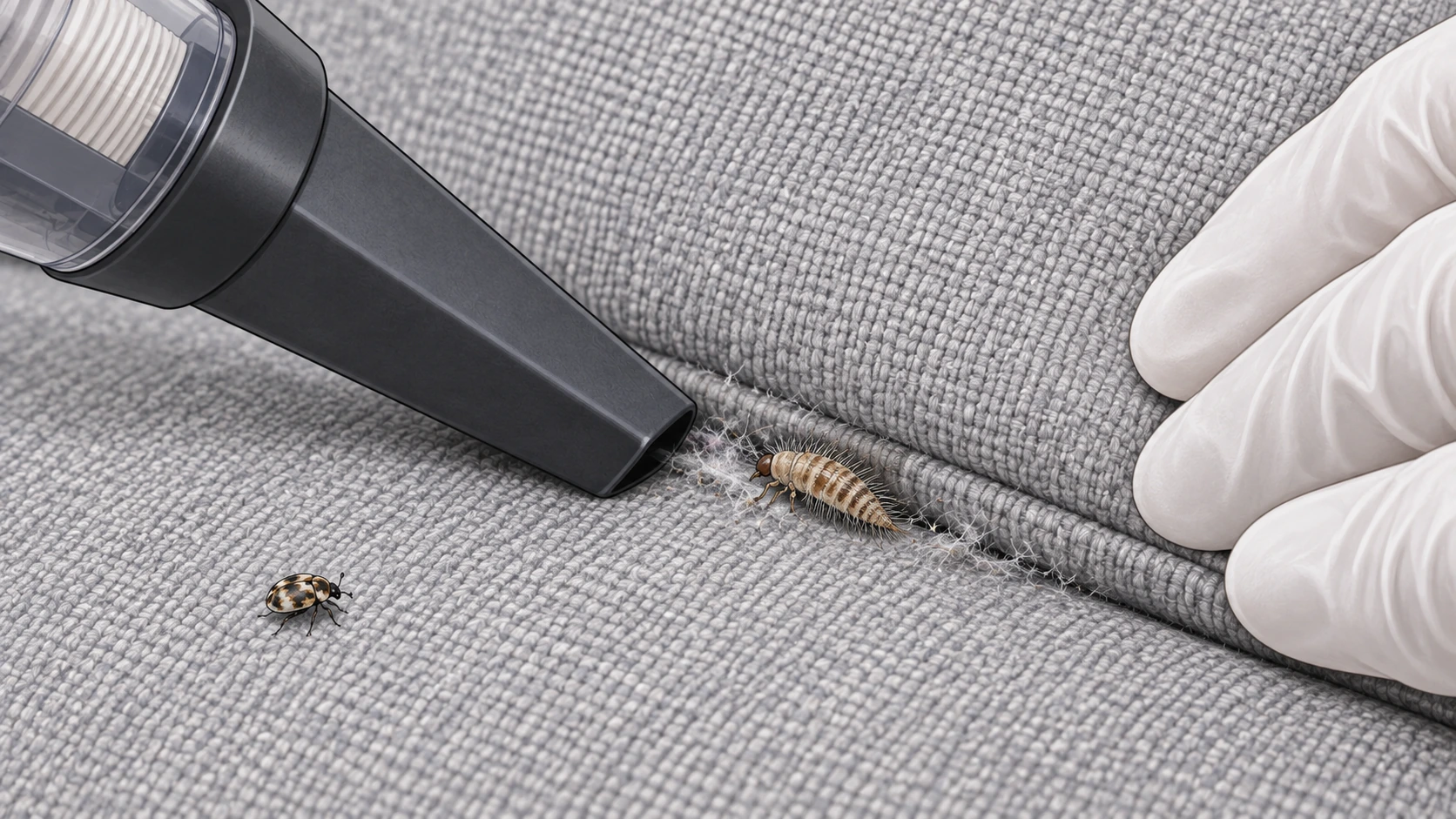
Getting rid of carpet beetle larvae requires removing the materials they are feeding on, cleaning the areas where they hide, and addressing any concealed sources that continue supporting their development. Vacuuming an infested carpet while leaving larvae inside a wool blanket, upholstered chair, or accumulated debris beneath furniture can leave much of the infestation untouched.
Start with the material containing the larvae, not the adult beetles appearing around your windows. Carpet beetle larvae cause the feeding damage. They can remain concealed in fabrics, furniture, floor edges, storage areas, and other places containing suitable organic material.
The work should begin with the affected belongings and expand to their immediate surroundings. Remove or clean infested items, collect loose larvae and debris, and investigate nearby areas before returning cleaned belongings to storage.
Insecticides may supplement these measures when an infestation persists, but they cannot reliably compensate for a missed food source or an inaccessible breeding area. The sequence below focuses on removing existing larvae and dealing with the materials supporting them.
1. Find the Material Containing the Larvae
Begin by identifying the belongings or surfaces where live larvae are concentrated. Carpet beetle larvae often remain in dark, undisturbed locations because these areas provide access to food and shelter.
A wool rug may contain larvae beneath its edges, especially where lint and animal hair have accumulated. Stored clothing, feather-filled furnishings, fur accessories, and upholstered furniture can also support development.
Do not restrict the search to the middle of a carpet. Check places where material and debris collect, including beneath furniture and inside storage spaces.
Pay particular attention to:
-
Wool rugs, blankets, coats, and stored garments.
-
Furniture seams, cushion interiors, and concealed upholstery.
-
Carpet edges, floor gaps, and baseboard junctions.
-
Areas containing accumulated pet hair, lint, and dead insects.
-
Boxes containing feathers, animal-derived materials, or old textiles.
-
Stored products that may contain suitable organic food.
The room-by-room carpet beetle inspection process helps establish whether activity is confined to one affected item or extends into other parts of the home.
Look for live larvae, shed skins, and feeding debris together. An old empty skin establishes previous larval activity, but it does not prove that larvae are still developing inside that particular item.
Pay attention to where the evidence is concentrated. Finding several larvae in one stored blanket provides a more useful starting point than finding one adult beetle on a distant windowsill.
2. Separate Infested Belongings Before Cleaning Them
Once you locate an affected item, keep it separate from clean belongings while deciding how to handle it.
Moving an infested sweater directly into a clean clothing drawer, for example, can carry larvae and debris into another storage area. The same concern applies to blankets, cushions, and other movable household materials.
Place affected items in a suitable bag or container while preparing to clean or treat them. Avoid shaking infested fabrics around the room because loose larvae, cast skins, and debris can fall onto nearby surfaces.
You do not need to discard every item containing larvae. The condition, value, construction, and suitability for cleaning all matter.
A badly infested item with extensive damage may not be worth preserving. A valuable wool garment or antique textile may justify professional cleaning or specialist treatment instead.
Keep cleaned belongings separate until the surrounding source has also been addressed. Returning an item to an infested closet or furniture area can expose it to surviving larvae.
3. Remove the Larvae From Affected Materials
The appropriate removal method depends on the material in which the larvae are developing.
Washable fabrics can be cleaned using a method suitable for their care instructions. Items that cannot tolerate ordinary washing may need dry cleaning or another treatment specifically appropriate for their construction.
Wool, fur, feathers, leather, and delicate furnishings require particular care. An aggressive cleaning attempt can damage the item while leaving larvae protected in seams, padding, or other concealed parts.
For washable belongings, follow the applicable care instructions and select a treatment capable of addressing the insects within the item. Do not assume that a quick surface wipe or ordinary room cleaning has eliminated larvae inside thick material.
Detailed temperature, exposure-time, drying, and freezing decisions belong to the individual material-treatment process. The effects of washing, drying, and freezing on carpet beetles are particularly relevant when deciding how to handle items that cannot all be treated in the same way.
Items that cannot be cleaned safely should be assessed before using chemicals. A product permitted for a carpet edge is not automatically suitable for a wool garment, stuffed animal, mattress, or upholstered cushion.
4. Vacuum the Areas Where Larvae Feed and Hide
Removing the infested item will not necessarily eliminate the surrounding larvae. Some may have crawled into nearby cracks, floor edges, furniture joints, and accumulated debris.
Vacuum the affected area thoroughly, working beyond the obvious feeding location. Concentrate on carpet edges, baseboards, corners, closet floors, furniture crevices, and areas beneath objects that are rarely moved.
Use an appropriate attachment for seams and narrow gaps. Check upholstery folds and the undersides of removable cushions when the item’s construction allows safe access.
Pay attention to the debris being collected. Hair, lint, loose fibers, dead insects, and other organic material can support additional larval development.
After vacuuming an infested area, empty the canister or remove the bag promptly and dispose of the collected material in an outdoor trash receptacle. Secure the waste so that insects cannot escape during handling.
A vacuum cleaner physically removes accessible larvae and contaminated debris. It cannot guarantee removal of insects hidden deep inside an item or an inaccessible building cavity.
The effectiveness and limitations of vacuuming for carpet beetles are important when activity continues after an initial cleanup.
Regular vacuuming is particularly useful around feeding locations, but repeatedly cleaning only the visible floor while ignoring the original infested material is unlikely to resolve the problem.
5. Clean the Debris Surrounding the Infested Material
Carpet beetle larvae can survive on organic debris even when no obvious wool garment or carpet is being damaged.
Accumulated human and pet hair, lint, dead insects, old spider webs, and other suitable materials may provide food in neglected locations. Removing the insects without addressing these deposits can leave other larvae with available resources.
Check beneath furniture, inside storage spaces, around floor vents, and behind objects that rarely move. Remove accessible debris and vacuum the surrounding surfaces.
Old insect accumulations near windows deserve attention because adult beetles may become trapped there. Spider webs containing dead insects can also provide feeding material for dermestid larvae.
Do not assume that every dusty area contains carpet beetles. Clean the locations where there is supporting evidence, and use the surrounding materials to determine whether further inspection is needed.
The carpet beetle management recommendations for removing food sources and contaminated materials include accumulated hair, lint, dead insects, and old webs as targets for sanitation.
Cleaning becomes particularly important when the original infested item has already been removed. Remaining debris can make it difficult to determine whether subsequent sightings represent surviving larvae or new activity elsewhere.
6. Check Concealed Areas That Could Be Supporting More Larvae
Some infestations persist because the main feeding source is hidden from ordinary household cleaning.
Carpet beetle larvae may occur in accumulated organic material beneath furniture, inside upholstery, in stored belongings, or around old animal-associated debris. In some houses, a concealed bird or rodent nest can provide suitable food.
Attics and other little-used spaces deserve attention when adult beetles or larvae repeatedly appear in rooms below them. However, the discovery of an adult upstairs does not by itself prove that an animal carcass or nest is present.
Investigate visible evidence before opening walls, ceilings, insulation, or other building cavities. Disturbing rodent remains or contaminated nesting material can create separate sanitation and exposure concerns.
The attic and concealed-building locations associated with carpet beetle activity are particularly relevant when the source cannot be found among accessible household belongings.
If larvae keep appearing from an inaccessible location, professional inspection may be more appropriate than repeatedly vacuuming the same room. A specialist can investigate the suspected source without unnecessary destructive work.
7. Decide Whether an Insecticide Is Actually Needed
Many carpet beetle infestations can be addressed through the removal of affected materials and thorough cleaning. Insecticides are not automatically necessary when accessible food sources and larvae have been removed.
A targeted pesticide application may have a supporting role when confirmed activity persists in suitable treatment locations. The product must specifically authorize carpet beetle control and the intended indoor application site.
A product labeled for crack-and-crevice treatment cannot automatically be used across clothing, bedding, toys, or upholstered surfaces. Read the complete label before purchasing or applying anything.
Keep children and pets away from treated areas according to the product’s directions. Follow all required protective equipment, ventilation, drying, storage, and reentry instructions.
The step-by-step requirements for applying carpet beetle sprays should be considered separately from the physical removal of larvae. Application technique, permitted surfaces, and safety precautions require product-specific instructions.
Avoid using foggers or indiscriminate room spraying as a substitute for removing infested materials. Pesticide exposure on accessible surfaces does not establish that larvae deep inside furniture or thick fabrics have been reached.
8. Check Whether Larval Activity Has Actually Stopped
After removing affected belongings and cleaning the surrounding areas, keep track of where new evidence appears.
A single old shed skin does not establish that larvae are still present. Fresh live larvae, newly accumulated cast skins, and continuing feeding damage provide stronger reasons to investigate.
Check the original feeding location and nearby materials again. Pay particular attention to the seams, undersides, and concealed spaces that were difficult to examine during the first cleanup.
If larvae keep appearing, consider whether the original source was missed or whether another area is supporting development. An apparently clean room may still be affected by a concealed feeding source in furniture, a storage space, or an adjoining building cavity.
The evidence used to determine whether carpet beetle activity has stopped helps separate historical signs from continuing infestation.
Do not judge the result solely by whether adult beetles have disappeared from windowsills. The larvae are responsible for most household feeding damage, so their activity deserves greater attention.
When the Infested Item Cannot Be Salvaged
Some belongings are too heavily damaged, contaminated, or difficult to clean safely to justify attempting recovery.
Discarding a badly infested item may be reasonable when the material is inexpensive and its construction prevents effective treatment. Secure it before removal to reduce the chance of spreading loose insects and debris through the house.
Valuable rugs, antiques, upholstered furniture, and delicate clothing deserve a more careful assessment. A professional cleaner or pest-management specialist may be able to determine whether the item can be treated without damaging its construction.
Do not apply a household insecticide simply because an item cannot be washed. Products differ in their permitted sites, and some formulations can stain or damage certain surfaces.
A decision to discard one badly infested belonging should also include an inspection of nearby items. Otherwise, another affected object may remain in storage and continue supporting larvae.
When Repeated Larvae Mean the Problem Is Bigger
Repeatedly finding larvae after cleanup can indicate that the original feeding material remains, that additional items were missed, or that activity is coming from an inaccessible location.
A small concentration around one stored garment may be relatively straightforward to address. Larvae appearing across several rooms or repeatedly emerging from furniture and concealed building spaces require broader investigation.
A qualified pest professional can help identify persistent sources, assess affected materials, and determine whether a targeted treatment is appropriate. Ask for the suspected breeding source and proposed treatment locations to be explained before agreeing to a chemical application.
The response should account for the actual materials involved. Treating exposed carpet edges repeatedly will not necessarily address larvae developing inside an inaccessible object or concealed source.