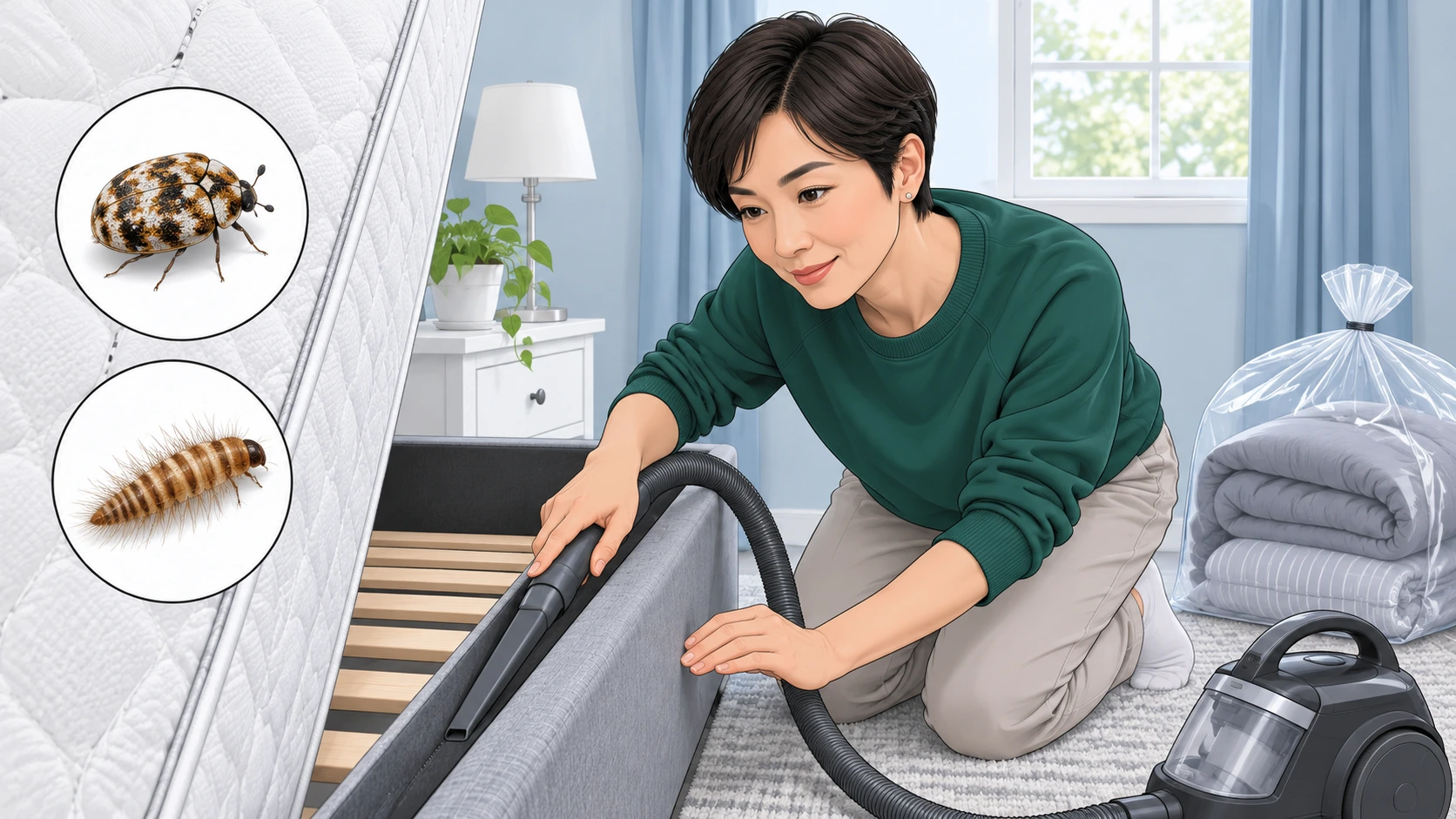
Finding carpet beetles in your bed can make the entire mattress feel contaminated. You might notice a small, hairy larva crawling near a pillow, discover several shed skins along a mattress seam, or find tiny beetles when changing your sheets. The temptation is to spray everything immediately, but that can expose you to pesticides without addressing the infestation.
The best way to get rid of carpet beetles in your bed is to remove and clean the bedding, thoroughly vacuum the mattress and bed frame, and locate the material supporting the larvae. Wash or professionally clean affected fabrics according to their care labels, remove accumulated hair and lint, and inspect nearby furniture and storage areas. Most localized problems can be managed without applying insecticides to the mattress.
Carpet beetles are not blood-feeding insects. Their larvae feed on suitable animal-derived materials and organic debris, including wool, feathers, hair, and dead insects. A mattress containing synthetic foam is not automatically a food source, but larvae can still hide in its seams or move across its surface from another infested item.
The critical task is separating beetles that happen to be on the bed from larvae actively developing in the bedding or mattress. That determines whether ordinary cleaning is enough or whether an infested item needs more specialized treatment.
First, Check Whether Carpet Beetles Are Actually Living in Your Bed
Before stripping everything off the mattress, examine the insects and the evidence around them. Carpet beetle larvae are usually small, elongated or tapered, and covered in bristles. Their shed skins may look like hollow, brownish, segmented shells. Adult carpet beetles are small, oval beetles that may be black or mottled with pale markings, depending on the species.
Larvae and shed skins are more useful evidence of a possible breeding site than a single adult beetle. Adults can fly and may appear indoors without an established infestation. Larvae are the stage responsible for damage to susceptible textiles, and their presence deserves a closer inspection.
Use a flashlight to examine the mattress piping, seams, tufts, handles, and folds. Look beneath the mattress and around the box spring, headboard, bed-frame joints, and the floor immediately under the bed. Pay attention to areas where dust, pet hair, feathers, or loose fibers have accumulated.
Finding a larva on a sheet does not prove that it developed inside the mattress. Carpet beetle larvae can crawl away from their feeding sites. Several larvae, fresh shed skins, and damaged natural-fiber material concentrated in one location provide stronger evidence that the source is nearby.
If the insects are flat, reddish-brown, and associated with dark spotting around mattress seams, investigate the possibility of bed bugs instead. Our carpet beetles vs. bed bugs guide explains the differences. Skin irritation alone cannot reliably identify either pest.
How to Remove Carpet Beetles From Your Bed, Step by Step
The following cleaning sequence addresses the mattress, removable bedding, bed structure, and immediate surroundings without introducing unnecessary chemicals into the sleeping area.
1. Remove All Bedding Without Scattering the Insects
Take off the sheets, pillowcases, blankets, mattress protector, bed skirt, and removable covers. Handle potentially infested materials carefully rather than shaking them over the bedroom floor. Shaking can scatter larvae, shed skins, and debris into places you will then need to clean.
Place the bedding directly into a laundry basket or bag for transport. Keep visibly affected items separate from clean bedding until they have been inspected and treated. Examine decorative pillows, wool throws, down-filled comforters, and other items containing animal fibers before returning them to the bed.
A quick visual check may reveal the actual source. For example, a wool blanket containing multiple larvae and damaged fibers is more suspicious than a clean cotton sheet on which one larva happened to crawl.
2. Wash or Professionally Clean Affected Bedding
Check the manufacturer’s care instructions before selecting a wash or drying cycle. For washable bedding that tolerates it, hot laundering is an established way to kill carpet beetles and their immature stages. A suitable heated dryer cycle can also help, but the item must tolerate the temperature and receive adequate heating throughout.
Do not assume every blanket can withstand high heat. Wool, silk, specialty fillings, waterproof mattress protectors, and some synthetic materials may shrink, deform, lose their coatings, or otherwise become damaged. Professional dry cleaning is an appropriate option for many delicate, dry-cleanable textiles.
The purpose is to remove insects and contamination without ruining the fabric. Our separate guide to washing clothes and fabrics affected by carpet beetles covers laundering in greater detail.
Once cleaned and completely dry, keep the bedding away from the affected area until you have finished inspecting and vacuuming the mattress and its surroundings.
3. Vacuum the Mattress Carefully
With the bed stripped, use a vacuum cleaner fitted with an upholstery attachment and a crevice tool. Start at the top of the mattress and work systematically across the surface, paying particular attention to seams, piping, folds, and any stitched or tufted sections.
Move the crevice tool slowly along the edges where larvae and shed skins can become trapped. Vacuum the mattress sides and, if you can safely move it, inspect and vacuum the underside. Do not overlook fabric handles or the junction between the mattress cover and its edge binding.
Vacuuming physically removes accessible insects, shed skins, loose fibers, and food debris. It does not guarantee removal of every egg or larva concealed deep within an item. The carpet beetle management guidance emphasizes thorough cleaning and removal of food sources because larvae can survive in overlooked locations.
Empty the vacuum promptly after cleaning. For a bagged vacuum, seal the used bag before placing it in an outdoor trash container. For a bagless model, empty the canister into a sealed waste bag and clean the container according to the manufacturer’s instructions.
4. Clean the Bed Frame, Headboard, and Box Spring
A clean mattress can become infested again if larvae remain in the bed structure. Vacuum the joints of wooden or metal frames, the underside of slats, and the spaces where the headboard attaches to the bed. Use a flashlight to inspect screw holes, cracks, fabric folds, and other sheltered locations.
An upholstered headboard needs particular attention because its fabric, seams, and underlying padding may collect hair, lint, and other debris. Inspect the back and underside as well as the visible front. If the box spring has a fabric dust cover, examine its edges and any accessible folds without tearing the material open unnecessarily.
Wipe suitable hard surfaces with a lightly dampened cloth and mild cleaning solution, then allow them to dry. Avoid soaking wood, upholstery, or internal padding. Cleaning residues and removing insects are useful; leaving damp materials inside the bed structure creates an entirely different problem.
5. Vacuum Beneath the Bed and Along Nearby Baseboards
Carpet beetle larvae often remain in dark, undisturbed locations rather than on exposed sleeping surfaces. The area under the bed may contain enough hair, lint, and natural-fiber debris to support them even when the mattress itself is clean.
Move accessible storage boxes and lightweight furniture so you can vacuum beneath them. Clean along carpet edges, baseboards, furniture legs, and the junction between the floor and wall. Pay particular attention to areas behind bedside tables and beneath rugs.
The feeding and hiding habits of carpet beetle larvae explain why concealed accumulations of lint and hair deserve attention. Removing these materials can matter more than repeatedly cleaning the exposed mattress surface.
If you discover several larvae in an old wool rug, a stored blanket, or a dusty upholstered chair, investigate that item as a possible source rather than assuming the insects originated in your bed.
6. Inspect Nearby Natural-Fiber Materials
A bed can be the place where you notice carpet beetles even when the infestation is elsewhere in the bedroom. Check wool clothing in nearby drawers, feather-filled cushions, stored blankets, felt items, fur accessories, and other susceptible materials.
Look for concentrated larvae, shed skins, and irregular feeding damage. Inspect folds, seams, and the undersides of items that have remained undisturbed. A damaged wool blanket stored beneath the bed may be more important than several beetles found on the sheets.
Clean or isolate affected materials according to their composition. Severely damaged, inexpensive items may be more practical to discard than restore. Keep cleaned natural-fiber belongings in properly sealed storage containers until the infestation has been resolved.
For a wider investigation beyond the bed, our guide to getting rid of carpet beetles covers household source removal and control.
Can You Get Carpet Beetles Out of a Mattress Without Throwing It Away?
Yes. A mattress with a few accessible carpet beetle larvae or shed skins can often be kept after careful inspection, vacuuming, and removal of the infestation source. Finding insects on a mattress does not automatically mean they are living inside it.
The mattress’s construction matters. Modern mattresses commonly contain synthetic foams, polyester fabrics, and other manufactured materials that are not the preferred food of carpet beetle larvae. Nevertheless, the insects may shelter in seams or feed on accumulated organic debris. Some mattresses also contain wool, cotton blends, animal hair, or other materials that require closer inspection.
An older mattress stuffed with horsehair, feathers, or other animal-derived filling presents a different situation. Larvae can penetrate susceptible stuffing, where surface vacuuming may not reach them. The management recommendations for carpet beetles identify infested hair- or feather-stuffed mattresses and pillows as items that may require specialized professional treatment.
If you repeatedly find live larvae emerging from seams or damaged filling after cleaning, do not assume another round of surface vacuuming will solve the problem. Have the item assessed by a qualified pest-control professional. Depending on its construction, condition, value, and available treatment options, replacement may be more practical.
Should You Steam Clean a Mattress With Carpet Beetles?
Steam can kill insects that receive sufficient heat, but that does not make every mattress suitable for steam treatment. The equipment, application method, mattress materials, and ability to dry the item thoroughly all affect whether steam cleaning is appropriate.
Some mattresses contain adhesives, layered foam, moisture-sensitive fillings, or covers that can be damaged by heat or excessive water. Steam that penetrates deeply enough to wet internal layers may leave moisture trapped where it cannot dry readily. A damp mattress can develop odor or mold, particularly in a poorly ventilated room.
Check the mattress manufacturer’s cleaning instructions before using a steamer. If steam cleaning is permitted, use equipment suitable for upholstery, follow its operating instructions, and avoid saturating the material. Do not return bedding or sleep on the mattress until it is completely dry.
We would not make steam cleaning the first treatment for a mattress with only one or two visible larvae. Careful vacuuming and source removal involve less risk of material damage. Steam becomes a more reasonable option when the item permits it and there is a specific infestation site that can be treated safely.
Should You Spray Insecticide on Your Mattress?
Do not spray insecticide on a mattress, pillow, sheet, blanket, or other sleeping surface unless the product label explicitly authorizes that exact use. A product labeled for carpet beetles is not automatically approved for application to mattresses.
Pesticide labels distinguish between target insects and permitted application sites. A spray may be approved for carpet edges, cracks, baseboards, or selected furniture surfaces without being approved for bedding. Instructions for one pest or one type of surface cannot be transferred to another.
For carpet beetles, chemical treatment is generally secondary to removing the source and cleaning the affected area. When a pesticide is necessary, the label-based treatment guidance emphasizes confirming the pest, locating the infestation, and choosing a product intended for the specific use.
If larvae remain concentrated around the floor beneath the bed or inside accessible cracks after thorough cleaning, a properly labeled treatment of those non-sleeping areas may be considered. Follow all label restrictions concerning application surfaces, ventilation, reentry, children, and pets. Never treat a surface merely because it is close to the infestation.
Avoid using foggers, essential-oil mixtures, rubbing alcohol, household disinfectants, or loose insecticidal dust on the mattress as improvised carpet beetle treatments. They introduce exposure, flammability, inhalation, or material-damage risks without reliably reaching concealed larvae. In particular, do not scatter diatomaceous earth or other pest-control powders over bedding.
What if Carpet Beetles Are Inside Your Pillows or Comforter?
Pillows and comforters deserve individual inspection because their fillings vary considerably. A synthetic-filled pillow with a larva crawling across its outer cover is not the same as a feather-filled pillow with repeated larval activity inside its seams.
Inspect the stitching, zipper openings, corners, and any areas where feathers or filling are escaping. If larvae appear to be coming from inside an item, check its care label before deciding whether laundering, professional cleaning, or replacement is appropriate.
Some down and feather bedding can be machine-washed and dried under carefully controlled conditions. Other items require specialist cleaning. Follow the manufacturer’s instructions rather than assuming that every feather-filled product can tolerate the same treatment.
When a heavily infested pillow is inexpensive or cannot be cleaned reliably, replacement is often the simpler choice. Seal the discarded item in a bag before carrying it through the house, and do not place it beside clean bedding while you continue treating the bedroom.
Why Carpet Beetles May Still Appear After You Clean the Bed
A thorough mattress cleaning can remove the insects you see without eliminating larvae elsewhere in the bedroom. This is especially likely when an infested rug, upholstered headboard, stored wool blanket, or accumulation of debris remains untreated.
Fresh activity after cleaning needs to be interpreted carefully. A single adult beetle on a windowsill is not the same as finding several live larvae repeatedly emerging from the same mattress seam. Adults can enter from outdoors, while persistent larval activity points toward a food source that deserves further investigation.
Inspect the areas where larvae are repeatedly discovered. If they appear beneath one corner of the bed, examine the nearby carpet edge, baseboard, and stored belongings. If they appear in the same upholstered headboard seam, inspect the fabric and padding. The location of repeated sightings can help narrow the search.
The inspection methods for carpet beetles include examining concealed furniture surfaces, lint-filled corners, storage areas, and other protected spaces. These areas are easily overlooked when all attention remains on the mattress.
Keep a simple record of where and when you find live larvae. A photograph and a note of the location are more useful than relying on memory, particularly if the problem continues and you eventually need professional identification.
How to Tell Whether Your Mattress Cleaning Worked
You should see less evidence of live carpet beetle larvae as affected items are cleaned, debris is removed, and breeding sources are eliminated. There is no dependable universal number of days after which every infestation can be declared eliminated. Development varies with species, temperature, available food, and other conditions.
For the first several weeks, inspect the mattress seams and previously affected areas regularly. Weekly checks are a reasonable monitoring routine, although more frequent checks may be useful immediately after cleaning a heavily affected item.
Look for new live larvae rather than judging success by old shed skins alone. A shed skin that was missed during vacuuming does not prove the infestation is continuing. Conversely, finding new larvae repeatedly in the same place suggests that something nearby still supports them.
If the mattress remains free of new activity but larvae continue appearing beneath the bed, shift your attention to the surrounding materials. Repeatedly stripping and cleaning an already clear mattress is unlikely to solve a problem developing in a rug or upholstered piece of furniture.
Common Mistakes That Keep Carpet Beetles in the Bedroom
One common mistake is treating every carpet beetle sighting as evidence that the mattress is infested. That can lead to unnecessary disposal of an expensive mattress while the real source remains untouched beneath the bed.
Another is cleaning only the visible sleeping surface. Mattress seams, the underside of the box spring, bed-frame joints, nearby carpeting, and stored textiles can contain insects or debris that ordinary sheet changes never disturb.
Excessive chemical treatment is also counterproductive. Spraying the mattress or applying pesticide powders to bedding can create avoidable exposure without addressing the feeding site. The insects do not need to be on the sleeping surface for an infestation to persist.
Finally, returning untreated wool blankets, decorative pillows, or other affected belongings to a freshly cleaned bed can reintroduce larvae. Cleaned items should remain separate until the bedroom inspection and source-removal work are complete.
When to Call an Exterminator for Carpet Beetles in Your Mattress
Professional help becomes worthwhile when you repeatedly find live larvae despite thorough cleaning, when the infestation appears to involve inaccessible mattress or furniture filling, or when you cannot locate the source.
An experienced pest-control professional should identify the insect, examine the suspected breeding sites, and determine whether the mattress itself requires treatment. Ask which materials can be treated, what method is proposed, and whether any pesticide is specifically authorized for the intended surface.
A professional inspection is especially useful when several bedrooms are affected or when larvae appear to be emerging from wall voids, inaccessible upholstery, or other concealed areas. Treatment of the mattress alone may accomplish little if the infestation is established elsewhere.
You do not necessarily need to replace the mattress or purchase an expensive whole-house treatment. The appropriate response depends on where larvae are developing and whether the affected material can be cleaned or treated safely.
Keeping Carpet Beetles Out of Your Bed
After the initial cleanup, keep the bed and its immediate surroundings free of accumulated lint, hair, and fabric debris. Vacuum under the bed periodically, inspect seldom-used bedding before returning it to service, and clean natural-fiber blankets before placing them in storage.
Use sealed storage containers for susceptible fabrics that will remain unused for extended periods. Inspect secondhand upholstered furniture and textiles before bringing them into the bedroom. Check any previously affected items for new larvae before placing them back on the mattress.
You can also protect the mattress with a removable, washable cover that is compatible with the mattress manufacturer’s instructions. Such a cover makes routine cleaning easier, but it should not be treated as a guaranteed carpet beetle barrier or a substitute for removing an established source.
Our carpet beetle prevention guide addresses the broader household habits that help reduce recurring infestations.
The Bottom Line
Getting rid of carpet beetles in your bed usually does not require throwing away the mattress or spraying the sleeping surface. Begin by identifying the insect, removing the bedding, cleaning affected fabrics, and vacuuming the mattress and bed structure. Then inspect the nearby materials that could support larvae.
A few accessible insects can often be removed through careful cleaning. Repeated larval activity inside natural-fiber stuffing or inaccessible upholstery requires a different assessment and may justify professional treatment or replacement.
The goal is not simply to make the mattress look clean. It is to remove the insects, eliminate the material sustaining them, and confirm that fresh larval activity has stopped.