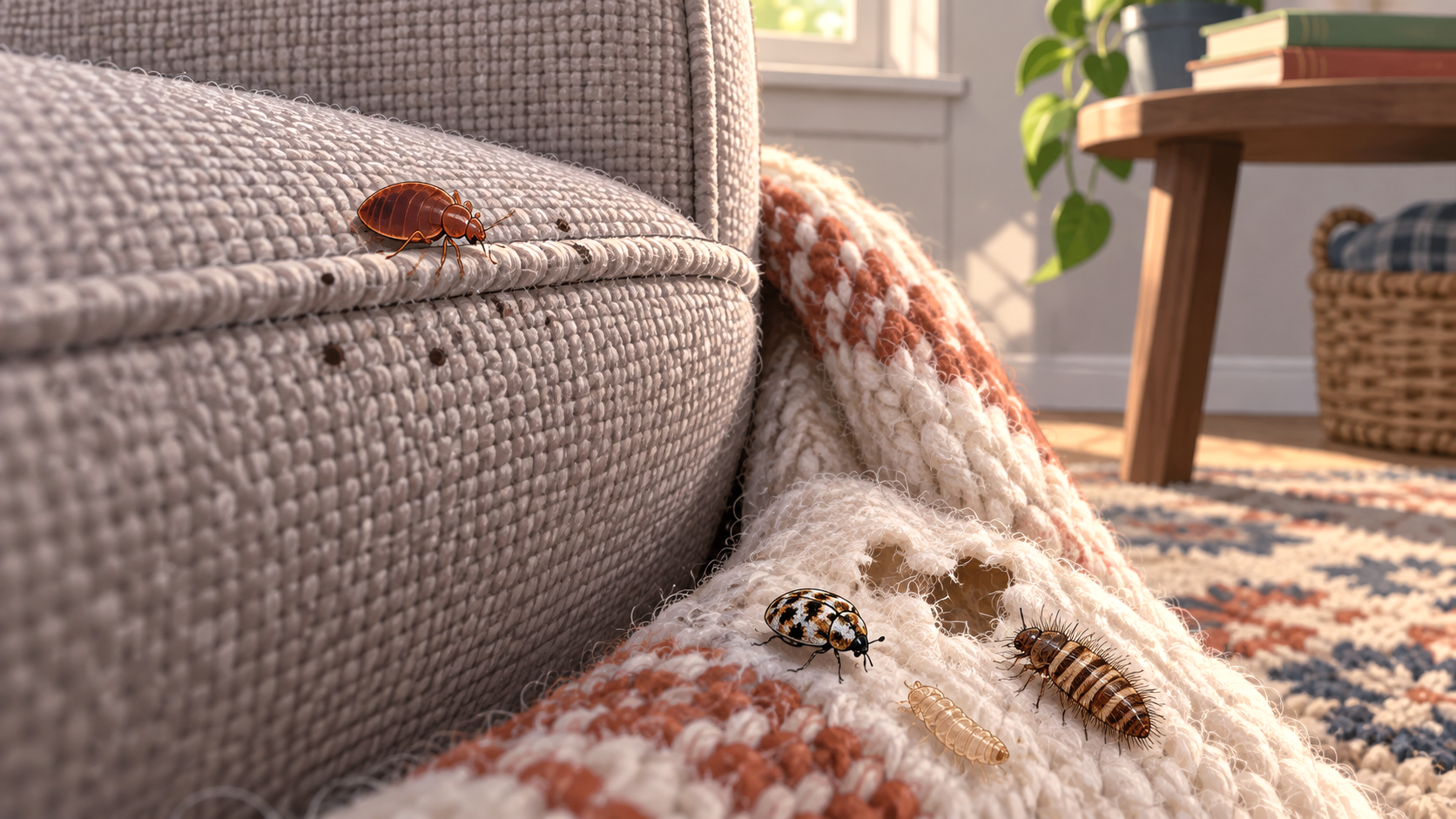
Carpet beetles and bed bugs can both turn up around beds, furniture, and fabrics, but that overlap is more misleading than helpful. The insects themselves are built differently, eat completely different things, and leave different evidence behind. The confusion gets worse because “carpet beetle” may refer to either the adult beetle or its hairy larva.
The quickest way to tell carpet beetles from bed bugs is to look for hair versus a flat bug-shaped body. Carpet beetle larvae are elongated and visibly hairy or bristly. Adult carpet beetles have hard wing covers and may be mottled or dark depending on the species. Bed bugs are wingless, broadly oval, flattened insects with six visible legs and no fuzzy larval covering. Instead of starting with where you found the insect, we would start with which of those body plans is sitting in front of you.
First Decide Which Carpet Beetle Stage You Found
A lot of carpet beetle versus bed bug comparisons quietly create a problem by describing “the carpet beetle” as though it has one appearance. It does not.
Carpet beetles belong to the beetle family Dermestidae and undergo complete metamorphosis. Their development includes egg, larval, pupal, and adult stages. The larva looks dramatically different from the adult, which is why identifying the life stage first makes this comparison much easier.
Carpet beetle larvae generally have elongated bodies covered with conspicuous hairs. Some species have especially noticeable tufts of longer hairs toward the rear. Their coloring varies by species, but dermestid larvae typically have a fuzzy appearance and are often reddish or light brown.
Adults look like beetles because that is exactly what they are. Depending on the species, they may be dark brown or black, or they may have patterned scales in combinations of white, yellow, brown, orange, or black. Some of the small patterned species look almost speckled when viewed closely.
A bed bug does not pass through a hairy larval stage or a pupal stage. Young bed bug nymphs resemble smaller versions of the adult, although the youngest are much paler.
That developmental difference is one of the cleanest ways to separate the two pests.
The Hair Test Separates Bed Bugs From Carpet Beetle Larvae Fast
When the mystery insect is a larva, body texture deserves your attention before almost anything else.
Carpet beetle larvae are hairy. Depending on the species, the hairs can cover much of the body and may form obvious tufts at the rear. For example, varied carpet beetle larvae are cream-colored with golden hairs, while black carpet beetle larvae are elongated and have a distinctive tuft of long golden-brown hairs extending from the rear. The appearance varies among carpet beetle species, but hairiness is a recurring larval feature.
Bed bugs are shaped differently. An unfed adult common bed bug (Cimex lectularius) has a broad, flattened, oval body. Adults are brown, while recently fed bugs become more reddish-brown and elongated. Young nymphs have the same basic bed bug body plan but are smaller and can be translucent or whitish-yellow. Adult common bed bugs are generally about 5 to 7 mm long.
So a fuzzy, segmented, somewhat carrot-shaped creature is not a bed bug. A smooth-looking, flat, oval insect with six legs extending from the sides deserves a much closer bed bug inspection.
That difference is more dependable than judging whether the insect simply looks “brown.”
Adult Carpet Beetles Give You a Different Clue: Wings
The comparison changes once you are looking at an adult carpet beetle rather than a larva.
Adult carpet beetles have hardened forewings called elytra, as other beetles do. Their body therefore has the compact, hard-backed appearance of a tiny beetle. Many adult carpet beetles are also more rounded or dome-shaped from the side than a bed bug.
Bed bugs are wingless in the practical sense that matters to identification. They have reduced wing pads but cannot fly. Their bodies remain visibly flattened from top to bottom, particularly before feeding. You can see that characteristic outline in our guide to what bed bugs look like.
This creates a useful real-world clue. A tiny patterned beetle flying near a window is not behaving like a bed bug. Adult carpet beetles can fly, while bed bugs neither fly nor jump.
We would still inspect the specimen rather than identify it from movement alone, but a flying insect immediately changes the direction of the investigation.
The Bed Is Not Enough to Make Something a Bed Bug
Location causes a surprising amount of misidentification. Finding a small insect on a bed understandably makes bed bugs the first concern, but a mattress is not an identification feature.
Carpet beetle larvae can occur where suitable animal-derived materials and debris are available. Depending on the species, their food can include wool, fur, feathers, hair, lint, dead insects, hides, and other materials of animal origin. They may consequently turn up around upholstered furniture, closets, rugs, stored fabrics, air ducts, and edges where lint and hair accumulate.
Bed bugs are there for a completely different resource. They are blood-feeding insects that typically stay near places where a host rests long enough for them to feed. Around beds, they commonly hide along mattress seams and tags, box springs, bed frames, and headboards. Established infestations can also occupy couches, furniture joints, baseboards, and other protected cracks.
That difference in food source changes what you should inspect next. When a carpet beetle larva is found on bedding, search for larval food and additional larvae or cast skins rather than assuming the bed itself is the infestation center. When a suspected bed bug appears there, inspect the nearby harborages for physical signs of bed bugs.
The object under the magnifying glass should lead the search. The room where you happened to notice it should not decide the identification for you.
Their Shed Skins Look Almost Like Opposites
Discarded skins can be even more useful than the insects because both pests molt during immature development.
A bed bug nymph leaves behind a pale exoskeleton that retains its basic bed bug shape. You may still see the flattened body outline, legs, antennae, and abdominal segmentation. Our guide to bed bug shed skins and casings explains why these hollow skins can be strong physical evidence during an inspection.
Carpet beetle larvae also molt repeatedly, but their cast skins preserve the hairy larval appearance. Consequently, a brownish, bristly husk with obvious hairs is a much better match for carpet beetle larval remains than for a bed bug shell.
This is one comparison where we think the discarded skin may actually simplify the identification. A damaged live insect can lose legs or be crushed beyond recognition. A reasonably intact carpet beetle cast skin still advertises the larva’s hairiness, while an intact bed bug exuvia retains that unmistakable little bed bug silhouette.
Carpet Beetles Damage Materials, Bed Bugs Leave Feeding Evidence
When the insect itself is gone, the surrounding evidence can still point you in the right direction.
Carpet beetle larvae are the damaging stage. They feed on suitable materials of animal origin and can damage items such as woolens, fur, feathers, hides, and other susceptible materials. Depending on where they are feeding, you may discover damaged fabric along with larvae or their shed skins.
Bed bugs do not eat carpet, mattresses, clothing, or furniture. They feed on blood. Around an active harborage, you may instead find live bugs, pale eggs and eggshells, shed nymphal skins, dark fecal spotting, or rusty and reddish stains associated with crushed bugs. These are among the physical signs used to find bed bugs.
That contrast is more valuable than the pest names suggest. “Carpet beetle” sounds as though the insect should stay in carpet, while “bed bug” sounds as though the insect should stay in beds. Neither name gives you a complete picture of where the pest can occur.
Food and evidence tell the story better.
An Itchy Rash Does Not Settle Carpet Beetles vs. Bed Bugs
Skin symptoms are where these two pests become particularly easy to mix up.
Bed bugs feed directly on people. However, bite reactions vary considerably, and skin marks alone are a poor way to diagnose an infestation. Some people develop itchy welts while others show little or no reaction. That is why we prefer physical pest evidence over trying to identify bed bugs from bites alone.
Carpet beetles create a completely different skin problem. They do not need to bite people to cause irritation. Hairs from carpet beetle larvae can produce hypersensitivity reactions in susceptible people, including itching and skin eruptions. The reaction has been associated with contact with larval hairs, not blood feeding.
That means “I woke up itchy” does not choose between the two pests. In fact, treating every unexplained itchy mark as a bed bug bite can send the entire inspection in the wrong direction.
Look for the organism and its environmental evidence. The skin reaction is supporting context, not an insect identification key.
The Three-Clue Check We Would Use
When the specimen is still available, start with its surface. Obvious hairs or bristles point strongly toward a carpet beetle larva. A hard-backed little beetle, especially one with mottled scales, points toward an adult carpet beetle. A flattened, broadly oval, wingless insect fits the bed bug body plan.
Then look at the evidence around it. Hairy cast skins and damage to susceptible natural materials support carpet beetles. Bed bug-shaped shed skins, fecal spots, eggs, and live bugs concentrated around sleeping or resting areas support bed bugs.
Finally, use behavior as a cross-check rather than the deciding clue. A flying adult can be a carpet beetle but not a bed bug. A hidden, flattened insect tucked into a mattress seam or bed-frame crack fits bed bug behavior much better.
If the specimen is damaged or too small to identify confidently, preserve it instead of spraying or crushing it. Accurate identification matters because the treatment for carpet beetles is not the treatment for bed bugs. The wrong bed bug identification can lead to unnecessary treatment, while the actual pest remains untouched.
Other Questions About Carpet Beetles and Bed Bugs
Can carpet beetles and bed bugs live in the same house?
Yes. They use different food resources, so the presence of one does not biologically exclude the other. Finding a confirmed carpet beetle therefore does not prove that every other suspicious insect or mark in the home has the same cause.
Which one is more likely to be found near a window?
Adult carpet beetles are capable of flight and can occur around windows. Bed bugs cannot fly, so a small beetle repeatedly appearing at a window deserves a close look before anyone assumes bed bugs.
Can carpet beetle larvae be mistaken for baby bed bugs?
Yes, particularly when someone is judging only by small size and brownish coloring. The body texture resolves much of that confusion. Carpet beetle larvae are hairy and elongated, while baby bed bugs are small nymphs with the flattened bed bug body shape.
Should I throw away my mattress if I cannot tell which pest I found?
No. Discarding furniture before identifying the pest can create unnecessary expense and does not solve the source of either infestation. Preserve the specimen, inspect for pest-specific evidence, and get the insect identified when its features are too unclear to make a confident determination at home.
3 thoughts on “Carpet Beetles vs. Bed Bugs: How to Tell Them Apart”