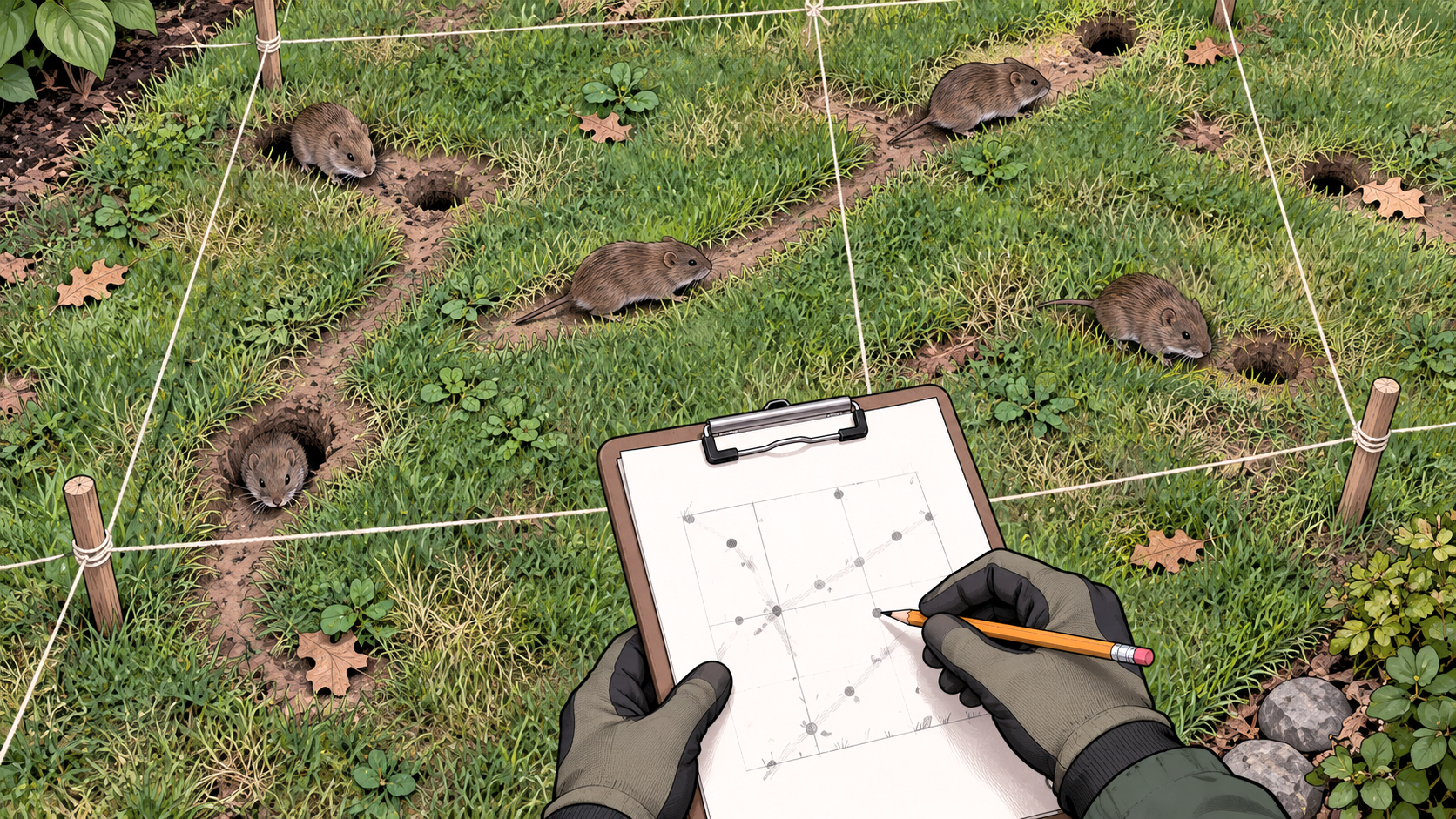
You can estimate vole activity in your yard by monitoring active runways, burrow entrances, and feeding at fixed locations over several days, but these observations cannot reliably tell you the exact number of voles present. One animal may use several openings, multiple animals may share an area, and many signs remain after the animals have moved elsewhere. A practical yard survey is therefore better at identifying where voles are active and whether activity is increasing or decreasing than at producing an exact headcount.
For most homeowners, a useful estimate is expressed as low, moderate, or widespread activity across the property. Assigning a numerical population requires more rigorous sampling, and even scientific surveys must account for animals that remain undetected.
Why Counting Vole Holes Gives Misleading Results
Finding twelve openings does not mean twelve voles occupy your lawn. Individual animals can maintain access to several underground passages, and their movements may connect multiple entrances with a smaller number of resting or feeding areas.
Meadow voles also travel along surface pathways rather than relying exclusively on underground tunnels. A single animal moving between several protected locations can leave evidence across a relatively large area. Meanwhile, woodland voles often remain below ground, making them less visible during ordinary inspections.
The arrangement of vole burrows and their openings provides clues about movement but cannot reveal how many individuals use them. Even the depth and horizontal extent of underground passages cannot be converted into a dependable population figure.
Old evidence further complicates matters. An abandoned runway may remain visible until vegetation recovers, while unused openings can persist in firm soil. Fresh plant clippings and droppings are more suggestive of current occupation; vegetation growing inside runways or mold accumulating along them suggests the routes may no longer receive regular use.
Divide Your Yard Into Monitoring Areas
A consistent survey starts with a simple sketch of the property. Divide the yard into recognizable areas, such as the front lawn, rear lawn, vegetable beds, shrub borders, and fence lines. Smaller properties may need only three or four sections, while larger yards with several distinct landscapes benefit from more.
Inspect each section using the same approximate amount of effort. If you spend twenty minutes examining one flower bed but only glance at the lawn, the resulting comparison will reflect your search effort as much as animal activity.
Record the locations where you find convincing recent evidence, distinguishing active-looking sites from older, uncertain signs. The combination of fresh droppings, clipped vegetation, and maintained runways is more informative than the total number of holes.
Photograph representative sites and mark them on the sketch. Rechecking the same locations is more useful than searching randomly for new evidence every day.
A property with recent activity confined to one border has a different distribution from one showing fresh evidence throughout several separated areas. Neither observation establishes a particular number of animals, but it identifies the scale and location of the current problem.
Use an Apple Activity Test to Compare Vole Hotspots
One established monitoring technique uses small pieces of apple placed at selected vole activity sites. Orchard managers have used the Apple Activity Index to assess vole distribution and changes in relative activity.
The basic method involves placing an apple slice inside an existing runway or near a suspected burrow and examining it after approximately 24 hours for feeding marks. Apple monitoring stations can reveal where vole feeding is concentrated, although the results require careful interpretation.
For a residential yard, use the same number of comparable monitoring stations during each survey. Choose locations with recent evidence rather than distributing apple pieces indiscriminately. Where permitted and appropriate, a secure protective cover can help prevent birds and larger animals from reaching the bait without trapping or injuring wildlife.
Record how many stations show convincing rodent feeding. An apple with recognizable gnawing is more useful than one that has simply disappeared.
For example:
| Survey | Stations checked | Stations with feeding | Percentage active |
|---|---|---|---|
| First check | 10 | 6 | 60% |
| Second check | 10 | 4 | 40% |
| Third check | 10 | 2 | 20% |
These figures are illustrative, not a measured vole population. They show how a consistent monitoring index can reveal a changing pattern.
A decrease from six feeding stations to two does not mean four voles have disappeared. Multiple animals may visit one station, while a single animal may visit several. Other rodents can also eat apples, so feeding marks should be considered alongside evidence supporting vole identification.
Apple pieces can be removed by wildlife or pets, and repeated baiting may temporarily attract animals to the stations. Keep surveys limited, retrieve unused material promptly, and do not place food where it can create hazards.
How to Interpret Activity Trends
A rising activity index suggests that more monitoring locations are being used, but it does not necessarily prove that the population has increased proportionally. Animals may shift their movements in response to vegetation, weather, or changing food availability.
The reverse is also true. Fewer signs can reflect reduced movement through the sampled locations rather than a corresponding reduction in the number of animals.
Research comparing vole field signs with mark-recapture population estimates found that burrows, runways, droppings, and damaged vegetation performed poorly as population-size indicators, particularly in mowed grasslands.
Another investigation involving Cabrera voles found that sign abundance was only moderately associated with actual population size, even with substantial survey effort. Detecting the presence of an animal is considerably easier than calculating how many individuals occupy the area.
Compare survey results over similar time intervals, using the same locations and methods whenever possible. If substantial mowing, construction, or vegetation removal occurs between surveys, record those changes because they can alter the visibility of vole evidence independently of population size.
Can You Estimate Vole Numbers From Yard Size?
Multiplying yard acreage by an average vole density produces a theoretical figure, not a reliable estimate of the animals actually present.
Field densities vary greatly between habitats, seasons, and population cycles. In some favorable environments, meadow vole populations can reach exceptionally high densities, while nearby areas may support far fewer individuals.
The territories and home ranges used by meadow voles can overlap, meaning the space used by several animals is not simply the sum of independent territories.
A quarter-acre backyard also differs substantially from a quarter-acre meadow. Buildings, pavement, closely mowed turf, dense garden beds, and neighboring vegetation affect how much usable space exists.
For these reasons, an average density figure drawn from an agricultural field should not be applied directly to a suburban property. The number of voles that may live together is a social and ecological question distinct from estimating the current population across a particular yard.
When Is Professional Population Sampling Worthwhile?
Scientific estimates of small-mammal abundance often rely on live trapping, individual identification, and repeated sampling. In mark-recapture studies, researchers use information about previously captured animals to estimate the individuals that were present but not detected.
These methods require suitable equipment, experience, adequate sample sizes, and attention to animal welfare. Capture probabilities can vary between individuals, making poorly designed surveys misleading even when numerous animals are caught.
For an ordinary residential yard, such work is rarely necessary. A qualified wildlife professional may instead assess how widely activity is distributed and whether damage is continuing, without claiming to know the exact population.
Where professional sampling is justified, methods involving mark-recapture estimation and imperfect detection require appropriate study design. Wildlife capture and handling may also be regulated locally.
The conditions that attract voles to a yard help explain why activity may remain concentrated in particular locations, but those conditions cannot reveal an exact animal count either.
How Often Should You Repeat Your Survey?
A short initial survey followed by checks at consistent intervals is usually sufficient to establish whether activity is localized, persistent, or changing.
Weekly comparisons can be useful during a period of concern, provided the method remains consistent. Record the number of monitored stations showing fresh activity, the sections of the yard involved, and any visible new plant damage. Avoid changing station locations merely because an earlier site produced no feeding.
When monitoring continues over several weeks, compare the pattern rather than treating every small difference as meaningful. A change from four active stations to three may reflect ordinary variation. A persistent increase across multiple areas offers stronger evidence that activity has become more widespread.
The recurrence of vole activity after earlier management is best assessed by checking for new evidence in previously affected locations rather than assuming that every visible opening represents a newly arrived animal.
Keep the monitoring goal realistic. A survey can establish where recent feeding occurs, identify changes in distribution, and indicate whether the same areas remain active. It cannot turn a count of holes, sightings, or apple slices into a verified vole headcount.
2 thoughts on “How to Estimate the Number of Voles in Your Yard”