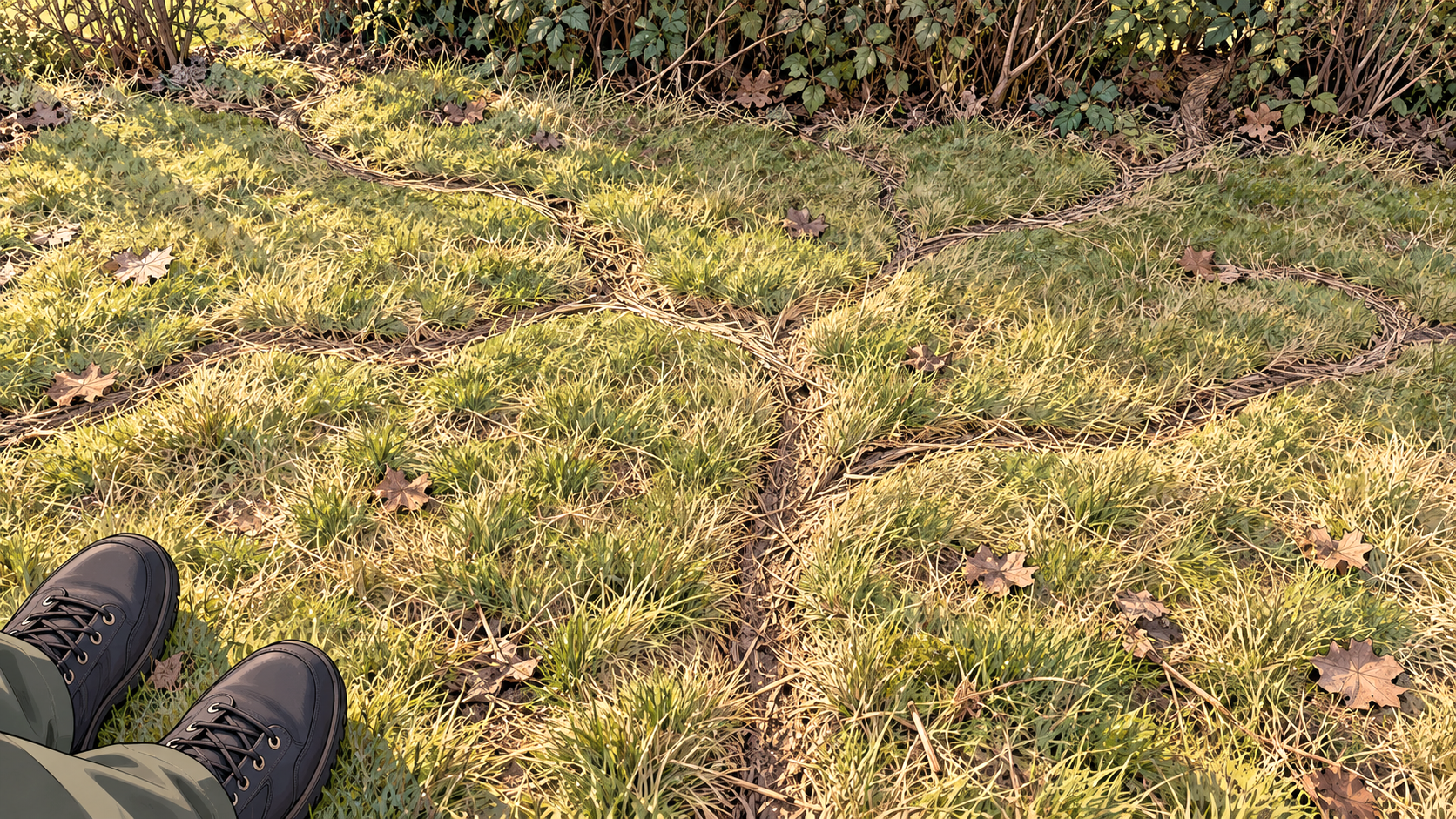
Vole runways look like narrow, winding strips of flattened or closely clipped grass, usually 1 to 2 inches (2.5–5 cm) wide. They often form branching networks across lawns, fields, and other grassy areas, with sections disappearing beneath vegetation or connecting to small ground openings. Heavily used routes may expose bare soil, while less obvious ones resemble shallow channels pressed into the turf. These pathways become especially noticeable when winter snow melts, revealing irregular lines across otherwise intact grass. Their appearance can also indicate whether voles have used them recently or whether the routes have been abandoned.
Recognizing a Vole Runway in Your Lawn
From a standing position, vole trails can resemble thin, brown lines winding through green grass. A closer inspection reveals that the vegetation within the pathway has been cut short, pressed flat, or removed through repeated movement and feeding. The edges are usually irregular rather than cleanly cut, and the route may curve around grass clumps before dividing into two or more branches.
Typical runways measure approximately 1 to 2 inches across. Some sections look like shallow depressions, particularly where frequent traffic has worn down the grass and uppermost soil. Others remain level with the surrounding lawn because only the vegetation has been disturbed. A distinctive feature is the arrangement of multiple connected paths rather than one isolated groove. Meadow voles frequently establish well-defined routes through turf, and several animals may use overlapping portions of the same network. A heavily traveled passage can become considerably more conspicuous than its smaller branches.
The paths sometimes terminate at small vole burrow openings hidden among grass stems. The surrounding vegetation may conceal the connection until the grass is gently parted. An exposed opening is not required for identifying a surface runway, however, since the visible trail may continue beneath plants rather than directly into the soil.
Why Some Runways Are Almost Invisible
Voles frequently travel beneath a canopy of grass and low-growing plants. Stems lean over the route, leaving a relatively clear passage underneath while concealing it from above. Where vegetation is especially thick, a runway may remain invisible until the surrounding stems are lifted apart.
This sheltered arrangement is characteristic of vole habitats with substantial ground cover. The animals can move between feeding areas without remaining continuously exposed. As grass grows taller or becomes matted, the passage may resemble a small tunnel through vegetation rather than an open line across the lawn.
The protected travel routes favored by meadow voles are particularly common in grassy areas with abundant vegetation. Frequent movement can clip grass close to the ground, leaving a narrow, recognizable channel beneath the overhanging growth.
Visibility changes abruptly where cover ends. A clearly defined runway may disappear at the edge of a closely mowed area, resume beneath an ornamental grass clump, and continue through another sheltered patch. The apparent gaps do not necessarily mean the routes are unrelated.
Species also influence the pattern. Meadow and prairie voles create recognizable surface networks, whereas woodland or pine voles spend considerably more time beneath the soil and leaf litter. The different movement patterns of meadow and pine voles mean that a property can support voles without displaying an extensive network of visible grass trails.
Vole Trails Are Often Most Obvious After Snowmelt
One of the most recognizable examples occurs in early spring, when a lawn emerges from prolonged snow cover with a network of narrow, flattened strips. The surrounding grass may remain relatively upright while the former travel routes appear pressed down, yellowish, or bare.
Voles can move beneath snow throughout the cold season, where the snowpack provides overhead shelter. Because voles remain active during winter, their repeated travel can leave patterns that become visible only when the snow disappears.
These springtime routes often have a tangled, maze-like appearance. Individual lines can extend across open parts of a lawn that would otherwise provide little overhead vegetation. Snow temporarily supplies that cover, allowing movement through areas where the same pathways might not remain well sheltered during summer.
The distinctive surface trails exposed by melting snow are characteristic of meadow and prairie vole activity. Their visibility does not establish that the animals are still using every section. The exposed network may preserve routes formed earlier in the winter.
It is also important to distinguish the existence of a runway from the extent of vole damage to surrounding turf. A visible channel establishes where movement or feeding occurred, but it does not by itself indicate whether nearby grass has been permanently injured.
How to Tell Whether a Vole Runway Is Still Active
Recently used pathways may contain freshly cut green grass, short plant fragments, and exposed sections that have not begun filling with new growth. The passage can look distinctly maintained, especially when the surrounding vegetation remains dense.
Fresh clippings are particularly useful. Short pieces of recently cut vegetation within a surface runway are recognized evidence of vole activity. They may be scattered across the path or concentrated beside stems that have been clipped near the ground.
An older, abandoned passage often begins losing its sharply defined appearance. New grass grows into the channel, leaves accumulate, and the flattened vegetation gradually changes as weather and plant growth alter the surface. A runway containing substantial regrowth is less suggestive of regular recent movement than one with fresh cuttings and an open floor.
Weather complicates these observations. Rain can wash away clippings, wind can deposit debris, and a newly exposed spring pathway can appear clear even when it has not been used recently. A single clean-looking trail is therefore insufficient to establish ongoing occupation.
A useful approach is to photograph a short section without disturbing it, then compare the same location over the following days. New clippings, repeated movement, or a directly observed vole offer stronger evidence of use than the condition of an old groove alone. Multiple signs of recent vole activity in a yard can also help distinguish occupation from an abandoned network.
Where the Most Distinctive Trails Develop
Runway networks are particularly noticeable in established grass, unmowed lawn edges, meadows, pastures, and vegetated agricultural fields. Their arrangement reflects how the animals move through available cover rather than following a regular geometric pattern.
In closely grown turf, some routes appear as continuous bands of missing grass. In taller vegetation, the same passages can be concealed beneath stems, with only occasional exposed sections visible. Around shrubs and perennial plantings, the paths may curve along sheltered edges before disappearing beneath the plants.
Voles also use grassy field margins and covered agricultural ground, where low vegetation provides continuity between travel routes. A pathway may become wider or more noticeable where several branches converge, although a broader strip should not automatically be interpreted as evidence of additional animals.
The most reliable visual identification comes from the combination of a narrow, winding channel, clipped or flattened grass, connected branches, and evidence of recent use. An isolated line through the turf can have other causes, but a network displaying several of these features is strongly consistent with vole activity.