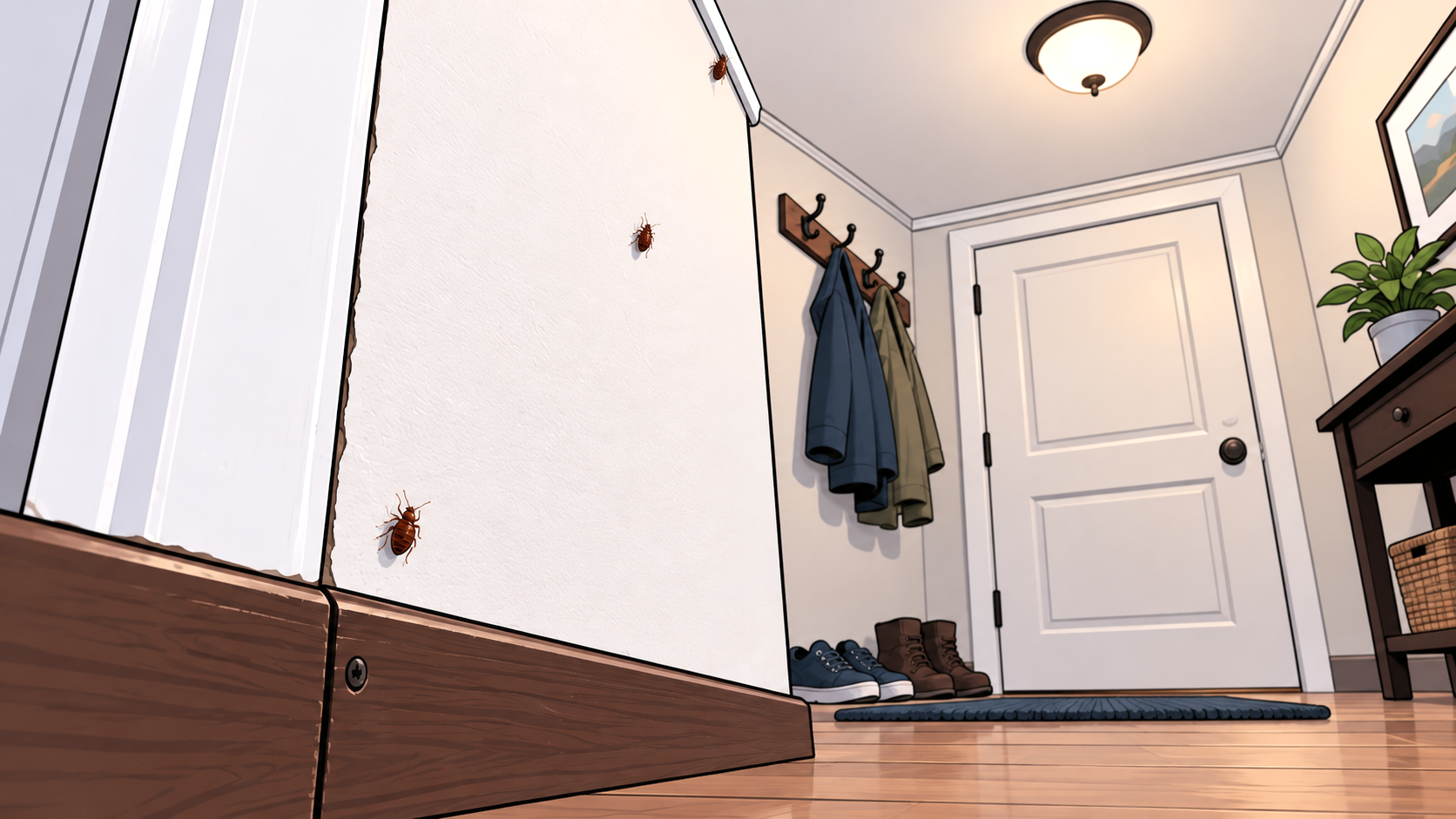
Bed bugs are best known for hiding around mattresses and bed frames, but they are perfectly capable of moving far beyond the bed. They can crawl up walls, across ceilings, and through structural openings that connect different parts of a building.
Yes, bed bugs can crawl on walls and ceilings. They cannot fly or jump, so they reach elevated surfaces entirely by crawling. Rough and textured surfaces generally provide better traction than very smooth materials, although climbing ability varies with the surface and even between bed bug species. What isn’t well documented is the popular claim that bed bugs deliberately climb onto ceilings and drop onto sleeping people to feed. Seeing one overhead can be unsettling, but the ceiling itself usually isn’t the most useful place to begin looking for the rest.
Bed Bugs Can Crawl Across Ceilings
The University of Kentucky’s bed bug guidance specifically states that bed bugs can crawl rapidly over floors, walls, ceilings, and other surfaces. The same guidance identifies ceiling-wall junctions among the places bed bugs may hide, alongside wall-mounted pictures, mirrors, outlets, carpeting, molding, and loose wallpaper.
This movement doesn’t require wings. Bed bugs are wingless and don’t jump like fleas. They reach a ceiling by climbing upward from another surface and continuing across it.
Walls and ceilings can also become routes through a building. University of Kentucky notes that bed bugs can crawl from room to room or floor to floor through cracks and openings in walls, floors, and ceilings. Rutgers similarly reports that bed bugs in multi-unit buildings can spread between adjacent units through hallways, common walls, and ceilings.
That makes ceiling movement particularly relevant in apartments and other connected buildings, where the space above one room may form part of a larger structural pathway.
Surface Texture Affects How Well Bed Bugs Climb
Bed bugs don’t perform equally well on every surface.
Controlled research has measured their ability to generate pulling force on materials ranging from rough sandpaper to smooth artificial surfaces. The results show that surface characteristics affect bed bug climbing performance, with smooth surfaces generally presenting a greater challenge.
Another study comparing the common bed bug (Cimex lectularius) with the tropical bed bug (Cimex hemipterus) found meaningful differences between the species. Adult tropical bed bugs escaped several smooth-surfaced pitfall monitors that common bed bugs generally could not. Microscopic examination found more tenent hairs on the tibial pads of adult tropical bed bugs, helping explain their stronger performance on smooth surfaces.
For a household wall or ceiling, the practical distinction is simple. A textured or otherwise climbable surface may give bed bugs enough traction to move across it. Very smooth materials can be substantially harder to climb.
That same principle is one reason smooth-sided interceptor traps can capture bed bugs moving around furniture.
Do Bed Bugs Drop From the Ceiling Onto People?
This is where a documented behavior often gets mixed with a much shakier claim.
Bed bugs absolutely crawl on ceilings. What we could not find in authoritative extension guidance or peer-reviewed behavioral research was evidence establishing deliberately climbing to a ceiling and dropping onto a sleeping person as a normal feeding strategy.
Bed bugs already have effective ways of locating hosts. Rutgers notes that they respond to cues including carbon dioxide, body heat, and human odor. They normally crawl from their hiding places toward a host, feed, and retreat.
That doesn’t justify turning every ceiling sighting into a story about a bed bug preparing to drop onto someone below. Being capable of crawling above a bed and deliberately using the ceiling as a launch point are two different claims, and the evidence firmly establishes only the first.
A Bed Bug on the Ceiling Doesn’t Automatically Mean a Severe Infestation
A ceiling sighting is worth investigating, but it cannot reliably tell you the size of the infestation by itself.
Bed bugs are most commonly associated with beds, sofas, and other places where people remain still long enough for feeding. Rutgers notes that when populations become high, bed bugs can be found throughout a room and even in neighboring rooms. University of Kentucky likewise documents hiding places extending well beyond beds, including ceiling-wall junctions and wall-mounted objects.
That means widespread activity can accompany a larger infestation, but the reverse conclusion isn’t reliable. One bed bug in an unusual location doesn’t establish that the home is heavily infested.
Severity is better judged from the amount and distribution of evidence throughout the room. Our comparison of a mild vs severe bed bug infestation looks at that broader pattern rather than using one sighting as the deciding factor.
Start Your Inspection Around the Bed
Finding a bed bug on a wall or ceiling shouldn’t make the ceiling the center of the investigation.
Start with the places bed bugs use most often. Inspect mattress seams and piping, the box spring, bed-frame joints, screw holes, the headboard, and nearby upholstered furniture. Then expand outward to carpet edges, molding, pictures, wall cracks, outlets, and other protected spaces if the initial inspection doesn’t explain what you’re seeing.
If activity extends along the perimeter of the room, baseboards can provide hiding places and deserve close inspection. In an apartment or another multi-unit building, evidence near walls or ceilings is also a reason to consider possible movement between adjoining spaces rather than assuming everything originated in the room where the bug was spotted.
Our room-by-room bed bug inspection covers the wider search without giving an isolated ceiling sighting more importance than it deserves.
Questions About Bed Bugs on Walls and Ceilings
Can bed bugs climb a popcorn ceiling?
Bed bugs can crawl across textured surfaces, so a rough ceiling does not create a barrier to movement. There isn’t good evidence that bed bugs specifically prefer popcorn ceilings. The relevant factor is whether the surface provides enough traction for climbing.
Can bed bugs climb glass?
Common bed bugs have considerably more difficulty with very smooth surfaces than with rough ones, which is one reason smooth-sided pitfall interceptors can trap them. Climbing performance isn’t identical across every life stage or bed bug species, however, so “bed bugs cannot climb glass” is too absolute.
Why would a bed bug be near the ceiling?
It may simply have crawled there while dispersing or found a suitable hiding place around molding, a ceiling-wall junction, loose material, or another protected gap. A ceiling sighting alone doesn’t reveal exactly why that individual moved there.
Can sealing wall and ceiling cracks help?
Sealing cracks and crevices can remove hiding places and reduce structural pathways, and Rutgers includes sealing cracks among its recommended environmental modifications for bed bug management. It does not eliminate bugs already established elsewhere, so it should be part of a broader control strategy rather than the only treatment.