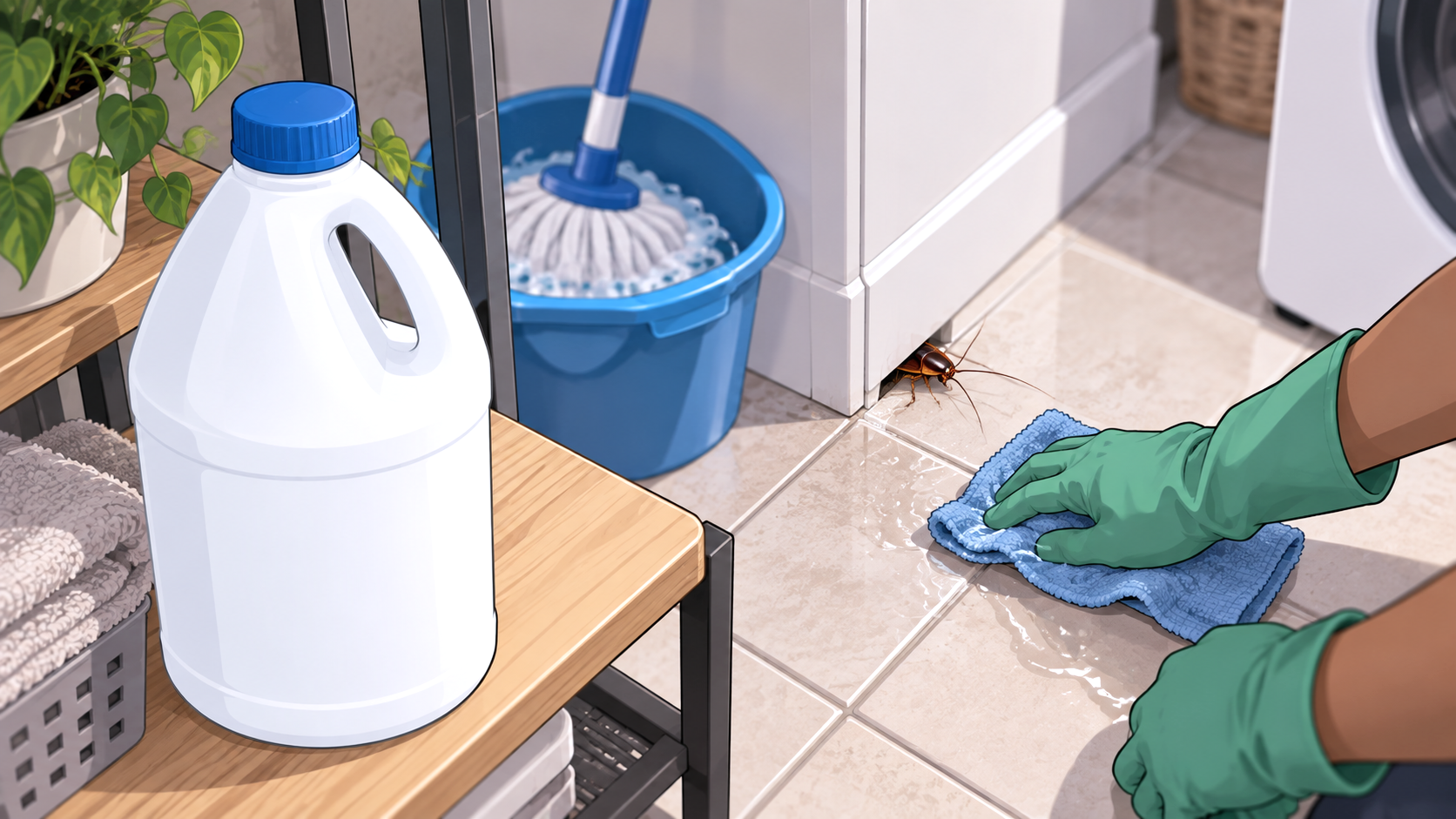
Bleach is harsh enough that sufficiently intense direct exposure can injure or kill many small organisms, but that does not make ordinary household bleach a dependable cockroach treatment. A cockroach disappearing beneath a cabinet, appliance, or wall void is no longer exposed to whatever was sprayed on the floor, while the rest of an infestation remains untouched. Bleach is far more useful as a cleaning or disinfecting product when its label calls for that use.
Bleach may kill a cockroach that receives sufficient direct exposure, but household bleach is not a reliable way to eliminate cockroaches. It does not reach most hidden insects or provide dependable population control. Use bleach only for its labeled cleaning or disinfecting purposes, never mix it with other cleaners, and use proven cockroach-control methods for an infestation.
Killing the Cockroach You Can See Is a Very Small Test
Spraying a visible cockroach tells you little about what happens to the population occupying inaccessible spaces. Cockroaches spend much of their time concealed in cracks, cabinet voids, appliance areas, and other protected locations. An established infestation can also contain nymphs and other evidence beyond the insects you happen to see. A liquid cleaner applied to one exposed adult has no dependable route to all of those locations.
Household bleach is principally a cleaning and disinfecting chemical, not automatically an insecticide. In the United States, a bleach or cleaning product making claims that it destroys or mitigates a pest becomes subject to pesticide registration requirements. In Canada, pest-control products likewise must be registered for their intended pest-control uses. A bottle labeled for laundry, cleaning, or surface disinfection should not be repurposed into a cockroach pesticide simply because sodium hypochlorite is chemically aggressive.
For an infestation, methods need to affect more than insects caught in the open. The broader cockroach control process combines monitoring, sanitation, treatment, resource reduction, and follow-up rather than judging success by how many visible adults can be sprayed.
Bleach Can Clean a Cockroach-Contaminated Surface Without Controlling the Infestation
Cleaning after cockroach activity and treating the cockroaches themselves are separate jobs. Fecal material, food residue, and other debris should be physically removed from appropriate washable surfaces. If disinfection is necessary, a suitable disinfectant can then be used according to its label. Household sodium hypochlorite is an effective disinfectant against many microorganisms, but its antimicrobial action does not establish it as an effective whole-infestation cockroach treatment.
That difference is useful in areas where cockroach droppings have accumulated. Loose material can be removed first, followed by appropriate cleaning of surfaces that tolerate the selected product. Bleach can discolor fabrics and damage or corrode some materials, particularly at higher concentrations, so the surface manufacturer’s instructions and bleach label still matter.
Bleach should not be expected to neutralize every concern associated with cockroaches either. A study combining professional extermination with repeated sodium-hypochlorite cleaning found that the bleach cleaning did not provide an additional reduction in cockroach allergen levels beyond the broader intervention. People concerned about cockroach-related allergies or asthma therefore need population reduction and thorough environmental cleaning rather than treating bleach as an allergen-removal shortcut.
Pouring Bleach Down a Drain Is Not a Cockroach Solution
A cockroach seen around a sink can make pouring bleach into the drain seem logical. The insect may instead be traveling through a gap around plumbing, emerging from a wall void, or simply using the sink area for moisture. Even when cockroaches repeatedly appear around a drain, the actual route should be identified before chemicals are poured into the plumbing.
Using extra bleach also creates a serious compatibility problem. Drain cleaners, toilet cleaners, vinegar, ammonia-containing products, and other household chemicals may already be present in or around plumbing. Mixing bleach with acids or ammonia can release dangerous toxic gases. Never pour bleach into a drain as a cockroach remedy when doing so is outside the product’s labeled use or could bring it into contact with another chemical.
A Bleach Smell Does Not Create a Protective Barrier
Bleach does not turn a freshly cleaned kitchen into a cockroach-proof zone. Once an appropriate cleaning job is finished, prevention still depends on the conditions available to cockroaches. Food residue beneath appliances, leaking water, garbage, clutter, and protected harborages remain relevant regardless of how strongly the room smells of cleaner.
Cockroaches can use many different food sources, so removing grease, crumbs, spills, and accessible garbage contributes more to long-term management than repeatedly wiping already-clean surfaces with stronger bleach. Health Canada recommends combining intensive cleaning with appropriate cockroach-control measures, including removing food and water, vacuuming, monitoring, and addressing hiding places.
A household trying to minimize conventional pesticide use can also rely on vacuuming, sticky monitoring, sanitation, moisture correction, and other nonchemical cockroach-control measures without substituting bleach as an improvised insecticide.
The Safety Cost Is Higher Than It Looks
Bleach can irritate or burn the skin, eyes, and respiratory tract, depending on concentration and exposure. Indoor use requires ventilation and whatever protective measures the product label specifies. Household chemical guidance warns that bleach must not be mixed with ammonia, acids such as vinegar, or other cleaners because hazardous gases can form. CDC guidance gives the same warning and recommends good ventilation during bleach use.
Repeatedly spraying bleach into cabinet gaps, beneath appliances, along baseboards, or into inaccessible spaces in pursuit of cockroaches can therefore create exposure and material-damage risks without providing dependable infestation control. Swallowing bleach or substantial exposure to concentrated products can also cause serious poisoning or chemical injury, making casual pest-control experiments particularly inappropriate around children and pets.
Useful Questions About Bleach and Cockroaches
Does the smell of bleach repel cockroaches?
A strong odor may alter an individual insect’s immediate movement, but there is no good basis for treating household bleach odor as a dependable cockroach repellent. Repellency would also be of limited value if insects simply retreat deeper into untreated harborages.
Can I mop with bleach after seeing a cockroach?
You can use a bleach product on a compatible floor when its label permits that cleaning or disinfecting use. Mopping should be treated as cleaning, not as cockroach treatment, and the product should never be mixed with another floor cleaner unless the label explicitly says the combination is safe.
Can bleach destroy cockroach eggs?
Do not rely on household bleach to eliminate concealed cockroach egg cases. Oothecae can be hidden in locations a cleaning solution never contacts, so monitoring and appropriate infestation control remain necessary when reproduction is occurring.
Should I spray bleach behind my refrigerator if cockroaches hide there?
Not as an improvised insecticide. Bleach can damage materials, create fumes, and contact electrical or mechanical components. Vacuum accessible debris where it can be done safely, clean suitable surfaces according to their instructions, and use a cockroach-control product only where its pesticide label permits application.
One thought on “Does Bleach Kill Cockroaches?”