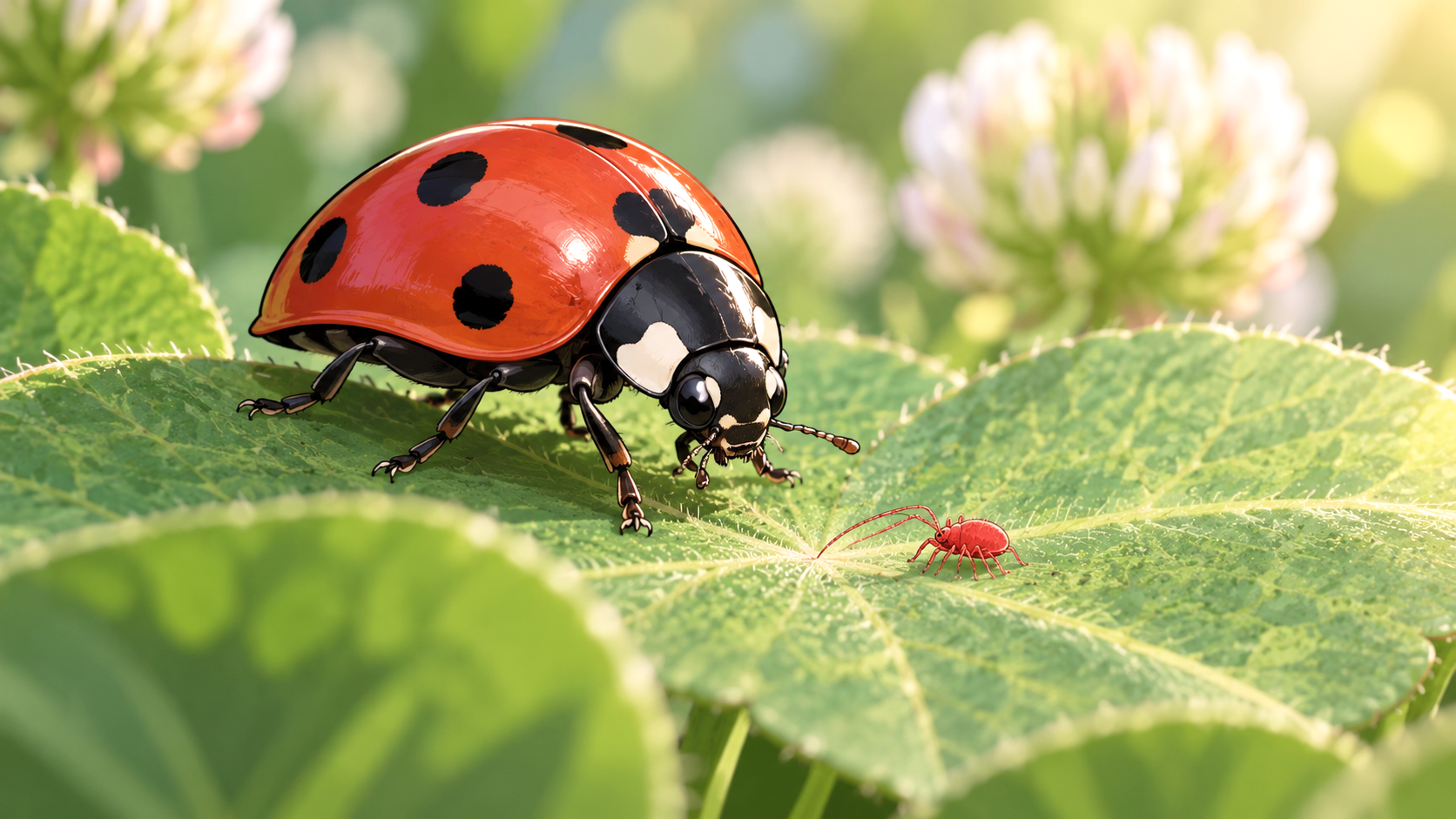
Ladybugs, more accurately called lady beetles, are among the documented predators of Bryobia praetiosa or clover mites as they are more often called. Records from California identified 15 species of coccinellid beetles among at least 62 arthropod predators attacking clover mites. Lady beetles are therefore genuine natural enemies of this pest, although their presence does not mean they will prevent every clover mite outbreak. The familiar idea that ladybugs eat aphids can make their diet seem narrower than it is. Many predatory lady beetles also consume mites, thrips, insect eggs, and other small prey, while certain species specialize more heavily on mites than others.
Some Ladybugs Are Better Mite Hunters Than Others
“Ladybug” describes an entire beetle family rather than one predator with a single diet. North America has hundreds of lady beetle species, and their preferred prey differs considerably. Some concentrate on aphids or scale insects, while mite-feeding species are adapted to pursuing extremely small prey. The wider clover mite predator record includes 15 coccinellid species, showing that lady beetle predation is not limited to a chance encounter by one unusual species.
Mite-specialist lady beetles can be surprisingly small themselves. Species in the genus Stethorus, often called spider mite destroyers, are well-established predators of plant-feeding mites. That does not mean every Stethorus species should automatically be labeled a clover mite predator, but it helps explain how members of the lady beetle family can exploit prey as tiny as an adult clover mite.
Both Adult and Larval Ladybugs Can Be Predators
The rounded adult beetle is only half of the picture. Predatory lady beetles generally hunt during both the adult and larval stages. Their larvae look very different from adults, with elongated bodies and conspicuous legs, so they are sometimes mistaken for pests even while they are feeding on other arthropods.
Preserving larvae can be just as valuable as leaving adults undisturbed. Lady beetles typically place eggs where suitable prey is available, giving emerging larvae immediate access to food. Clover mites spend much of their active lives among grasses and other vegetation, putting them in the same outdoor environment as lady beetles searching foliage for small prey.
Ladybugs Cannot Be Expected to Stop a Mass Migration
Predation happens one mite at a time. A clover mite population can become enormous around favorable lawns and landscaping, and thousands may leave the vegetation during seasonal movement. Even an active community of predators may be overwhelmed by the number of mites heading toward a building.
A lady beetle population also does not necessarily stay where a homeowner wants it. Adult beetles are mobile and can fly elsewhere as prey, temperature, and other conditions change. Clover mites meanwhile may spread across exterior walls and enter through tiny openings before predators remove enough of them. Once large numbers have reached the structure, preventing entry through landscaping and exclusion is more predictable than waiting for ladybugs to reduce the population.
Buying Ladybugs Is Unlikely to Fix a Clover Mite Infestation
Commercial ladybug releases are commonly marketed for garden pest control, but purchasing beetles specifically for clover mites has little support. The convergent lady beetle, Hippodamia convergens, is frequently sold commercially, yet released adults have a strong tendency to disperse. Purchased beetles can fly away soon after being released, sometimes before providing much local pest suppression.
There is also no established residential release rate showing how many lady beetles would control a clover mite infestation around a house. Naturally occurring predators are better treated as part of the outdoor ecosystem than as a replacement for direct management of a large clover mite population.
Protecting Existing Ladybugs Can Still Be Useful
Clover mites have numerous natural enemies, and allowing that predator community to persist can contribute to background population regulation. Broad-spectrum pesticide applications can disrupt beneficial arthropods as well as pests, so chemical treatment should be limited to areas where it is actually needed. Clover mite management guidance specifically recognizes that the species has important natural predators that should be considered before chemical treatment.
A severe infestation may still justify treatment. Preserving predators does not require tolerating thousands of mites entering a house or significant clover mite feeding damage on plants. Targeted control leaves more of the surrounding habitat untouched than spraying an entire landscape simply because mites are present in one section.
Questions About Ladybugs and Clover Mites
Will ladybugs eat clover mite eggs?
Lady beetles as a family can consume various arthropod eggs, but the available clover mite predator records do not justify promising meaningful control of clover mite eggs hidden in protected sites. Adult mites are not the only life stage predators may encounter, but egg suppression should not be assumed.
Are all ladybugs beneficial predators?
No. Most North American lady beetles are predatory, but some species feed on plants. The Mexican bean beetle and squash beetle are notable plant-feeding exceptions within the lady beetle family.
Should I spray ladybugs if they appear beside clover mites?
Not simply because they are present. Lady beetles can be beneficial predators, and indiscriminate treatment can remove part of the same natural-enemy community that feeds on clover mites outdoors.
Can ladybugs control clover mites inside the house?
They should not be introduced indoors for that purpose. Clover mites that wander inside can be removed directly with a vacuum, while the outdoor source and entry points can be handled separately.