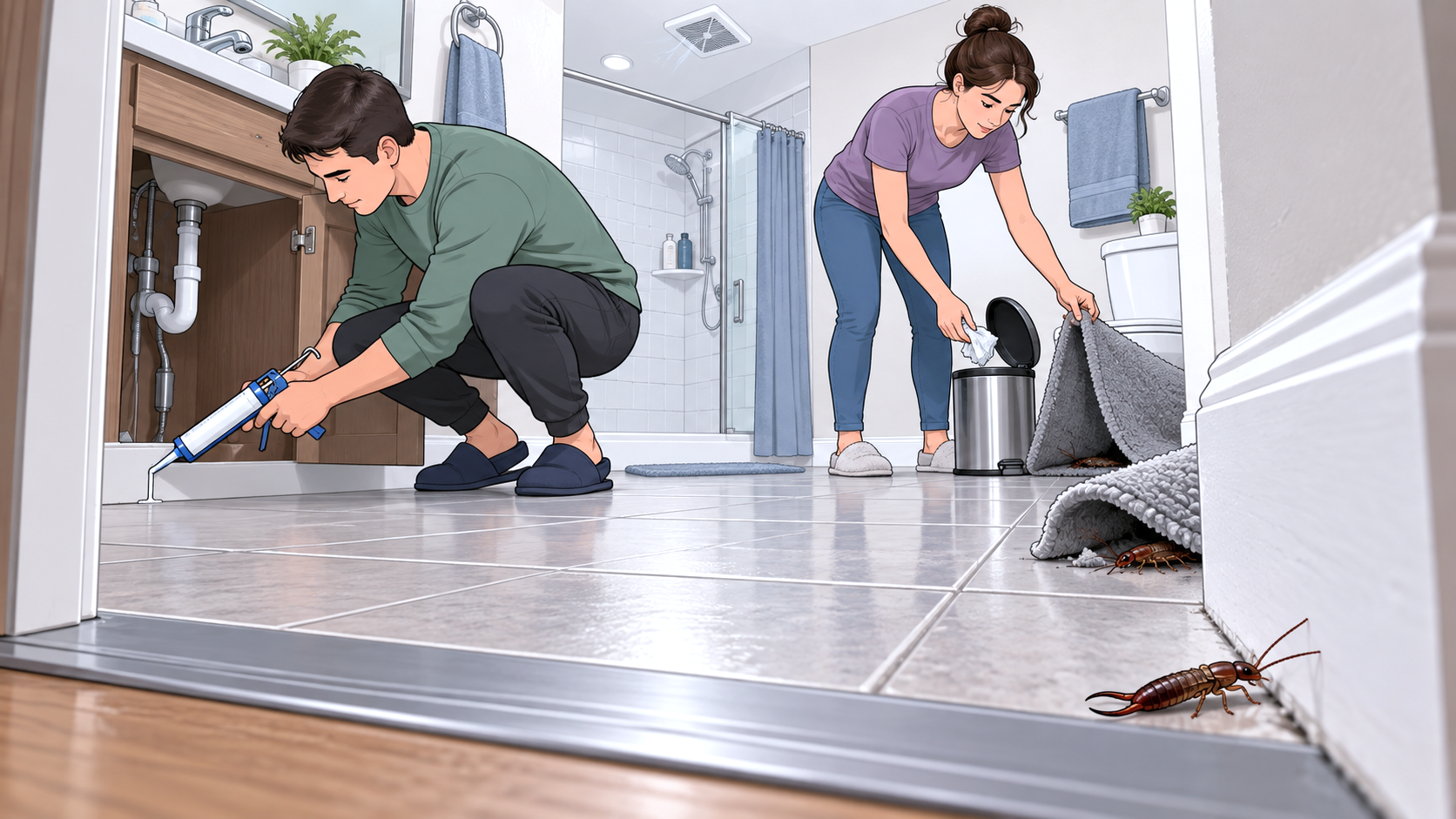
Finding an earwig beside the bathtub makes the bathroom look like the obvious source of the problem. The room is damp, there are drains nearby, and the insect may even appear in the tub or sink. That combination can send you looking for something to pour down the drain.
Usually, that starts the investigation in the wrong place. To get rid of earwigs in the bathroom, remove the insects you find, then work backward to determine how they are entering the house. Seal accessible gaps around doors, windows, vents, utility penetrations and the foundation, correct unnecessary moisture around the building, and reduce earwig shelter close to likely entry points. Indoor pesticide applications generally do little to stop continuing invasions.
The bathroom still gives you useful information. Instead of treating it as the infestation site, use the location of each sighting as a clue to where the insects may be getting inside.
First, Get the Earwigs Out of the Bathroom
There is rarely a complicated treatment required for an earwig already crawling across the bathroom floor. Vacuum it up or remove it with a broom and dustpan. Physical removal is appropriate for earwigs found indoors, particularly when only one or two have wandered inside.
That may be all you need when the sighting is isolated. European earwigs do not reproduce indoors, so finding one in a bathroom does not mean a hidden indoor colony is multiplying behind the walls. Individual earwigs also do not survive for long inside homes. The more important question is whether new ones continue arriving from outdoors.
For that reason, we would not spray the entire bathroom after a single sighting. Indoor pesticide treatments do little to prevent additional earwigs from entering. Removing the insect solves the immediate problem. Stopping the route into the building solves the recurring one.
The Bathtub or Sink May Be Where the Earwig Gets Stuck
An earwig sitting in a bathtub creates a convincing story. There is a drain directly beneath it, so it seems reasonable to assume the insect climbed through the plumbing.
Location alone does not establish an entry route.
Earwigs primarily disperse by crawling and can move around buildings after entering through small openings. Bathrooms also contain smooth-sided tubs and sinks where a wandering insect can become conspicuous. An earwig discovered there may simply have reached the fixture after entering somewhere else.
This distinction matters because pouring chemicals into a drain will not seal a gap beneath an exterior door, around a pipe penetration or elsewhere along the building envelope. If drain sightings are your specific problem, our guide to earwigs coming up drains looks at that question separately rather than assuming every bathroom earwig came through plumbing.
For the broader bathroom problem, start looking around the room instead of down the drain.
Read the Bathroom Like an Entry-Point Map
Where you repeatedly find earwigs can narrow the search.
A bathroom on the ground floor deserves a close inspection around exterior-facing walls, windows and nearby doors. Look for accessible cracks and gaps where the building meets the foundation. Openings around vents, faucets, pipes, cables and other penetrations are also worth checking. Properly fitted door sweeps can block crawling earwigs from moving beneath exterior doors.
Earwigs are primarily crawlers, and physical exclusion is a central way to prevent them from entering buildings. That makes repeated sightings near the same side of a bathroom more useful than they initially appear. The insects may be showing you which part of the building needs attention.
Caulk appropriate cracks and crevices, repair damaged screens and weather stripping, and replace poorly fitting door sweeps where necessary. Our broader guide to keeping earwigs out of the house covers exclusion beyond the bathroom.
Do not expect every entry point to be visible from inside the room. Once you have inspected the bathroom, walk outside and examine the corresponding section of the building.
The More Important Moisture May Be Outside the Bathroom
Bathrooms are naturally associated with water, but a damp bathroom does not automatically explain why earwigs reached the house.
Earwigs spend the daytime in protected, dark spaces and particularly favor shelters that are moist. Around a building, wet organic debris, dense vegetation, leaf litter and mulch can provide those conditions. Poor drainage and water collecting beside the structure can make the area even more favorable.
So when bathroom sightings keep happening, check what is on the other side of the wall. A constantly damp bed of thick mulch below the bathroom window is more relevant to entry than ordinary moisture created while somebody takes a shower.
Keeping water away from the structure is part of established earwig prevention. Repair drainage problems and downspouts that leave areas beside the building unnecessarily wet. At the same time, remove accumulations of leaves and other debris near likely entry points.
This does not mean creating a dry wasteland around the house. Plants still need appropriate irrigation, and landscaping can remain in place. The aim is to remove unnecessary combinations of persistent moisture and shelter directly beside the building.
Look Immediately Outside the Bathroom Wall
This is the inspection step we would prioritize when the same bathroom keeps producing earwigs.
Stand outside the house at approximately the same location as the bathroom. Look downward first. Earwigs can shelter beneath boards, leaf litter, pots, wood piles, dense groundcover and other protected materials. Removing sheltering debris near likely entry points makes the area immediately around the structure less accommodating.
Then look at the building itself. Check the foundation junction, window edges, vents, utility penetrations and nearby exterior doors. The objective is not to locate an earwig nest inside the wall. You are looking for the combination of outdoor earwig activity and a physical route into the building.
This approach can also explain why only one room seems affected. A house can have earwigs outside several walls, yet one section may offer easier access. The bathroom becomes the place you notice them because of its position relative to that route.
If earwigs are turning up in several unrelated rooms instead, broaden the inspection. Our guide to why earwigs get into houses covers the whole-building problem.
Do Not Turn a Bathroom Earwig Into a Cleaning-Chemical Experiment
Bathrooms contain plenty of products that can kill or injure small insects on direct contact. That does not make them useful earwig-control methods.
Bleach, vinegar, rubbing alcohol and other household products do not address how earwigs are entering. Spraying or pouring them around the bathroom can therefore distract from the part of the problem that actually determines whether another earwig appears tomorrow.
The same reasoning applies to indiscriminate indoor insecticide use. Indoor pesticide applications are not recommended as a way to prevent earwig invasions because they do not stop insects outside from finding another route indoors.
This is one of those pest problems where doing less inside can produce a better plan. Remove the individual insect, clean the area normally, and spend your effort on exclusion and exterior conditions.
Dedicated guides on whether bleach kills earwigs, whether vinegar kills earwigs and whether rubbing alcohol kills earwigs deal with those methods individually.
Repeated Bathroom Earwigs Change What You Should Do
One earwig and twelve earwigs should not produce exactly the same response.
With an isolated sighting, physical removal and a basic inspection may be enough. When new earwigs keep appearing, the pattern tells you that removal alone is not stopping entry. At that point, concentrate on the outside perimeter and the particular side of the building closest to the bathroom.
Earwig populations can be reduced outdoors with refuge or oil traps when necessary. Rolled corrugated cardboard and newspaper create daytime shelters that can be collected and emptied. Containers using vegetable oil with an odorous attractant can also trap earwigs. These methods belong outside where the population originates rather than beside your bathtub.
Our DIY earwig trap guide explains those options in detail. Trapping can reduce nearby numbers, but exclusion still matters. Catching earwigs outside while leaving an obvious gap beneath a door gives the survivors the same route into the house.
When indoor sightings continue despite exclusion and exterior habitat changes, the problem has moved beyond simply removing bathroom wanderers. That is a reasonable point to consider whether an earwig exterminator is warranted.
Make the Next Earwig Prove the Fix Failed
After sealing likely entry points and correcting exterior conditions, you do not need to keep treating the bathroom indefinitely.
Clean up the existing insects and then watch what happens. The absence of new sightings is more meaningful than repeatedly applying something “just in case.” If another earwig appears, note exactly where you found it and inspect that part of the room and corresponding exterior wall again.
That turns each new sighting into information. An earwig repeatedly appearing near one window tells you more than an insect found once in the middle of the floor. Likewise, continued appearances immediately after heavy weather may justify another exterior inspection rather than another round of bathroom spraying.
For persistent problems, the goal is not to make the bathroom toxic to earwigs. It is to make the route into the bathroom disappear.
Other Questions About Earwigs in Bathrooms
Can an earwig live behind a bathroom vanity?
An earwig can temporarily hide in a dark, confined space indoors, including spaces around bathroom fixtures. That does not mean it is establishing a reproducing indoor population. Repeated sightings should prompt an inspection for entry points rather than an assumption that a colony lives behind the vanity.
Why do I find dead earwigs in the bathroom?
Earwigs that wander indoors can die because indoor conditions provide little suitable food and habitat. A dead earwig still indicates that an insect entered the building, so repeated discoveries are worth tracing back to possible exterior access points.
Can earwigs climb bathroom walls?
Earwigs can climb many surfaces, so finding one above floor level does not identify where it entered. A wall sighting should not automatically send you searching for a hole at the same height. The insect may have entered near ground level and moved afterward. Our guide to whether earwigs can climb walls and glass covers their climbing ability separately.
Are bathroom earwigs dangerous to people?
Earwigs are nuisance invaders indoors and do not damage people, property or food. Their intimidating rear forceps make them look more threatening than the household risk warrants. Our guide to whether earwigs are dangerous to humans covers that question in more detail.
Why did several earwigs suddenly appear in my bathroom?
Earwigs can move indoors when outdoor conditions become unfavorable, including periods that are excessively hot, dry or cold. A sudden cluster of sightings can therefore reflect migration into the building rather than reproduction inside the bathroom. Check exterior shelter and entry points even when the insects seem to have appeared overnight.