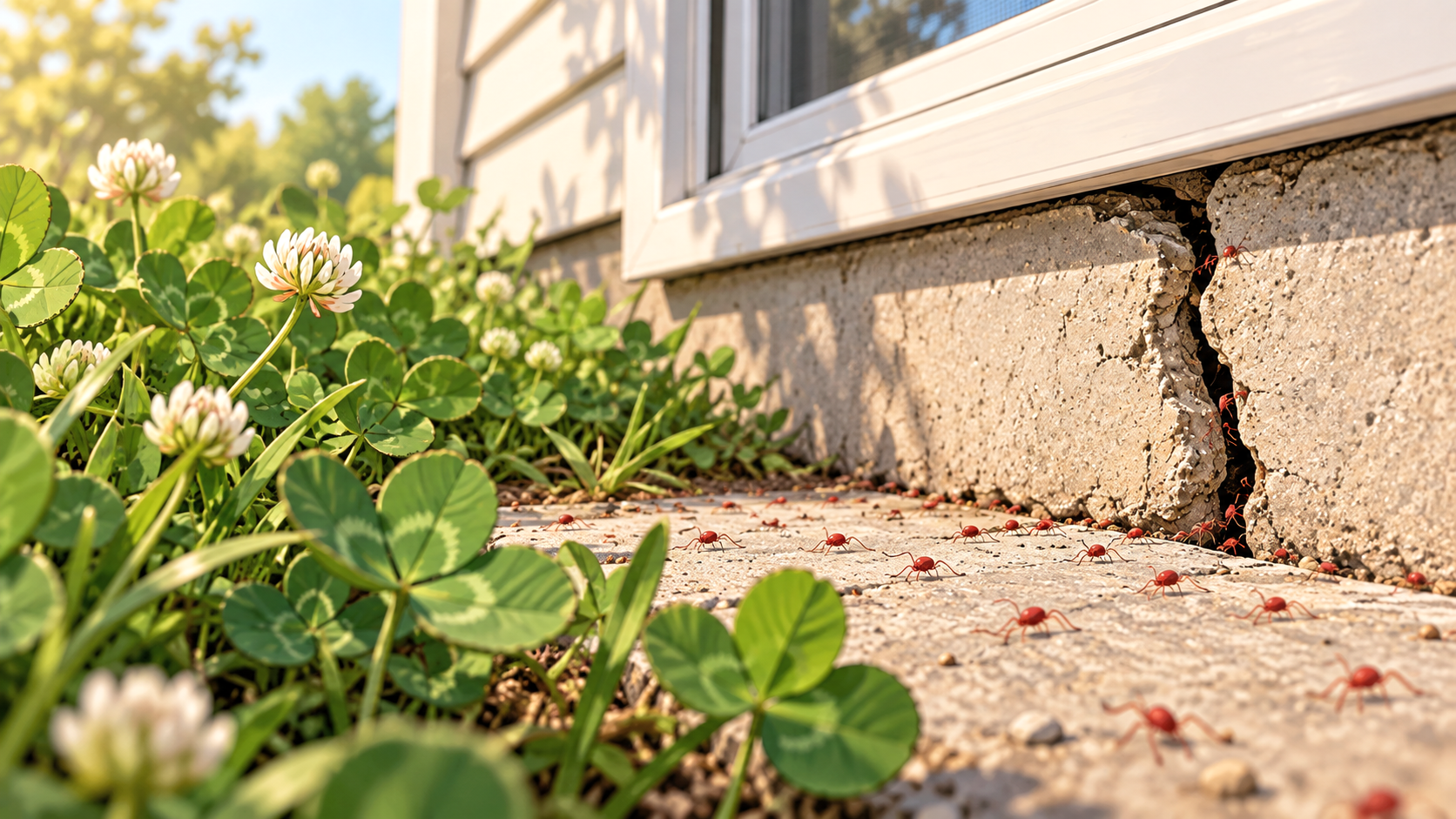
Clover mites keep coming back when the outdoor population that produced the problem is still present. Removing or killing the mites you can see may end the immediate nuisance, but it does not necessarily affect eggs, mites elsewhere in the landscape, or conditions that continue to support large populations. Recurrence can also be seasonal. Clover mites naturally pass through periods of activity and dormancy, so a problem that seems finished can return when another generation becomes active.
Killing Visible Clover Mites Does Not Remove the Outdoor Population
Indoor cleanup deals with mites that have already left their normal habitat. Clover mites live and reproduce outdoors, primarily in turfgrass and other vegetation.
This makes vacuuming useful for immediate removal but not a complete solution to recurring invasions. The mites inside are only part of a potentially much larger population outside. Fortunately, clover mites cannot maintain a reproducing population indoors, so repeated appearances do not usually mean they are breeding somewhere in your rooms.
When clover mites become a routine problem, management has to address the population around the building rather than repeatedly removing only the mites that become visible.
New Eggs Can Hatch After Treatment
Clover mite eggs can survive when a treatment kills active mites. That matters because the species lays eggs in protected locations, and egg hatch can occur after rain. A successful treatment of exposed mites can therefore be followed by another wave.
Clover mites also produce multiple generations while temperatures remain favorable. Two or more generations can develop during periods of moderate weather, giving populations opportunities to rebuild even after numbers have been reduced.
This is one reason a single application should not automatically be judged by whether every mite disappears permanently. If pesticide treatment is necessary, the product must be labeled for the intended site and pest, and its directions determine whether and when another application is permitted.
The Landscape May Still Favor Large Populations
Recurring problems often make more sense when you look at the vegetation surrounding the building. Clover mites feed on grasses and numerous other plants, and certain lawn conditions can support unusually high numbers.
Lush, heavily fertilized turf is particularly important. Over-fertilized lawns can encourage clover mite population increases, while newer lawns can also experience substantial populations. Applying more fertilizer than the turf needs can therefore work against long-term management.
Hot, dry areas around sun-exposed walls can support problems as well. Supplemental watering can reduce populations in dry development sites, particularly around foundations and evergreens.
Changing favorable habitat can have a longer-lasting effect than repeatedly reacting to individual mites. The relevant conditions are covered more broadly by what attracts clover mites to a property.
Clover Mites Can Return With the Seasons
Sometimes the mites have not defeated the treatment at all. Their normal biology has simply produced another active period.
Clover mites are cool-season mites with their greatest activity concentrated in spring and fall. Summer heat can interrupt development, followed by renewed activity when temperatures become favorable again. A property can consequently have a quiet stretch followed by another noticeable population months later.
Year-to-year recurrence is possible too. Properties with persistent conditions around the building may experience mites repeatedly, and annual invasions are specifically documented. Population size can still vary considerably from one year to another.
Their ability to survive unfavorable periods contributes to this pattern. Clover mites overwinter mainly as protected eggs, preserving the population through cold weather rather than requiring a completely new introduction each year.
Long-Term Control Means Reducing the Source
For a property with recurring clover mites, prevention deserves more attention than repeatedly killing visible mites. One of the most established approaches is reducing suitable vegetation immediately beside the foundation.
A plant-free strip can discourage migration, with recommendations commonly ranging from about 18 inches to several feet depending on the source and site. Keeping grass and host plants away from foundations can substantially reduce migrations. Even this is not an absolute barrier, but it removes favorable habitat from the area where repeated problems develop.
Lawn management matters at the same time. Avoid unnecessary fertilizer, manage dry turf appropriately, and concentrate on the outdoor population rather than treating indoor sightings as separate infestations.
If chemical control becomes necessary for a persistent problem, use only a product currently labeled for clover mites and the intended treatment site. Exterior treatment may be appropriate when clover mites repeatedly enter buildings, but pesticide use works best as one part of habitat management rather than the only response.
Other Questions About Recurring Clover Mites
Can clover mites return after professional treatment?
Yes. Treatment can reduce active mites without eliminating every protected egg or the surrounding outdoor population. Long-term results depend partly on whether favorable conditions around the property remain.
Does recurrence mean the pesticide did not work?
Not necessarily. New mites may emerge after the original exposed population was killed. Judge treatment according to the product label, expected residual activity, and whether the outdoor source is also being managed.
Why do I get clover mites every year?
A suitable outdoor habitat can support new generations year after year. Seasonal activity then makes the problem noticeable again when conditions favor mite development and movement.
Will recurring clover mites eventually go away?
They can decline substantially. Some properties experience problems for several years before populations stabilize, particularly as new lawns mature and conditions become less favorable for population increases.
5 thoughts on “Why Do Clover Mites Keep Coming Back?”