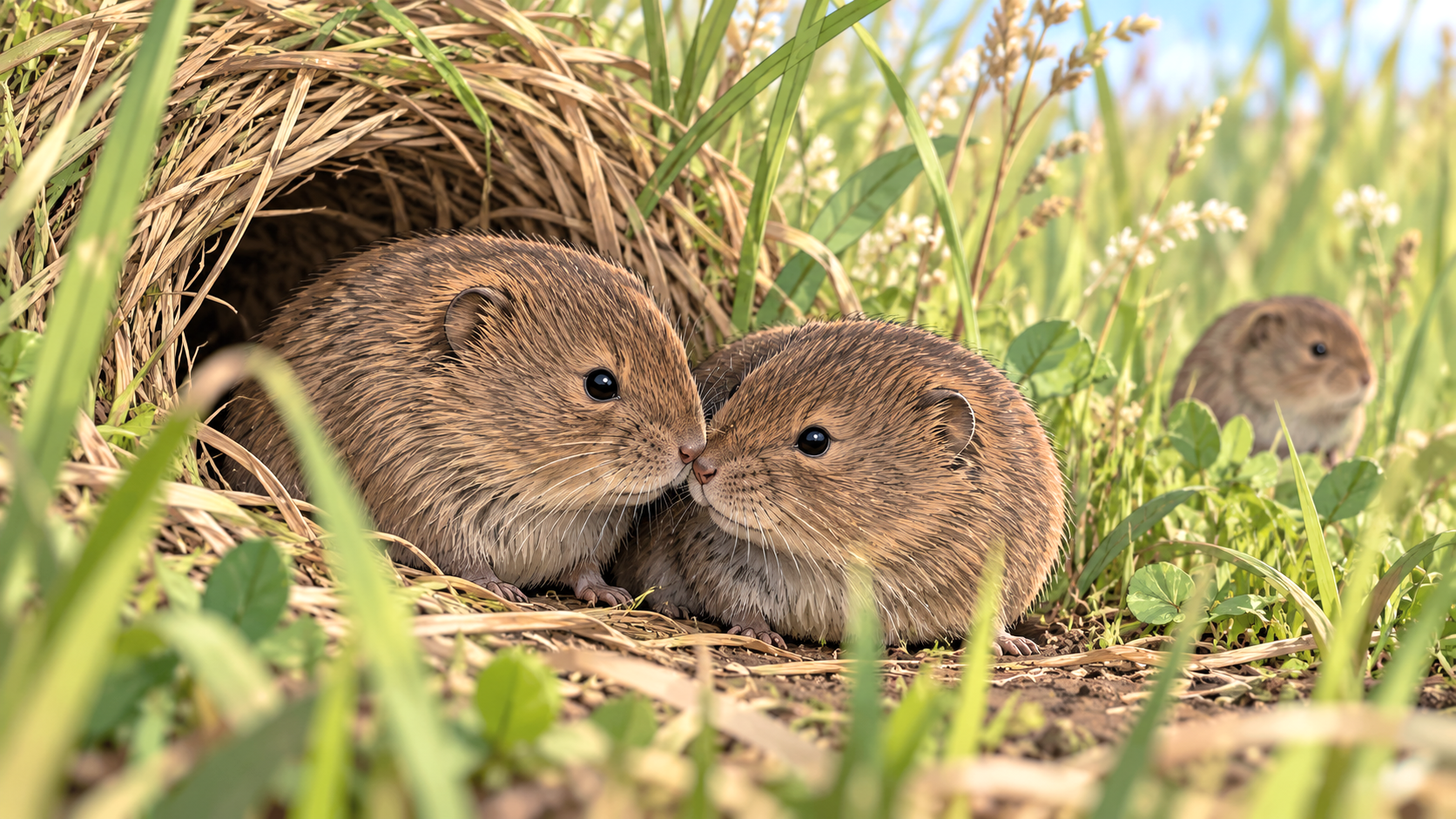
Some voles form lasting pair bonds, but not all voles mate for life. Prairie voles and woodland voles are known for socially monogamous relationships, while meadow and montane voles generally mate with multiple partners. Even among pair-bonded prairie voles, social attachment does not guarantee sexual exclusivity, and a surviving vole may sometimes form another bond after losing its partner.
The familiar claim that voles are lifelong mates comes largely from research on prairie voles (Microtus ochrogaster). Their unusually strong partner preferences have made them important animals in the scientific investigation of attachment, but their behavior should not be generalized to every vole species.
Prairie Voles Form Bonds That Can Last
A prairie vole pair may share a nesting area, maintain a close association, and raise offspring together. Both parents participate in caring for the young, and paired animals commonly show a preference for one another over unfamiliar individuals.
These relationships involve more than two animals temporarily occupying the same space. Laboratory experiments have demonstrated that prairie voles develop selective preferences for familiar partners, sometimes after relatively brief periods of mating or cohabitation. Once established, these preferences can persist beyond the initial reproductive encounter.
Their social relationships are also associated with changes in behavior toward strangers. Paired prairie voles may become more selective about whom they approach and tolerate, contributing to the stability of their relationships.
This contrasts with the reproductive behavior of many other small rodents, where mating does not ordinarily produce the same enduring affiliation. The shared nesting arrangements used by voles can reflect different social relationships depending on which species occupies them.
A pair bond nevertheless does not establish that two prairie voles will remain together until both die. Their relationship can end through death, separation, or changes in circumstances, and not every prairie vole forms a stable pair in the first place.
A Faithful Social Partner Is Not Necessarily an Exclusive Mate
Scientists distinguish between social monogamy and genetic monogamy.
Social monogamy describes animals that maintain a relatively stable association with a particular partner. Genetic monogamy means that the offspring produced during the relationship are exclusively parented by those two individuals.
Prairie voles demonstrate why these definitions should not be treated as interchangeable. Genetic testing of wild populations has revealed offspring fathered by males outside established social pairs. Some paired males also father offspring with females other than their usual partners.
In certain investigated populations and years, extra-pair paternity has occurred in a substantial proportion of litters. The frequency varies, however, and no single percentage describes every prairie vole population.
The reproductive success of socially paired prairie voles has been found to exceed that of unpaired animals, even though exclusive mating was not necessary for this advantage. Maintaining a social partner and mating only with that individual are therefore separate behaviors.
A prairie vole can remain strongly attached to one partner while having offspring with another. Calling the species socially monogamous accurately describes its characteristic pair-bonding system without implying universal sexual fidelity.
Do Meadow Voles and Other Species Have Lifelong Partners?
Meadow voles (Microtus pennsylvanicus) usually have a polygamous mating system. During the breeding season, males may encounter and mate with multiple females rather than maintaining a stable reproductive partnership with one individual.
Montane voles (Microtus montanus) also generally exhibit a polygamous mating system. They are not known for the strong, lasting reproductive pair bonds characteristic of prairie voles.
Woodland voles (Microtus pinetorum), sometimes called pine voles, provide a closer comparison to prairie voles. They are commonly described as socially monogamous and exhibit biparental care, although the extent and persistence of pair bonding should not be assumed identical between the two species.
The behavioral differences among prairie, woodland, meadow, and montane voles are well established in comparative research.
| Vole species | Typical mating system | Pair bonding |
|---|---|---|
| Prairie vole | Socially monogamous | Strong, often enduring partner bonds |
| Woodland or pine vole | Generally socially monogamous | Pair bonds and biparental care |
| Meadow vole | Generally polygamous | No characteristic lifelong reproductive bond |
| Montane vole | Generally polygamous | Long-term mating partnerships are not typical |
The variety of vole species makes any blanket statement about lifelong mating unreliable.
An additional complication is that meadow voles can develop preferences for familiar animals under certain conditions. Laboratory meadow voles have shown selective partner preferences, despite belonging to a species generally classified as polygamous. Familiarity and social preference do not necessarily indicate a naturally monogamous reproductive system.
What Happens When a Prairie Vole Loses Its Mate?
Prairie voles can respond strongly to the loss of an established partner. Their behavior may change, and some individuals are reluctant to form another relationship.
In one experiment, researchers removed the males from established prairie vole pairs and offered the surviving females opportunities to associate with new males. Only three of the 22 females formed new pairs under the tested conditions. The low frequency of re-pairing after partner loss supported the interpretation that an existing bond could inhibit formation of another.
That result does not mean prairie voles are biologically incapable of choosing a second mate.
Experiments involving males have demonstrated that a new pair bond can form after a previous relationship ends. The time spent separated from the original partner can affect the strength and consistency of the new preference.
Partner separation also has measurable effects on behavior and physiology. Male prairie voles subjected to prolonged separation have exhibited changes in anxiety-related behavior and brain signaling. Those responses support the existence of meaningful attachments, but they should not be interpreted as proof that the surviving animal permanently refuses another mate.
The expression mate for life is consequently a useful shorthand for the potential durability of prairie vole relationships, not a biological rule that applies without exceptions.
Why Do Prairie Voles Form Such Strong Pair Bonds?
Partner preference in prairie voles involves neural systems associated with social recognition, reward, and attachment. Two particularly important chemical messengers are oxytocin and vasopressin.
Their effects depend partly on where receptors are distributed within the brain. Experiments have demonstrated that vasopressin signaling contributes to partner preference and selective social behavior in male prairie voles.
Comparisons with meadow voles have helped clarify why closely related animals can show contrasting relationships. Changes in vasopressin receptor expression can influence partner preference, although no single gene or hormone entirely determines whether an animal is monogamous.
These mechanisms affect attachment rather than creating an absolute guarantee of lifelong fidelity. Environmental conditions, individual experience, and opportunities to encounter other animals can influence the relationships that develop.
The reproductive capacity of voles is a separate characteristic from whether adults maintain exclusive partnerships. A species can reproduce frequently while retaining strong social bonds, just as another can reproduce frequently without forming them.
Can You Tell Whether Two Voles Are a Mated Pair?
Seeing two voles traveling together or occupying the same sheltered area does not establish that they are lifelong partners.
They could be a breeding pair, siblings, a parent and offspring, or temporarily associated individuals. Meadow voles, for example, can become more socially tolerant during the nonbreeding season, including forming familiar social associations unrelated to lifelong mating.
Even observing two prairie voles sharing a nest cannot establish genetic monogamy. Determining parentage requires evidence that ordinary field observation cannot provide.
The social organization of vole populations differs considerably among species and circumstances, making a brief sighting insufficient for identifying a permanent reproductive relationship.
For prairie voles, an enduring pair bond is a genuine and well-supported biological trait. Whether any particular pair remains together for its entire life, mates exclusively, or eventually acquires a new partner is a more individual question.
2 thoughts on “Do Voles Mate for Life?”