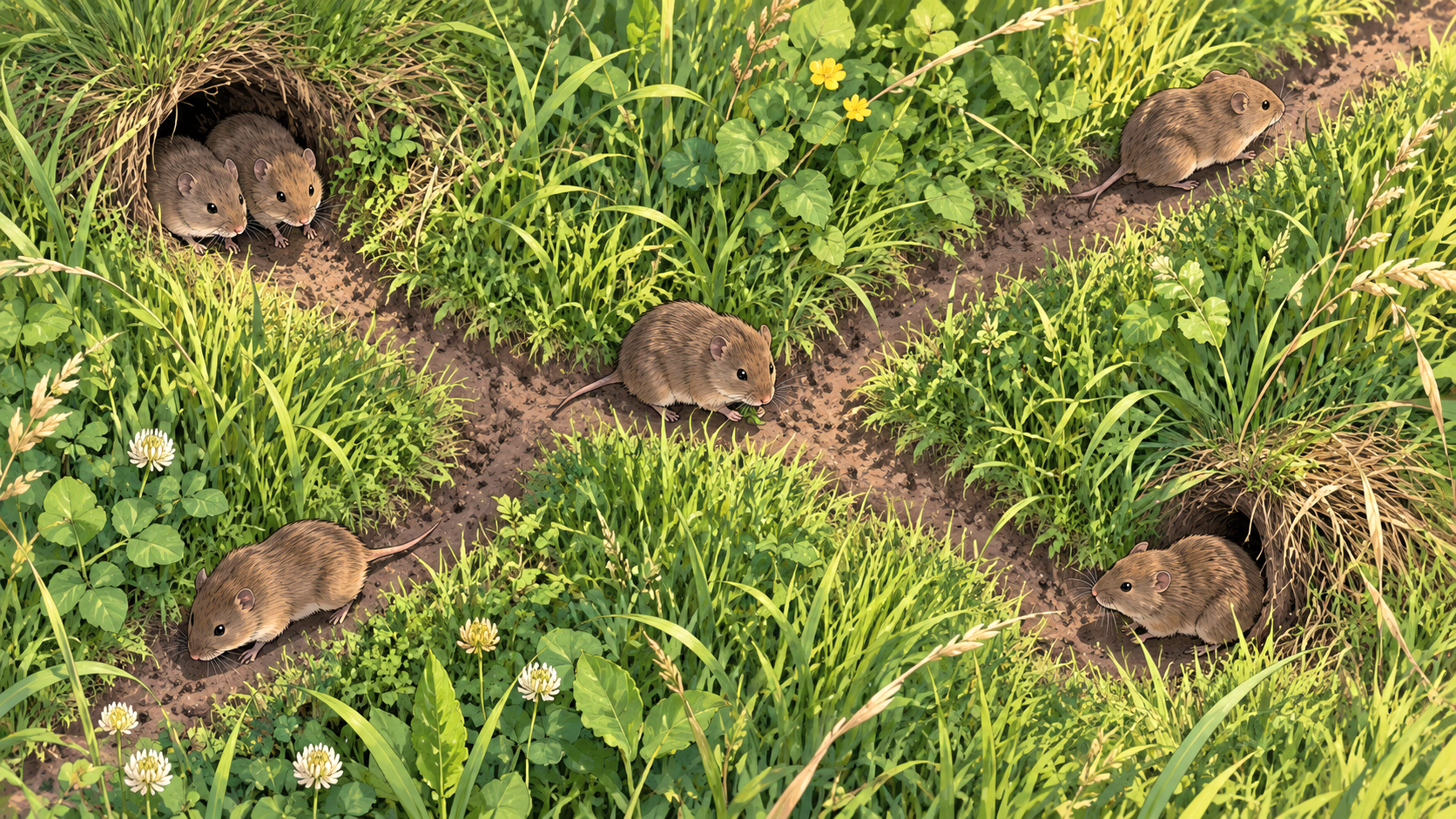
A vole colony can contain anywhere from a few animals to more than 20, depending on the species and season. Prairie voles have been recorded in communal groups averaging 3.5 individuals during warmer months and 8.4 during winter, with one study documenting a group of 21. Meadow voles often live separately during the breeding season but form winter associations, while woodland voles can occupy shared family territories.
The term colony needs some qualification. Unlike ants or termites, voles do not belong to a single type of social organization. Some live in extended family groups, others defend individual territories, and certain species change their social behavior as conditions change. A group sharing a nest is also different from several unrelated animals occupying neighboring areas.
Prairie Voles Can Live in Surprisingly Large Family Groups
Prairie voles (Microtus ochrogaster) are among the better-documented examples of communal living. Their social groups commonly begin with an adult male and female sharing a nest and home range. Offspring may remain with their parents after reaching maturity, while unrelated adults sometimes join established groups. Long-term research on prairie vole social organization found that offspring remaining in their birth group accounted for approximately 70% of additions to established breeding units.
Group size changes markedly during the year. In a long-term Illinois field study, communal nesting groups averaged 3.5 animals from spring through early autumn, with a maximum of six. During November through February, the average communal group contained 8.4 animals, and the largest recorded group had 21 members. Communal groups represented 26.9% of observed social units during the warmer portion of the year and 68.6% during winter.
These figures describe communal groups rather than every prairie vole encountered in the study. Some animals occupied male-female pairs or single-female units. The relationship between prairie vole group size and reproductive success also shows that larger groups do not automatically function better. In the examined population, groups with three adults had higher reproductive success per adult female than smaller or larger groups.
A prairie vole family may therefore consist of a breeding pair, an extended family, or a larger association that includes unrelated members. The pair-bonding behavior of voles is especially relevant to prairie voles, but their social arrangements cannot be generalized to every species.
Meadow Voles Are Territorial Before Gathering in Winter
Meadow voles (Microtus pennsylvanicus) follow a different social pattern. During the spring and summer breeding season, adult females generally maintain separate territories and defend them against other females. Males travel across larger home ranges that overlap those of multiple females. Sharing the same general habitat does not mean those adults belong to one cooperative colony.
Winter changes these relationships. Meadow voles become more tolerant of one another and may gather in communal nests. Field observations described in research on seasonal social behavior documented winter social groups containing three to ten animals, with smaller sleeping associations of two to five individuals. Groups initially formed around a female and her offspring may later include unrelated adults.
Short winter day lengths also influence their social behavior. Controlled experiments involving meadow vole social attachments found that females exposed to winter-like day lengths formed social preferences involving both relatives and unrelated individuals. These associations were not restricted to one partner.
The change in social tolerance helps explain why several meadow voles may use the same shelter during one season even though the animals maintain separate spaces at another time. Their winter activity and shelter use continue despite cold conditions, and communal nesting is one part of that seasonal behavior.
Woodland Voles Share Family Territories
Woodland voles (Microtus pinetorum), also called pine voles, can organize themselves into discrete family groups with overlapping movements inside a shared territory. A field study of free-ranging woodland voles in an orchard found an average of 6.5 individuals per family unit. Members used one or two communal nests, and the territories of different family groups did not overlap.
The field research on woodland vole family organization documented considerable overlap among the home ranges of animals belonging to the same family. Males traveled somewhat farther than females, but the groups maintained shared living spaces rather than completely independent nesting areas.
Woodland vole social organization can include several adults and immature animals from related litters. The Canadian woodland vole status assessment also documents cooperative behavior among young animals that remain with their families, including maintaining burrows and helping care for younger offspring.
Laboratory observations provide additional evidence of social organization, although captive colonies should not be treated as equivalent to wild populations. In six laboratory colonies established from breeding pairs, research on pine vole social hierarchy recorded dominant founding females and restrictions on reproduction among other group members. Those results demonstrate that living together can involve organized social relationships rather than unrestricted sharing of space.
Other Vole Species Have Their Own Social Arrangements
The social vole (Microtus socialis) inhabits parts of western and central Asia and forms family groups containing one adult male, one or two breeding females, and their offspring. Its documented cooperative behavior includes shared burrow construction, nest maintenance, and territorial defense. These groups cooperate in ways that differ from the seasonal associations found among meadow voles.
California voles (Microtus californicus) provide another example of variation. Females can maintain breeding territories, while younger females sometimes establish adjacent or overlapping home ranges near their mothers. During the dry, nonbreeding season, female ranges become smaller and more clustered. Research on California vole social organization also documented extensive seasonal overlap among male home ranges.
Even species that form family groups may differ in whether they tolerate unrelated adults, share nests throughout the year, or maintain exclusive breeding territories. The different types of voles therefore cannot be assigned one standard colony size.
Does a Shared Burrow Mean the Voles Belong to One Colony?
A connected burrow system does not establish the number of animals living inside it or prove that every occupant belongs to one social group. Prairie voles may share a nest and defend a common territory, while meadow vole males can cross several female territories without becoming permanent members of their households. Woodland vole families provide another arrangement, with substantial internal overlap but separate territories between groups.
A useful distinction is between a nesting group, whose members share shelter, and a local population, which includes animals living across a larger area. Several separate nesting groups may occupy the same field or garden without functioning as one colony. Similarly, vole holes and burrow entrances do not provide a one-to-one count of animals or social units.
The social organization of meadow voles demonstrates how overlapping home ranges and shared winter nests can produce very different relationships at different times of year. Counting openings or observing multiple animals near one location cannot reveal those relationships without sustained observation.
For homeowners, identifying the species and recognizing whether the animals are using a shared shelter or separate territories provides a more meaningful understanding of colony structure. A vole population estimate for a particular yard requires different evidence from determining how many animals can belong to one social group.
One thought on “How Many Voles Live in a Colony?”